





AI in Accounting Statistics 2026
AI in accounting by the numbers in 2026: nearly half of accountants use AI daily, the AI-for-accounting market is growing 44.6% a year, plus our own firm survey.


Contents
- What accounting firms actually want from AI — our 2026 survey
- The market AI is moving into
- How fast AI adoption is moving in firms
- Technology spend and the tech-stack efficiency problem
- The talent shortage behind the AI push
- The advisory shift and changing client expectations
- What this means for accounting firms in 2026
- See the full picture
AI in accounting stopped being a someday conversation. Nearly half of accountants now use it every day, firms are pouring budget into it, and the market for AI built specifically for accounting is growing faster than almost anything else in the profession. But the numbers that get quoted most are the loud ones — adoption rates, market forecasts, productivity gains. They tell you that AI is here. They don’t tell you what firms actually want it to do.
So we asked our own customers. Real accounting firms, running real practices, told us where they’d hand work to AI and where they’d keep a human in the loop — and the answers are more grounded than the headlines. This page pairs what our firms told us with the best verified market data we could find, so you can see the whole picture: where the market is heading, and what the people inside it are actually asking for.
What accounting firms actually want from AI — our 2026 survey
Most AI stats measure adoption. They count who’s using it and how much they spend. They almost never ask the more useful question: what do firms want it to do?
We did. The numbers below come from our 2026 survey of accounting firms — our own customers, telling us in their own words where they’d hand work to AI. They’re soft-framed on purpose. It’s a self-selected sample, so we report it straight rather than dressing it up. The honesty is the point. You can read the full write-up in our 2026 report.
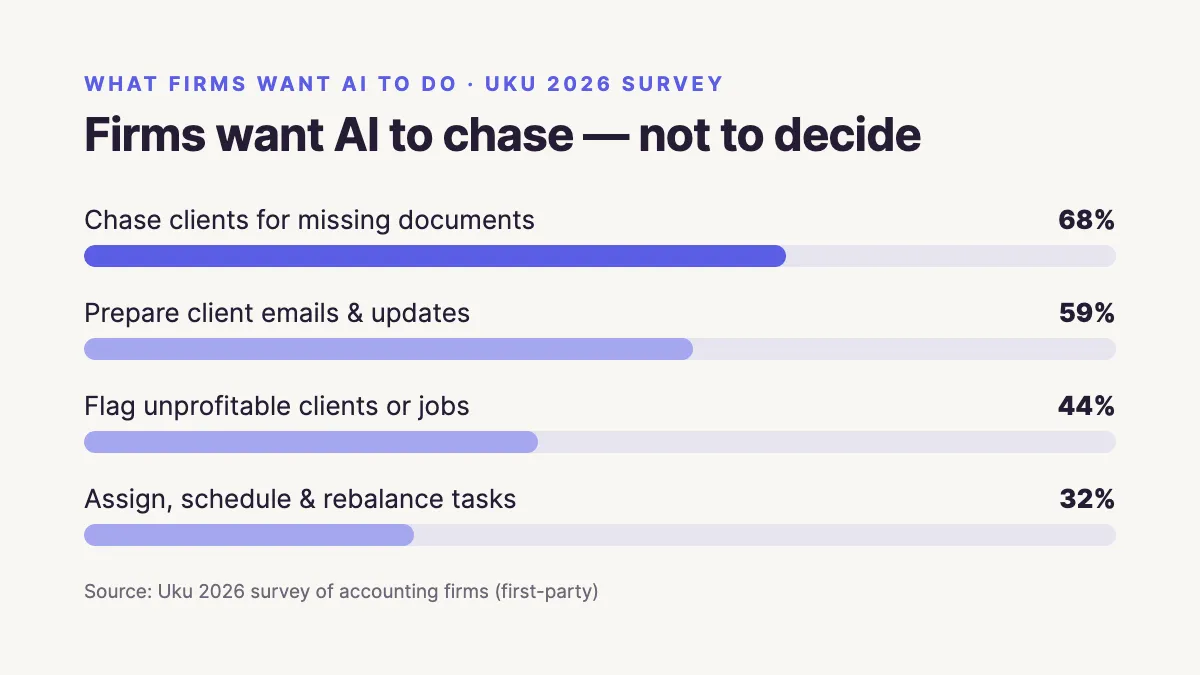
The #1 job firms would hand an AI agent: chasing missing documents
Nearly 7 in 10 firms told us the first task they’d hand to an autonomous AI agent is chasing clients for missing documents. Not forecasting. Not analysis. The dull, recurring chore that eats a junior’s week and never quite finishes. Firms don’t want AI to be impressive. They want it to take the work nobody enjoys.
”Describe it and AI builds it”: more than 8 in 10 find it appealing
More than 8 in 10 firms said it’s appealing to describe what they want in plain language and have AI build it — no developers required. The appetite for “describe-it-and-AI-builds-it” is real and broad. Firms are tired of waiting on a roadmap to get a small change made.
Trust is gated on control, not capability
Here’s the most telling number: 0% of firms said they already fully trust AI to act on its own. Not a single respondent. Most want a human to approve before anything is sent or filed. That isn’t a vote against AI — it’s a demand for control. Firms will give AI the work the moment they keep the final say.
Optimistic, but measured
About two-thirds of firms are optimistic about AI. But they’re more intrigued than excited — curious, not breathless. That’s a healthy place to build from. It means firms are paying attention without expecting magic.
How much connectivity matters
About half of firms rate open API or MCP connectivity as critical or important. Real appetite, reported straight. Firms increasingly expect their tools to talk to each other and to the AI layer sitting on top — and they notice when they don’t.
The market AI is moving into
Now the backdrop. Here’s the market all of that is happening inside.
The accounting-services market: global and US
The global accounting services market was worth USD 688.17 billion in 2025 and is projected to reach USD 1,275.84 billion by 2033, an 8.1% compound annual growth rate, per Grand View Research. A separate estimate from Fortune Business Insights puts it at USD 682.69 billion in 2025, growing to USD 1,088.95 billion by 2034 at 5.30% a year. Different models, same story: a large, steadily growing market.
In the US specifically, the Accounting Services industry is worth USD 158.4 billion in 2026, growing 1.8% in 2026 off a slow 1.4% five-year trend, according to IBISWorld.
Accounting software — and the fastest-growing slice
The global accounting software market is forecast to grow from USD 21.56 billion in 2025 to USD 35.86 billion by 2031, an 8.85% compound annual growth rate, per Mordor Intelligence.
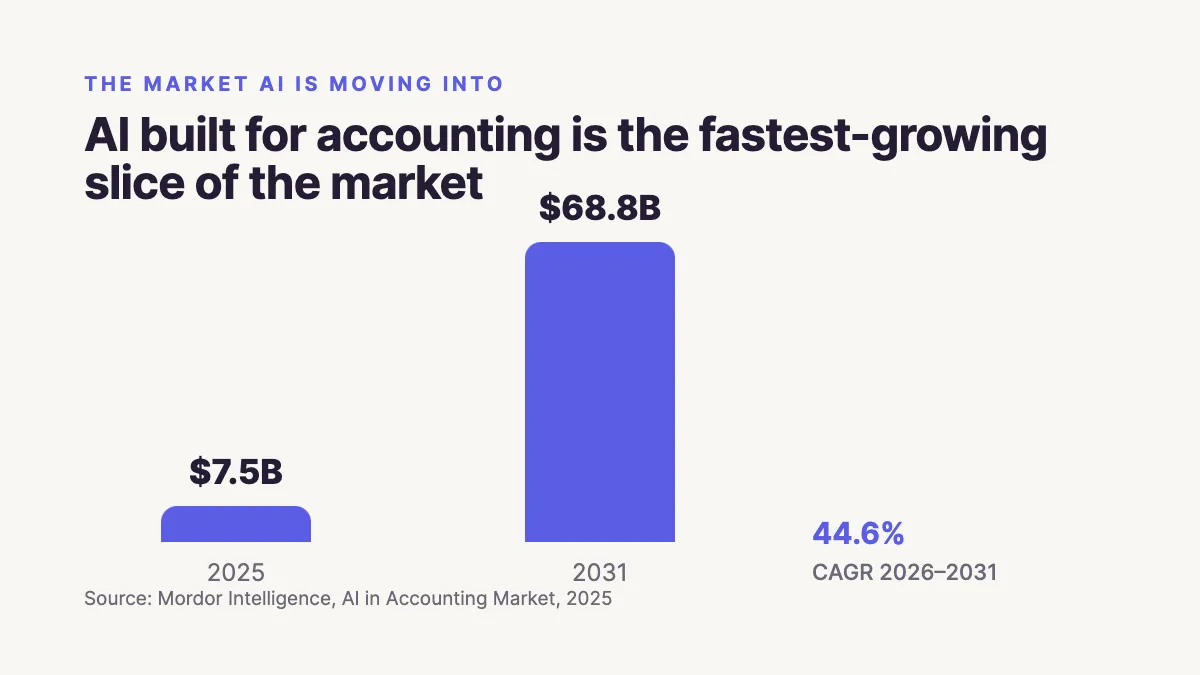
The AI-specific slice is the headline. The global AI-in-accounting market is projected to jump from USD 7.52 billion in 2025 to USD 68.75 billion by 2031 — a 44.6% compound annual growth rate, also per Mordor Intelligence. That’s roughly five times the growth rate of accounting software overall. Much of that growth runs through fintech software development, the engineering behind modern finance tools. AI isn’t a feature being added to the category. It’s becoming the category.
How many firms and accountants are in the market
The US had about 1.6 million accountants and auditors employed in 2024, earning a median annual wage of USD 81,680, per the US Bureau of Labor Statistics. There were 85,412 accounting-services businesses in 2026 in the US, essentially flat year over year, per IBISWorld. A big workforce, a stable count of firms — and rising pressure on every one of them.
How fast AI adoption is moving in firms
Daily and weekly use
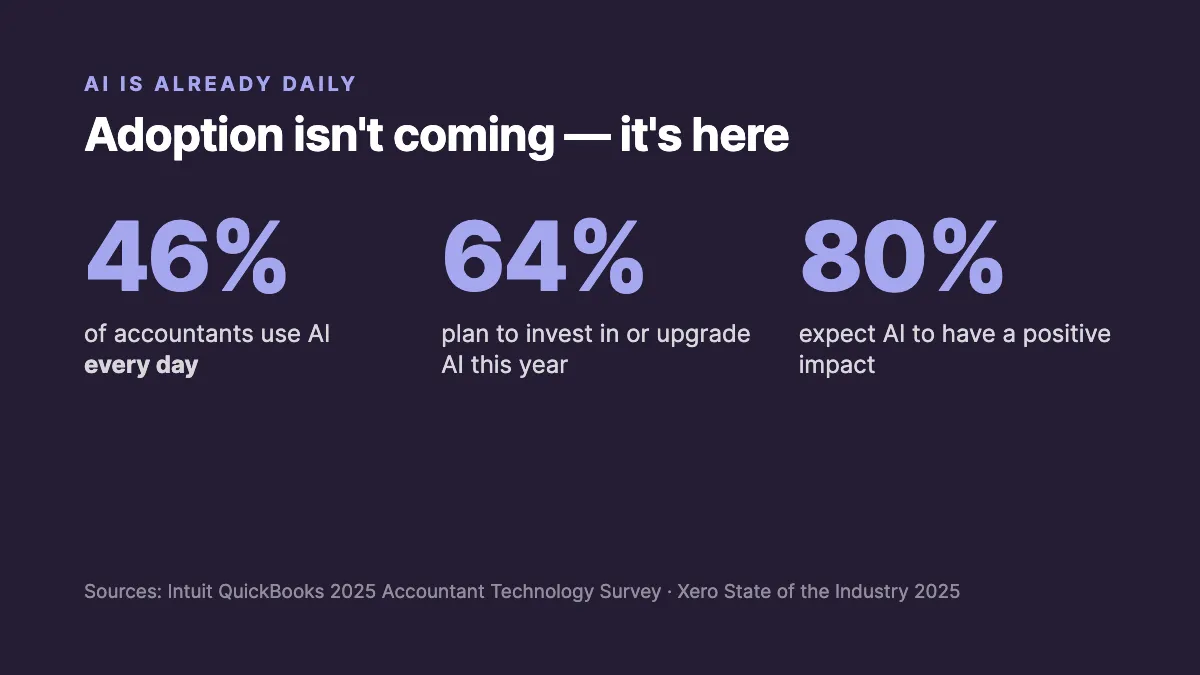
46% of US accountants report using AI daily — nearly double the 28% daily rate among small businesses, per the Intuit QuickBooks 2025 Accountant Technology Survey. Weekly use runs higher: 72% of accountants use AI at least weekly, and 35% daily, with 77% planning to increase AI investment over the next three years, per the Wolters Kluwer 2025 Future Ready Accountant Report.
Investment intent
64% of accountants say their firm plans to invest in or upgrade AI over the next year — up from 57% in 2024 and 48% in 2023, per Intuit QuickBooks. The line goes up every year, and the slope is steepening.
What AI is delivering today
It’s not all intent. 81% of accounting professionals say AI has positively impacted their productivity, and 86% say it has reduced their mental load on day-to-day tasks, per Intuit QuickBooks. And 80% of US accounting and bookkeeping firms anticipate a positive impact from AI on their practice, with the top use cases being faster client services (33%), reducing errors (33%), and automating routine tasks (32%), per the Xero US State of the Industry Report 2025.
Where leaders are confident — and where they aren’t
The bigger picture is striking. 8 in 10 professionals predict AI will have a transformational or high impact on their work over the next five years (44% transformational, 36% high) — and the transformational share was twice that of any other force, per the Thomson Reuters Future of Professionals Report 2025. Among tax practitioners, 54% already use some form of AI in their research, and 86% agree firms that use AI have a competitive advantage over those that don’t, per CPA.com & Blue J.
But confidence in the impact isn’t confidence in the readiness. 88% of finance and accounting leaders believe AI will be the most transformative trend over the next 12–24 months — yet only 8% feel very well prepared to manage it (21% well prepared), per AICPA & CIMA. Everyone sees the wave. Almost nobody feels ready to ride it. That gap is exactly where our survey’s “trust is gated on control” finding lives.
Technology spend and the tech-stack efficiency problem
Here’s where the story gets uncomfortable. More tech hasn’t automatically meant less work.
Tech budgets are tightening — and AI is a priority
Firms project an average tech spend of USD 20,000 over the next 12 months, down from USD 24,000 — budgets are tightening, per Intuit QuickBooks. They’re spending less, and they’re being choosier. AI is one of the priorities: 64% plan to invest in or upgrade it this year.
The compliance-time trap
Compliance still eats the day. Accountants spend an average of 62% of their workload on compliance work — tax filings, financial statements, bookkeeping, auditing — and they’d like to cut that to 58%, per Intuit QuickBooks / Firm of the Future. The good news: 95% of professionals say technology has significantly reduced time spent on compliance tasks, freeing capacity for advisory work, per Intuit QuickBooks.
Tool sprawl and overwhelm
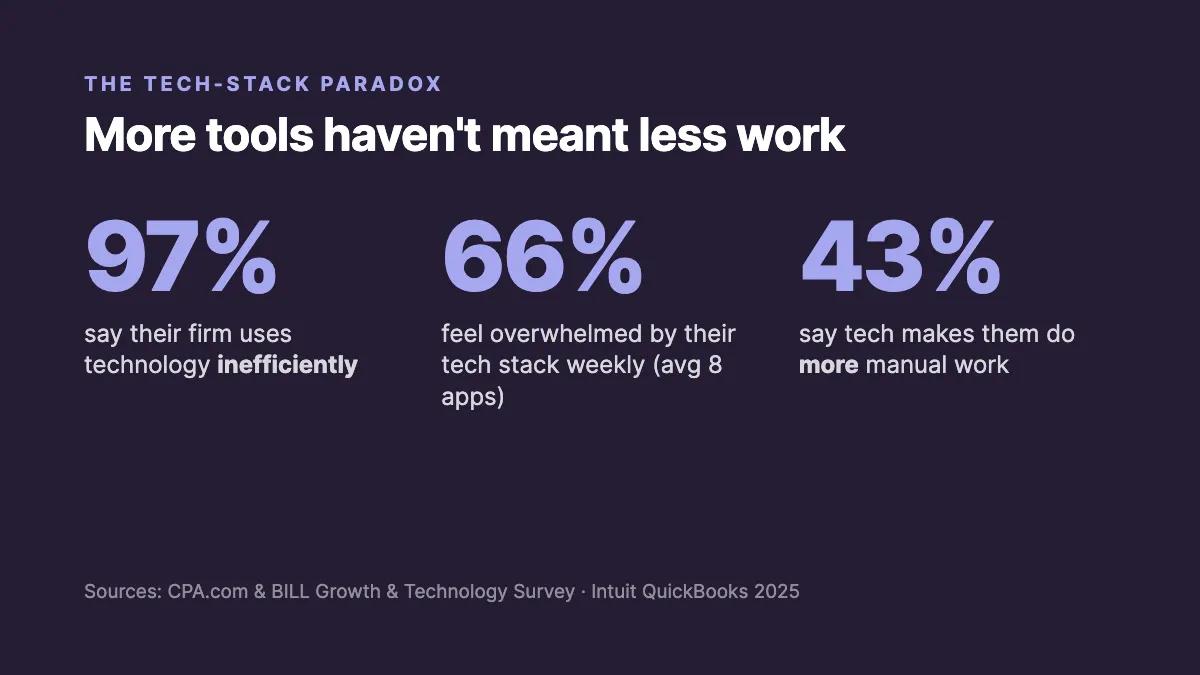
But the tools themselves have become a problem. 66% of accountants feel overwhelmed at least weekly by the volume or complexity of their tech-stack workflows, and firms use an average of eight different apps for core operations, per Intuit QuickBooks / Firm of the Future. Eight apps to run one practice. No wonder things slip through the gaps.
When more tech means more manual work
It gets worse. 97% of firms say they use technology inefficiently and need additional training to maximize ROI, and 43% say technology is making them do more manual work, not less, per a CPA.com & BILL survey reported by Accounting Today. Read that again. Nearly half of accountants feel their tools are adding manual work. The problem isn’t a lack of software. It’s software that doesn’t connect, doesn’t fit, and doesn’t talk to the rest of the stack.
Integration as a growth lever
And here’s the payoff for fixing it. 87% of professionals with highly integrated technology — at least 75% integrated — experienced revenue growth, per the Wolters Kluwer 2025 Future Ready Accountant Report. Integration isn’t a nice-to-have. It correlates directly with growth. The firms that get their stack working as one system pull ahead. (If you’re rethinking yours, our guide to the best accounting practice management software is a good place to start.)
The talent shortage behind the AI push
Put your whole firm in one place Start free for 14 days. No credit card, full access. Try Uku freeThere’s a reason firms are leaning on AI: there aren’t enough people.
The graduate pipeline — decline, then early recovery
The US awarded 55,152 accounting bachelor’s and master’s degrees in 2023–24, a 6.6% drop from the prior year, with the steepest erosion at the graduate level — master’s down about 15%, bachelor’s down 3.3%, per AICPA & CIMA and the Journal of Accountancy. There’s a green shoot, though: accounting program enrollment hit 266,506 students in spring 2025, up 12.4% and the highest since 2020, per the same Journal of Accountancy reporting. The pipeline is bending back, slowly.
The CPA pipeline and the replacement gap
The CPA funnel is thin. 27,994 new candidates entered the CPA Exam pipeline in 2024, and 13,070 passed their final section, per NASBA. Meanwhile, accountant and auditor employment is projected to grow 5% from 2024 to 2034 with about 124,200 openings a year on average, largely to replace workers who leave or retire, per the US Bureau of Labor Statistics. More seats opening than people qualifying to fill them.
Wage pressure and the return to the office
Scarcity shows up in pay. CPA-firm starting salaries jumped — master’s-degree new staff up 17% to USD 67,750, bachelor’s up 11% to USD 60,834, per the AICPA PCPS 2025 MAP Survey via the Journal of Accountancy. And the work is moving back on-site: 76% of finance and accounting job postings in Q1 2026 were on-site, 19% hybrid, and just 5% remote, per Robert Half.
Hiring is harder
Firms feel it. 61% of finance and accounting hiring managers say finding skilled professionals is harder than a year ago, and US employers posted 819,300 finance and accounting jobs in 2025, per Robert Half. When you can’t hire your way out, you automate your way out. That’s the engine under the AI push.
The advisory shift and changing client expectations
The other force reshaping firms: the move from compliance to advice.
Advisory is now nearly universal
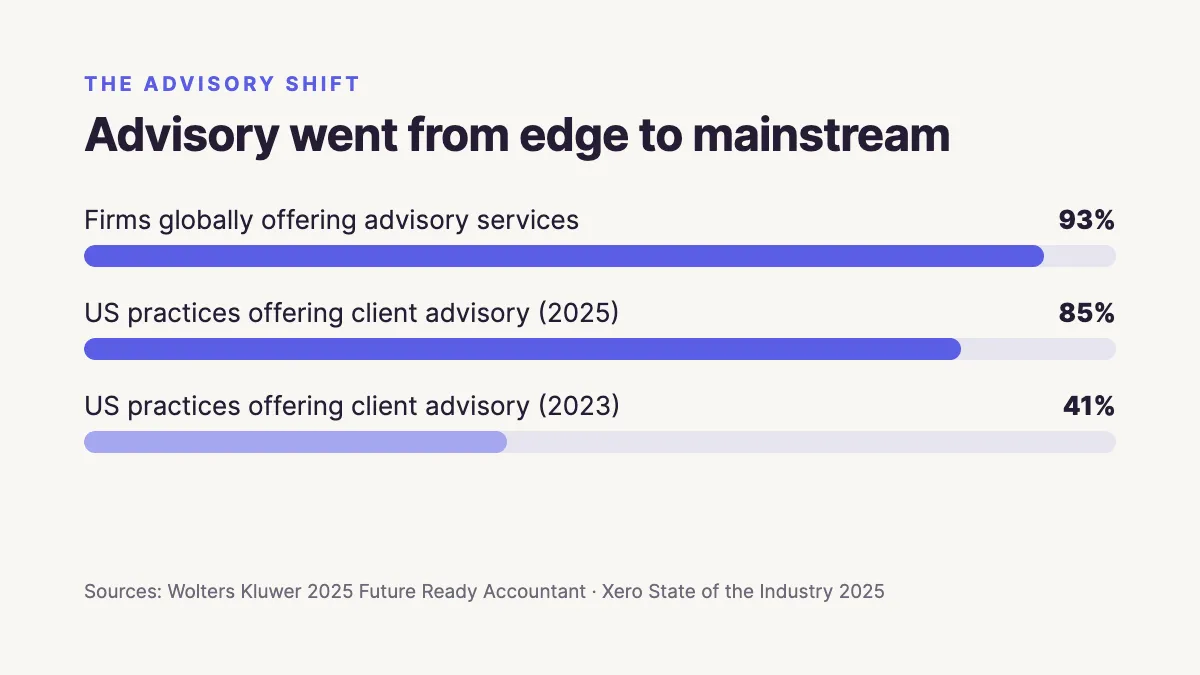
93% of firms globally now offer advisory services, up from 83% in 2024, per the Wolters Kluwer 2025 Future Ready Accountant Report. In the US, 94% of firms offer advisory and 63% call it a key service, and advisory now makes up 13% of firm revenue on average, up from 10% in 2024, per the US key findings. Advisory has gone from add-on to core.
Client advisory services: the fastest-growing area
Client advisory services (CAS) is the fastest-growing service area in public accounting, with a 17% median growth rate for participating CAS practices (2024 benchmark, based on 2023 data) and firms projecting a striking 99% median growth over the next three years — a near-doubling — per the AICPA & CPA.com 2024 CAS Benchmark Survey. In the US, 85% of practices now offer advisory, up from 41% in 2023 — more than doubling in two years — and 73% of practices reported increased profits over the prior year, per the Xero US State of the Industry Report 2025.
What clients are asking for
Demand is real, not manufactured. 35% of clients are actively asking firms for strategic business advice, and 88% of firms analyze client data to tailor advisory offerings, concentrated among high-growth and tech-forward firms, per Wolters Kluwer. Clients want their accountant to be a guide, not just a filer.
What this means for accounting firms in 2026
Step back and the picture is coherent.
Firms can’t hire fast enough. Compliance still eats two-thirds of the day. Clients want advice, and advisory is now where the growth and the profit are. The obvious answer is AI — and the market agrees, growing the AI-in-accounting category 44.6% a year. But the very tools meant to help have become part of the problem: eight apps per firm, 66% overwhelmed weekly, 43% doing more manual work. More software hasn’t meant less work. Better-connected software has — the integrated firms are the ones growing revenue.
That’s the through-line back to what our firms told us. They don’t want flashy AI. They want it to chase missing documents, to be described in plain language and built without developers, and — above all — to leave a human with the final say. 0% already fully trust AI. Control isn’t the obstacle to adoption. Control is the precondition for it.
The firms that win in 2026 won’t be the ones with the most AI. They’ll be the ones who consolidate the chaos — one system, one source of truth, deadlines that don’t slip — and then let AI take the dull, recurring work on top of it, with a person approving the output. Less stack sprawl. Less compliance grind. More room for the advisory work clients are asking for.
See the full picture
Want the detail behind the soft numbers? Read our 2026 report for what accounting firms actually want from AI, and see how Uku gives firms one source of truth — so deadlines stop slipping, the stack stops sprawling, and there’s finally room for the advisory work clients keep asking for.
Frequently asked questions
How many accountants use AI in 2026?
Nearly half of US accountants report using AI daily — 46%, almost double the 28% daily rate among small businesses (Intuit QuickBooks, 2025 Accountant Technology Survey). Wider studies put weekly use higher: 72% of accountants use AI at least weekly, and 35% daily (Wolters Kluwer, 2025 Future Ready Accountant Report).
How fast is the AI-in-accounting market growing?
The global AI-in-accounting market is forecast to grow from USD 7.52 billion in 2025 to USD 68.75 billion by 2031, a 44.6% compound annual growth rate (Mordor Intelligence, 2025) — far faster than the broader accounting software market at 8.85% a year.
Do accounting firms trust AI to act on its own?
Not yet. In our own 2026 survey of accounting firms, 0% said they already fully trust AI to act without a human checking first. Most want a person to approve before anything is sent or filed — trust is gated on control, not on capability.
What do accounting firms most want AI to do?
In our 2026 survey, the #1 task firms would hand to an autonomous AI agent was chasing clients for missing documents — nearly 7 in 10 firms picked it ahead of anything flashier. Missing deadlines was named the single biggest operational headache.

Published Jun 9, 2026 · Updated Oct 17, 2026