How to Write a Reliable & Inviting Bookkeeping Engagement Letter?
Learn how to write a bookkeeping engagement letter to set clear expectations, prevent scope creep, and build trust.


Contents
- What is a Bookkeeping Engagement Letter?
- Why Are Bookkeeping Letters of Engagement Necessary?
- Best Practices for Bookkeeping Engagement Letters
- 5 Simple Tips to Write the Best Letter of Engagement as a Bookkeeper
- What to Avoid When Writing Accounting Services Engagement Letters?
- What Every Bookkeeping Engagement Letter Should Cover
- Bookkeeping Engagement Letter Template
- Conclusion of Writing an Engagement Letter for Bookkeeping
A bookkeeper or accountant is best at providing accounting services. But you cannot provide a service if you don’t have any clients. A bookkeeping engagement letter is the first contact between an accountant and their client and needs to leave a good impression. If you’re still working through the earlier steps of how to start a bookkeeping business, this is the document you’ll need ready before your first client signs. But how to write the best reliable and inviting bookkeeping engagement letter?
What is a Bookkeeping Engagement Letter?
A bookkeeping engagement letter is a written agreement between a bookkeeper or accountant and a client that spells out exactly what services will be provided, what each side is responsible for, how and when the client will be billed, and how the arrangement can end. It’s signed before work starts, and it’s what both sides point back to if there’s ever a disagreement about what was promised.
The letter includes your services, expectations for both, all of the work you’ll do for the client and much more, if needed, to keep you both on the same page. Without an engagement letter, there is no start to your partnership.
Why Are Bookkeeping Letters of Engagement Necessary?
First impressions matter the most, as we all know. The law applies to client-accountant relationships. An engagement letter is likely your first contact with your potential client.
If you leave a good impression, the client will probably choose you as their service provider. Even if others offer a better price, the human touch is often a better motivator. This letter usually lands right after you’ve worked to get bookkeeping clients in the first place — it’s the document that turns interest into a signed relationship.
A bookkeeping engagement letter also allows you to set the standard for your clients. Yes, a client is king, but I’m sure you, as an accountant, also have your requirements for a client.
The letter provides legal protection for both parties, as setting clear and written expectations minimizes the risk of disputes.
Best Practices for Bookkeeping Engagement Letters
When writing a bookkeeping engagement letter, you must balance transparency and professionalism.
Demonstrate the accounting services you offer
First and foremost, clearly define the scope of your services. Specify whether you’ll handle bank reconciliations, financial statement preparation, payroll processing, or other tasks, leaving no room for assumptions or misunderstandings. A well-drafted engagement letter should remove any confusion by outlining what the client can expect, which helps prevent scope creep or confusion later.
What is scope creep in the accounting world?
You offer a service to your client, let’s say bank reconciliations, and they agree to that in the contract. Yet, they are always calling you with spontaneous questions or sending emails with extra tasks you have never agreed upon. Therefore, you have no legitimate reason to ask for money for it. Even though it might seem little initially, you’ll soon notice that it takes up a lot of time in a month. That’s scope creep – you work for free.
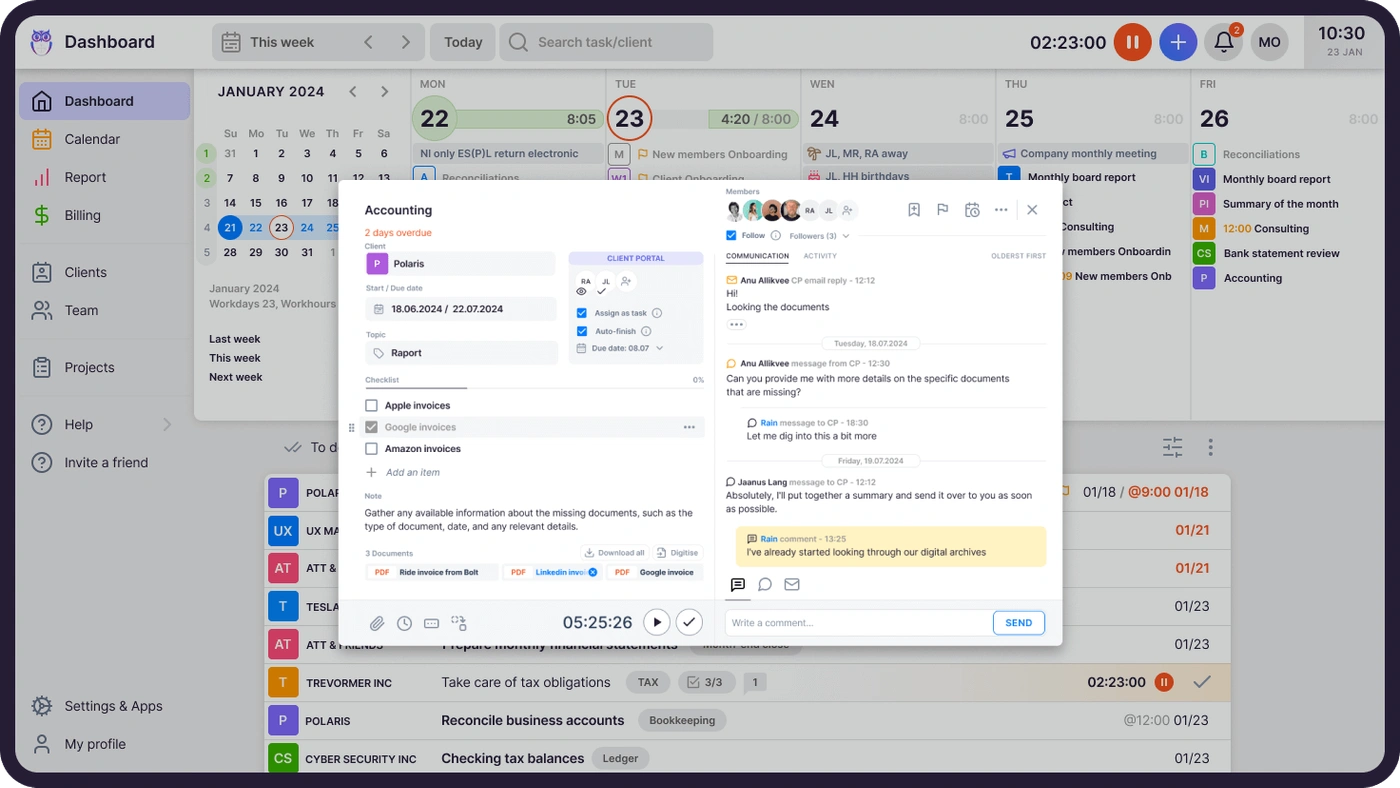
We recommend using time and billing or work management software with time-tracking features. When tracking working time for each task, you’ll know exactly how long these tiny extra questions take.
Uku even has a Magic Button that helps you start tracking time for a new task immediately when a client calls, stopping the timer for the task you were tracking time for.
Outline the accounting firm client’s responsibilities
It’s equally important to be precise about the responsibilities of both parties, the accountant and the client.
For example, while your role might involve processing transactions or preparing financial statements, the client must understand their obligation to provide timely and accurate documentation. All accountants know clients could be better at forwarding the needed information.
Laying out these responsibilities in the bookkeeping engagement letter ensures everyone knows what to expect, creating a foundation of mutual trust and accountability. It also protects the bookkeeper from the client’s rage when work isn’t done on time.
Don’t leave payment terms a question
Billing terms are another critical element. If you haven’t nailed down how to price your accounting services yet, do that first — the engagement letter should state the outcome of that decision, not paper over an unresolved one. Your engagement letter should clearly define the following:
- How much you’ll charge?
- When payments are due?
- What happens in case of late payments?
Address any potential out-of-pocket expenses that could arise, such as software subscriptions or additional consulting services, and spell these terms so that there is no room for disputes. Clearly outlining the payment initiation process helps avoid any misunderstandings and keeps the payment flow straightforward for both parties.
Lastly, include confidentiality clauses to protect your client’s sensitive information and establish clear guidelines for dispute resolution and contract termination.
5 Simple Tips to Write the Best Letter of Engagement as a Bookkeeper
Start with a sample engagement letter or a template
Using a professionally developed accounting email template ensures all the essential components are included, saving time and reducing the chance of overlooking something important.
Customize each client’s engagement letter for bookkeeping
Tailor the letter to each client’s specific needs rather than sticking with generic language, and taking cues from examples of email signatures to maintain a professional and consistent tone. Personalized communication strengthens your client relationships.
Review and revise the engagement letter
Always proofread the letter for accuracy and clarity before finalizing it. Avoid errors that could undermine your professionalism.
Use formal language with proper accounting terms
Keep the tone professional and avoid using abbreviations or informal language, which can detract from the seriousness of the agreement.
Incorporate automation tools
Use bookkeeping or accounting practice management software with automated email functions. The software makes creating and managing engagement letters effortless, ensuring consistency and reducing manual effort.
What to Avoid When Writing Accounting Services Engagement Letters?
Monthly Bookkeeping Workflow Template
Free, editable, and built for accounting firms. We'll email it to you in a minute.
Check your inbox
The template is on its way to your email. It usually arrives within a minute.
Writing a bookkeeping engagement letter might seem straightforward, but there are common mistakes you should avoid.
Keep the engagemet letter simple
One of them is not being straightforward enough. Writing and using big words is fun, yet your clients might miss the point. Phrases like “handle bookkeeping” are insufficient; be specific about each task to ensure there’s no room for misinterpretation.
Make the letter simple. A concise document that clearly outlines the key elements—without excessive legal lingo or irrelevant clauses — is more likely to be understood and agreed upon by the client. Simplicity and precision go a long way in ensuring both parties are on the same page from the outset.
Don’t use it as email marketing for accountants
You shouldn’t turn the bookkeeping engagement letter into a marketing opportunity. Although promoting your services is important, there are better places for upselling. Its purpose is to define the relationship, expectations, and terms, not highlight all the additional ways you could assist.
What Every Bookkeeping Engagement Letter Should Cover
Before you look at the full template below, here’s what each clause is doing and what tends to go wrong when it’s left vague.
| Clause | What it’s for | What goes wrong when it’s vague |
|---|---|---|
| Scope of services | Lists exactly which tasks you’re doing — reconciliations, ledger maintenance, financial statements, payroll, tax filing — and, just as usefully, which ones you’re not. | Clients assume “bookkeeping” covers whatever they ask for next, and you end up doing unpaid work you never agreed to. |
| Fees and billing terms | States the rate or flat fee, the billing date, payment due window, and what happens if an invoice goes unpaid. | Invoices get questioned or delayed because the client never saw a number in writing, and late fees you never disclosed are unenforceable. |
| Client responsibilities | Sets out what the client has to hand over, and by when, for you to do the work on schedule. | Deadlines slip and it looks like your fault when the real cause was documents arriving two weeks late. |
| Your responsibilities | Mirrors the client’s obligations with your own — what you’ll deliver, on what cadence, to what standard. | Without this, the letter reads one-sided, and clients have no way to hold you accountable to a schedule either. |
| Term and termination | Says when the engagement starts, how long it runs, and how either side can end it — usually with a notice period. | An open-ended relationship with no exit clause makes both an amicable handoff and a firm dismissal harder than they need to be. |
| Confidentiality and data handling | Commits you to keeping the client’s financial data private and describes, in general terms, how you store and share it. | Clients handing over bank access and payroll data have no written assurance about who else can see it. |
| Limitation of liability | Caps what you’re financially responsible for if an error occurs — typically tied to fees paid, and excluding losses caused by inaccurate client records. | Without a cap, a single mistake traced to bad client data could expose you to damages far beyond what the engagement was worth. |
| Dispute resolution | Names the first step when the two of you disagree — direct discussion, mediation, or arbitration — before either side considers anything more formal. | Disagreements go straight to “find a lawyer” because there was no agreed first step. |
| Signature | Turns the letter from a draft into a binding agreement both parties can point back to. | An unsigned letter isn’t an engagement — it’s a proposal nobody’s committed to. |
None of these clauses need to be long. A few plain sentences per clause, specific to the client in front of you, does more than a page of boilerplate.
Bookkeeping Engagement Letter Template
[Your Firm’s Name]
[Address]
[City, State, Zip]
[Date]
[Client’s Name]
[Client’s Address]
[City, State, Zip]
Dear [Client’s Name],
This letter outlines the terms and conditions of the bookkeeping services to be provided by [Your Firm’s Name] to [Client’s Name] as of [Start Date]. This engagement aims to set clear expectations and avoid misunderstandings in our professional relationship.
Scope of Services
We will provide the following bookkeeping services for [Client’s Name]:
- Monthly bank and credit card reconciliations.
- General ledger maintenance.
- Preparation of financial statements (profit & loss, balance sheet).
- Payroll processing (if applicable).
- Tax filing preparation (as requested).
Compensation and Payment Terms
Our fee for the services provided will be [Hourly Rate/Flat Monthly Fee] of $[Amount]. Invoices will be issued on [Billing Date] each month and are due within [Number of Days] days. Late payments may incur a fee of [Percentage]% per month.
Term and Termination
This agreement will commence on [Start Date] and continue until [End Date] or until terminated by either party with [Number of Days] days written notice. Either party may terminate this agreement at any time for cause or convenience.
Confidentiality
We understand that during the course of our work, we will have access to sensitive financial information. We are committed to maintaining the confidentiality of all such information, as detailed in our attached confidentiality policy.
Client Responsibilities
To provide accurate and timely financial information, the client agrees to supply all relevant documentation by the [Due Date] of each month. Failure to do so may affect the timely completion of the agreed services.
Our Responsibilities
[Your Firm’s Name] agrees to perform the services listed above with reasonable care and in accordance with generally accepted bookkeeping practices, and to deliver agreed reports and statements by [Delivery Schedule].
Limitation of Liability
Our liability for any claim arising from this engagement is limited to the fees paid by [Client’s Name] for the services in question during the [Time Period] preceding the claim. We are not liable for losses resulting from inaccurate, incomplete, or late information provided by the client.
Dispute Resolution
Should a disagreement arise under this agreement, both parties agree to first attempt to resolve it through direct discussion, and, if unresolved, through [Mediation/Arbitration] before pursuing any other remedy.
Signatures
If the terms of this letter are acceptable, please sign below to confirm your understanding and agreement.
Sincerely,
[Your Name]
[Your Title]
[Your Firm’s Name]
Acknowledged and Agreed:
[Client’s Signature]
Date: ________________
Getting it signed without chasing anyone
A finished engagement letter that sits unsigned for two weeks delays the start date, the first invoice, and everything downstream — and usually not because the client disagrees with it. It’s because the letter leaves your workflow: you export a PDF, attach it to an email, and wait for someone to print it, sign it, and photograph it.
Sending it for e-signature keeps it where the work is. In Uku you attach the letter to the task, add the client’s portal contact as a signer, and set a sign-by date. The request goes out from your own mailbox, the client signs in the client portal they already use, and the signed PDF lands back on the same task with the original kept beside it. You can see who has opened it and who hasn’t, so the follow-up is a nudge rather than an investigation.
One thing worth knowing before you switch a whole practice over: this is a witnessed electronic signature with an audit trail — signature image, IP address and timestamp — not a qualified digital signature such as ID-card or Smart-ID. For engagement letters, NDAs and consent forms that is normally what firms use. If a specific document in your jurisdiction has to carry a qualified signature, check your own requirements first.
Conclusion of Writing an Engagement Letter for Bookkeeping
A well-crafted bookkeeping engagement letter is essential for setting clear expectations and establishing a solid foundation with your accounting firm clients. Outline the services you’ll provide, define both parties’ responsibilities and state payment terms; you prevent misunderstandings and protect yourself from issues like scope creep. You’ll leave the best impression, and clients will trust you from the beginning.

Published Nov 13, 2024 · Updated Aug 12, 2026