How to Start a Bookkeeping Business in 9 Steps
Start a bookkeeping business the right way — pick a niche, write a plan, get certified, price your services, and choose software that scales as you add clients.


Contents
Starting a bookkeeping business means combining accounting skills with running a small service company: choosing a niche, picking software, pricing recurring packages, and finding clients who’ll pay for them. Most people can launch for a few hundred to a couple thousand dollars — software, certification, and insurance are the main costs — and start billing within weeks. Some experienced bookkeepers do build practices earning $40,000+ a month with 80 or more clients at roughly $500 each, but that’s the top end after years of work, not what you should expect in year one.
The upside is real: bookkeeping bills monthly and recurring, so revenue compounds as you add clients instead of resetting to zero on each new project. The tradeoff is that you’re responsible for accuracy on someone else’s books, on a deadline, every month.
Where new bookkeepers usually get stuck:
- Looking for clients before they’ve defined who they actually serve.
- Trying to serve everyone instead of picking a niche.
- Spending all their time in spreadsheets and none on marketing.
- Underestimating how much the tech stack matters once they pass a handful of clients.
This guide covers what bookkeepers actually do day to day, the nine steps to set up the business itself, when to bring on your first hire, and the software you’ll need to run it without drowning.
What Does a Bookkeeper Do?
A bookkeeper takes a client’s transaction history — bank feeds, invoices, receipts, payouts — and turns it into accurate, categorized financial records. That sounds simple until you’re looking at a client’s account with thousands of uncategorized transactions and no clean starting point.
A bookkeeper’s core work:
- Setting up and maintaining automated transaction imports from bank feeds and payment processors.
- Reconciling accounts so the books match the bank statements.
- Following up on unpaid invoices.
- Preparing income statements and balance sheets on a monthly cadence.
- Catching entry errors and duplicate transactions before they distort the numbers.
Whether you’re in-house at one company or running a portfolio of small-business clients, the job is the same: keep the numbers accurate enough that owners can make decisions and accountants can file taxes without chasing down mysteries first.
What Is a Bookkeeping Business?
A bookkeeping business is a service company you build to handle other people’s books — you sell accuracy and clarity as your core product, usually as a monthly retainer.
When you onboard a new ecommerce client, the first hour is setup work: connecting Stripe, Alidrop, Shopify, and PayPal to their bookkeeping software, then building bank-feed rules that auto-tag ad spend, merchant fees, and fulfillment costs. Many bookkeepers also connect a receipt-capture tool like Dext so invoices come in automatically instead of by email.
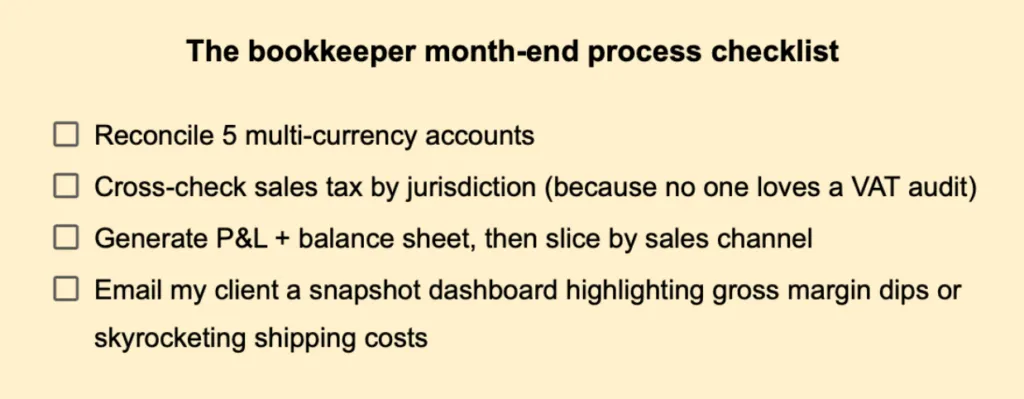
Get that setup right once, and the client stops emailing you every time a Stripe payout looks off — the automation catches it first.
How a bookkeeper is different from an accountant
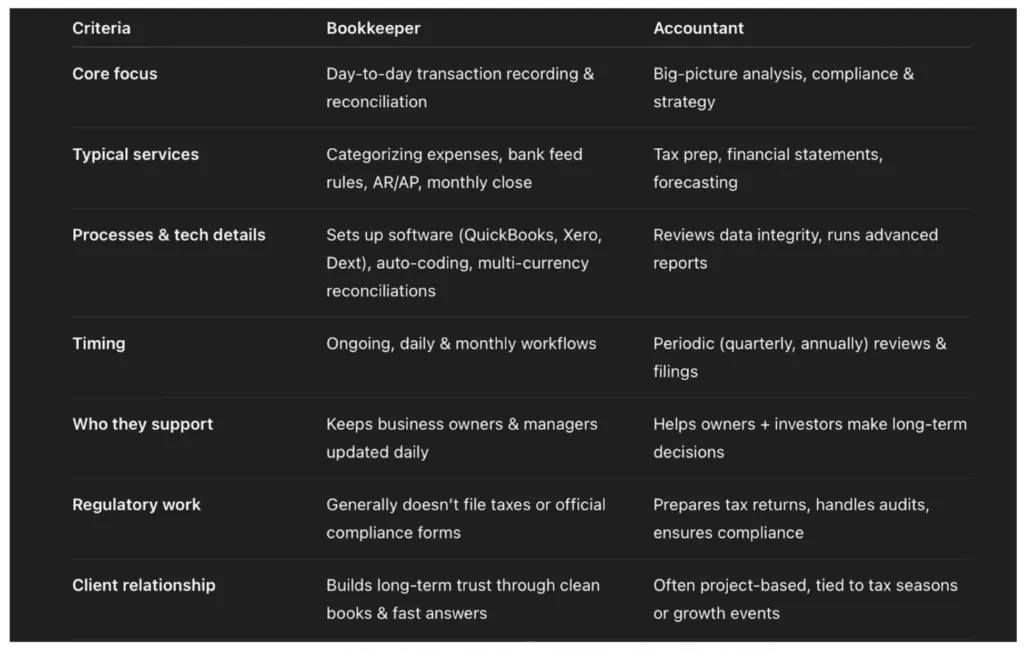
Bookkeeping and accounting overlap, but the split is roughly this: a bookkeeper builds and maintains the records — reconciling accounts, automating invoice capture, running clean month-end closes. An accountant works from those records to file taxes, advise on strategy, and handle compliance.
Your job as a bookkeeper is to hand the accountant clean, reconciled numbers so they’re not spending billable hours untangling your client’s books before they can even start their own work.
How to Start a Bookkeeping Business in 9 Steps
The steps below cover the practical sequence: define who you serve, write the plan, get certified, set up the legal and tech foundation, then price and market what you’re selling.
1. Choose Your Niche and Define Your Target Market
Pick a slice of the market instead of trying to serve everyone. SaaS companies with deferred revenue, construction firms with job costing, and Shopify stores needing real-time cost of goods sold each require different software setups and different expertise — including brands selling through social commerce channels like Instagram and TikTok.
The niches most new bookkeepers land in, and the recurring problem each one actually pays you to solve:
- Ecommerce and Shopify sellers — payout reconciliation, cost of goods sold, multi-channel sales tax.
- SaaS and subscription businesses — deferred revenue, prepayments, monthly recurring revenue reporting.
- Construction and trades — job costing, retainage, progress billing.
- Agencies and consultancies — project profitability, contractor payments, pass-through expenses.
- Nonprofits — restricted funds and grant reporting, which follow different rules than for-profit work.
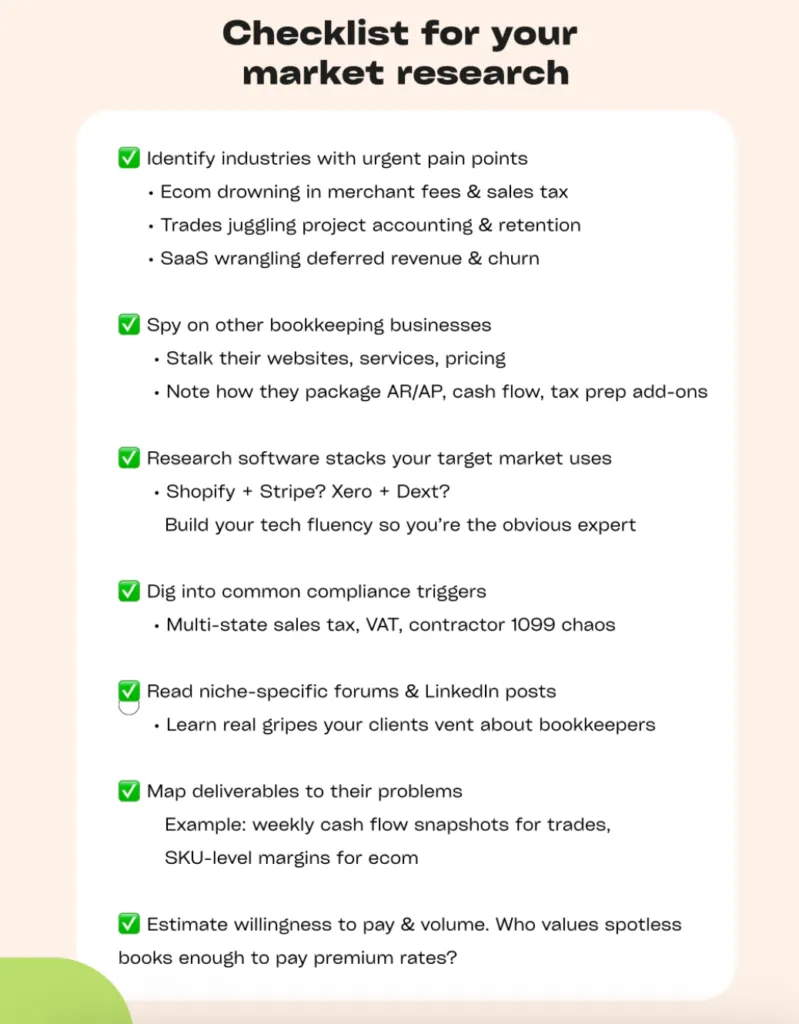
Market research for a bookkeeping business: who you serve, what they already pay for, and who else serves them.
You don’t have to lock a niche in before your first client. Plenty of bookkeepers generalize early and specialize once they see which clients they’re fastest at. But naming one, even loosely, makes every decision below sharper: a defined niche lets you standardize your packages, quote in minutes instead of days, and market to a specific audience instead of competing on price against every generalist in your area. Once you’ve solved the same problem for three clients, the fourth is faster — that compounding is the whole argument for niching.
2. Write a Business Plan
A bookkeeping business plan is a short working document, not a 40-page bank formality. Cover these eight sections:
- Executive summary — who you help, what you do, and why you’re the right choice.
- Services and packages — reconciliations, AR cleanup, payroll oversight, month-end closes, mapped into tiered packages.
- Target market and niche — the specific clients you’ll pursue and the problems you’ll solve for them.
- Competitive edge — what sets you apart: faster closes, a client portal owners actually use, deeper niche expertise.
- Pricing model — flat monthly rates per package, plus how you’ll scope transaction volume so you never quote blind.
- Marketing and sales plan — where leads come from and how a discovery call turns into a signed engagement.
- Operations and tech stack — the software that runs your practice day to day, including practice management that tracks who’s doing what across every client.
- Financial projections — target monthly recurring revenue, average ticket size, onboarding timelines, and a break-even number.
A business plan template can make the process faster, but the eight sections above are what actually matters.
Write sections 2 and 5 — services and pricing — before you touch section 8. Financial projections built on packages you’ve actually defined are a plan; projections built on a revenue target you’d like to hit are a wish. Then revisit the whole thing each quarter. Your first five clients will teach you more about your pricing and your niche than any planning you do before you have clients.
3. Get Certified
In most places, bookkeeping isn’t a licensed profession the way public accountancy is — you generally don’t need permission from anyone to start keeping a client’s books, which is why this business can be launched in weeks rather than years. That cuts both ways. Nothing stops the next person from launching either, so certification is how you shortcut a new client’s trust before you have a track record. Check your own jurisdiction’s rules before you assume it applies to you, and be clear that the picture changes the moment you offer tax filing or audit work.
Certification signals to clients that you know the tools you’re using, and it matters more in some niches than others. If you’re targeting ecommerce clients, QuickBooks Online Advanced plus an automated reconciliation certification will save you hours every month. If you’re serving multiple contractors or agencies, Xero Advisor certification plus a receipt-capture tool builds a defensible audit trail.
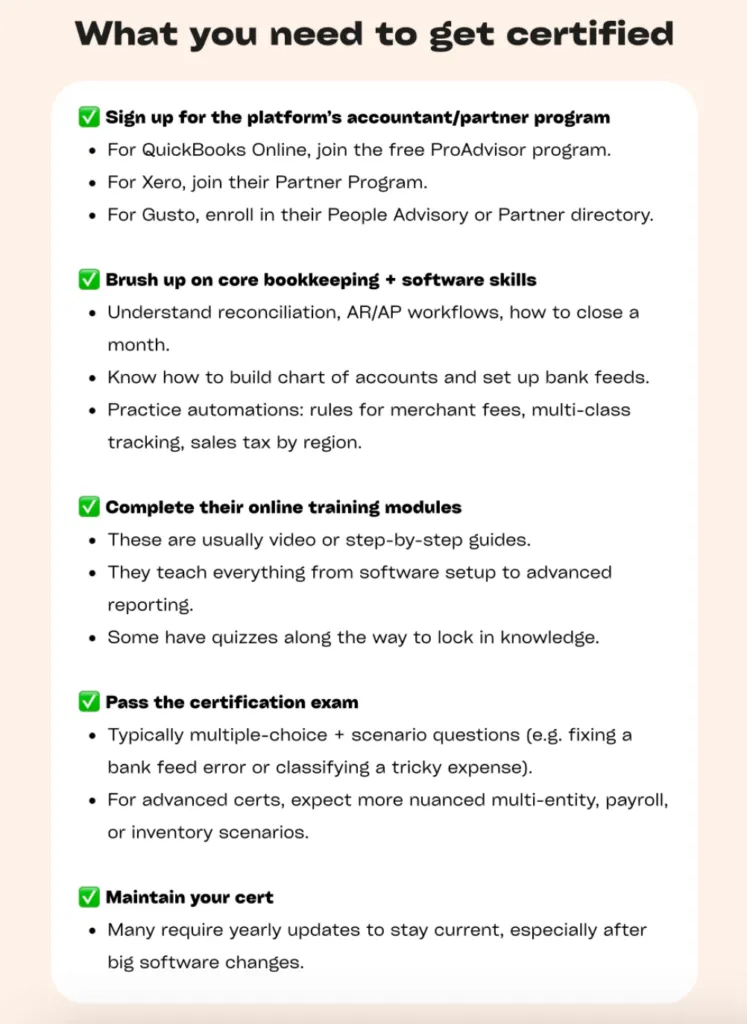
Pick certifications by the software your niche runs on, not by how many you can collect.
Budget one to two weeks per certification track, and work through the free online bookkeeping courses with certificates before you pay for anything — a paid credential is worth more once you already know which platform you’re standardizing on. If nonprofits are part of your niche, nonprofit bookkeeping practices differ enough from for-profit work that it’s worth a separate read before you pitch your first grant-funded client.
4. Pick a Business Name and Structure
Choose a name that’s clear about what you do — check business name availability, domain availability, and social handles before you commit, so you’re not rebranding mid-way through your first year.
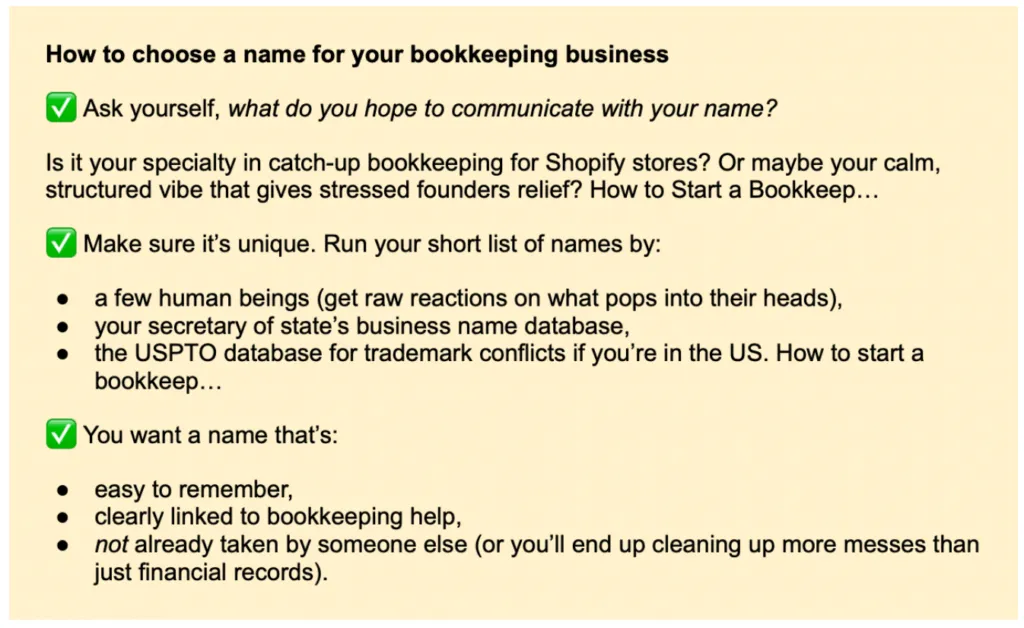
For structure: a sole proprietorship gets you started fastest if you’re testing demand. If you want to protect personal assets, get tax flexibility, or bring on subcontractors as you grow, forming an LLC is the more common move.
The tradeoff is the same everywhere — speed and simplicity versus liability protection — but the paperwork, cost, and tax treatment are not. US rules differ by state, and outside the US the equivalent choice is usually sole trader versus limited company. Don’t take a single template as universal; check what your own registry requires before you file anything.
5. Register Your Business and Get Insured
Register with your state so your contracts, EIN, and payment processors are all under one clean legal entity. The EIN also unlocks wholesale software pricing and lets you onboard clients who need a W-9 on file.
Get professional liability (errors & omissions) insurance before you take on your first paying client. A missed reconciliation or a data-entry error is the kind of mistake that’s cheap to insure against and expensive not to. Premiums scale with how many clients you carry and how much money moves through their books, so get two or three real quotes rather than budgeting from a number you saw in an article — this is the one startup cost where guessing is genuinely expensive.
6. Set Up Your Operations and Tech Stack
Match your software to your niche. Ecommerce clients: QuickBooks Online with an automated payout tool and payroll software. Contractors or creatives: Xero plus a receipt-capture app that pulls invoices from inboxes automatically.
Set up a secure document hub for signed agreements, a written process for AR follow-ups, month-end close checklists, and a task board so nothing gets missed between clients. If your own machine is cluttered with the apps and trial software you’re testing during setup, a utility like MacKeeper can clear out unused apps and junk files so your system stays fast.
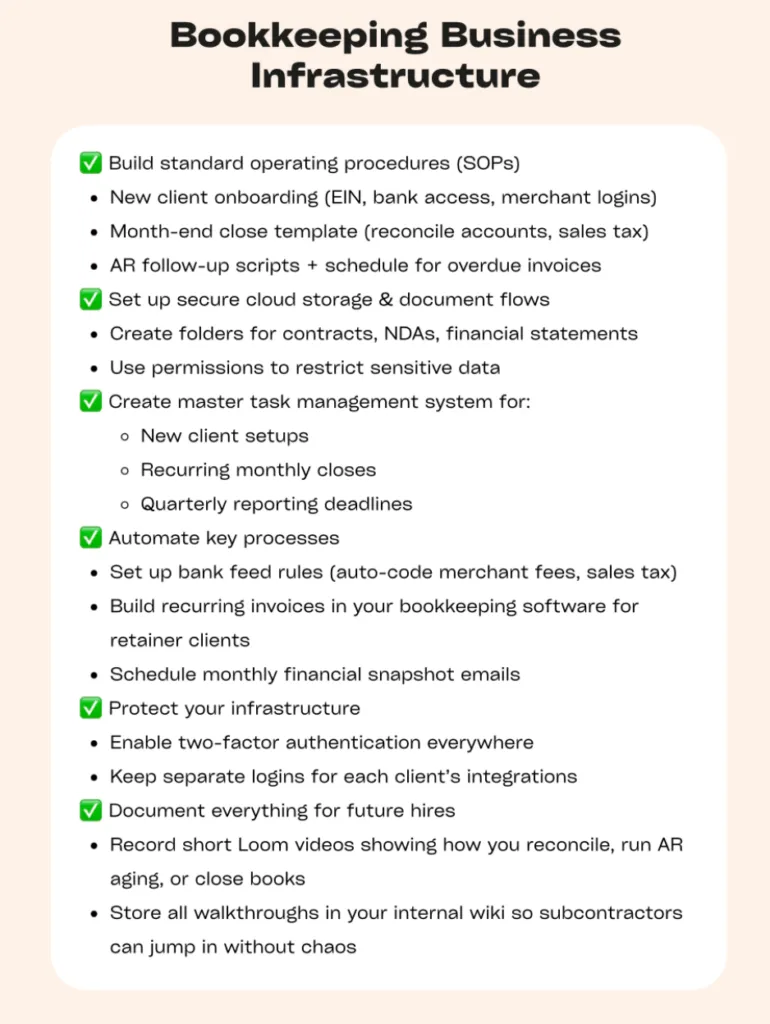
Month one has five recurring line items, and it’s worth pricing each of them yourself rather than trusting a total you read somewhere — vendor pricing moves, and it moves by country:
- Core accounting platform — QuickBooks Online, Xero, or FreshBooks, priced per client file or per subscription depending on the vendor’s partner program.
- Receipt and document capture — usually per client, and usually the cheapest line.
- Practice management — flat per person, not per client. Uku’s Solo plan, built for one accountant with up to 20 active clients, is $25 a month billed monthly or $19 billed annually, and every signup starts with a 14-day free trial of all Elite features, no credit card.
- Professional liability insurance — quoted, not listed. See step 5.
- Entity registration and domain — one-off, and small next to the rest.
The list is short on purpose. Bookkeeping is one of the rare businesses where you can be fully operational for the price of a few subscriptions, which is exactly why the competition is real and why steps 1 and 7 matter more than this one.
7. Price Your Services
Base pricing on the actual work, not a gut feeling. A client with five bank accounts, multi-location inventory, and per-entity AR aging costs you more time than a single-account startup on a cash basis — price accordingly.
Pull historical transaction volume from Xero or QuickBooks Online before you quote. A client running 3,000 transactions a month is not the same job as one running 200.
Package your pricing into clear tiers, for example:
- Bronze — monthly reconciliation + standard P&L.
- Silver — Bronze, plus cash flow forecasting and AR management.
- Gold — Silver, plus inventory tracking and weekly margin reporting.
Tiers do two jobs at once: they let a prospect self-select instead of making you negotiate, and they give scope creep somewhere to go. When a Bronze client starts asking for AR chasing, that’s not an awkward conversation — that’s Silver. Price flat monthly rather than hourly, because hourly punishes you for getting faster, and getting faster is the entire return on the setup work in step 6. For the full breakdown of building and defending these tiers, see how to price accounting services.
8. Market Your Bookkeeping Business
Your first two or three clients almost certainly won’t come from marketing. They come from your existing network — former colleagues, small business owners you already know, and accountants who don’t want to do bookkeeping themselves and are glad to hand it off. Referral relationships with CPAs and business attorneys are the highest-yield channel in this business precisely because those people meet new companies before you do. Marketing is what you build after you have two clients to point at, not instead of them. How to get bookkeeping clients covers the channels tactic by tactic.
Whatever channel a client arrives through, get the scope in writing before you start — see what to include in a bookkeeping engagement letter. The engagement letter is what makes the tier boundaries in step 7 real instead of theoretical.
Build a website that shows the specific software you work in and the specific problems you solve — multi-currency reconciliation, automated Shopify payouts via Shopify-QuickBooks integration, or cutting AR aging in half.
For in-person marketing — business cards, event booths, printed materials — a QR code from a tool like The QR Code Generator can point straight to your booking page or intake form. If you want to know which touchpoints are actually converting, a QR tracking tool like Uniqode shows you where scans came from.
See our marketing guide for accountants for more on lead generation specifically for accounting and bookkeeping firms.
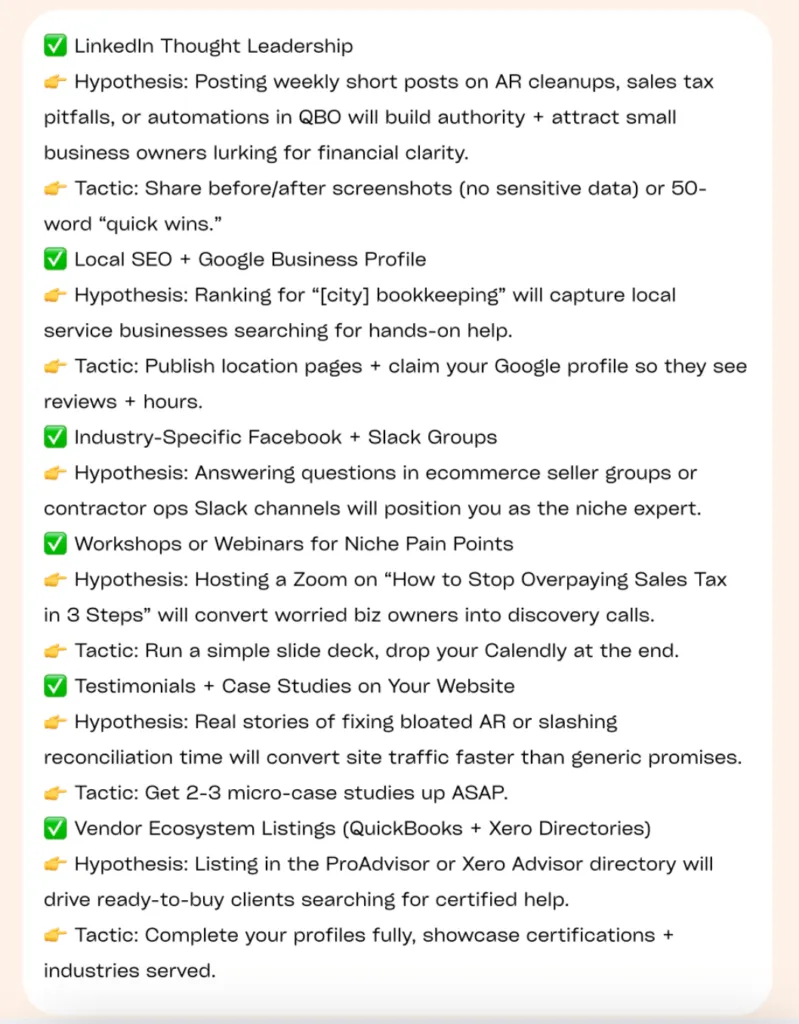
9. Line Up Funding
Most bookkeepers bootstrap the launch — software, a certification course, and a document-sharing setup rarely add up to more than a couple thousand dollars. If your runway is short or you want to scale faster, a small business loan or line of credit can smooth the gap before recurring revenue catches up.
Before you borrow, understand how loan principal and interest work so you can separate what reduces your balance from what you’re actually paying to borrow.
Open a dedicated business bank account as one of your first moves — it keeps your own books clean and makes deductions easier to track. If you’re setting up outside the US, local guides matter: this rundown of business accounts in Hong Kong is one example of how account requirements vary by jurisdiction.
When to Hire Your First Team Member
Monthly Bookkeeping Workflow Template
Free, editable, and built for accounting firms. We'll email it to you in a minute.
Check your inbox
The template is on its way to your email. It usually arrives within a minute.
Hire when the work is the bottleneck, not when the ambition is. The two honest signals are that you’re turning away clients you’d otherwise take, and that quality is starting to slip on the clients you already have — a close that lands late, a reconciliation you rushed.
There’s no client count that triggers this, because it depends entirely on how complex your average engagement is and how much of the routine you’ve automated. The better test is whether your processes exist anywhere outside your own head. If onboarding a client or closing a month still runs on memory, fix that before you hire — handing an undocumented process to a new person costs more time than it saves, usually for about three months. Many firms take on a contractor for overflow first, which keeps the commitment proportional to workload you’ve actually proven.
Essential Bookkeeping Software & Services
The right software is what lets you serve more clients without adding more hours. Here’s what a working bookkeeping practice typically runs on.
Bookkeeping Software: Your Daily Workspace
This is where you’ll spend most of your time — reconciling accounts, pulling multi-currency bank feeds, matching invoices, calculating sales tax across states, and tracking aged AR. The three most common platforms are QuickBooks Online, Xero, and FreshBooks; which one you standardize on usually follows your niche and certification choice from step 3.
Communication and Document Sharing with Customers
Clients need a secure way to send you documents and ask questions. That’s typically a client portal for invoice uploads, a messaging thread for quick AR questions, and e-signature software to keep authorizations on record.
A short knowledge base — even a simple Notion page — with instructions on uploading statements or completing month-end steps cuts down on repetitive emails. Pairing it with a shared inbox keeps client communication from getting lost across individual accounts.
Use bank-level encryption on your document hub. A P&L or payroll file has no business sitting in an unsecured inbox.
Practice Management & Workflow Tools
Bookkeeping software handles the ledger. It does not tell you which of your 30 clients is waiting on a bank-feed fix, who’s overdue sending payroll hours, or what’s due Friday. That’s a separate job — practice management — and once you’re past a handful of clients, running it out of memory or a spreadsheet stops working.
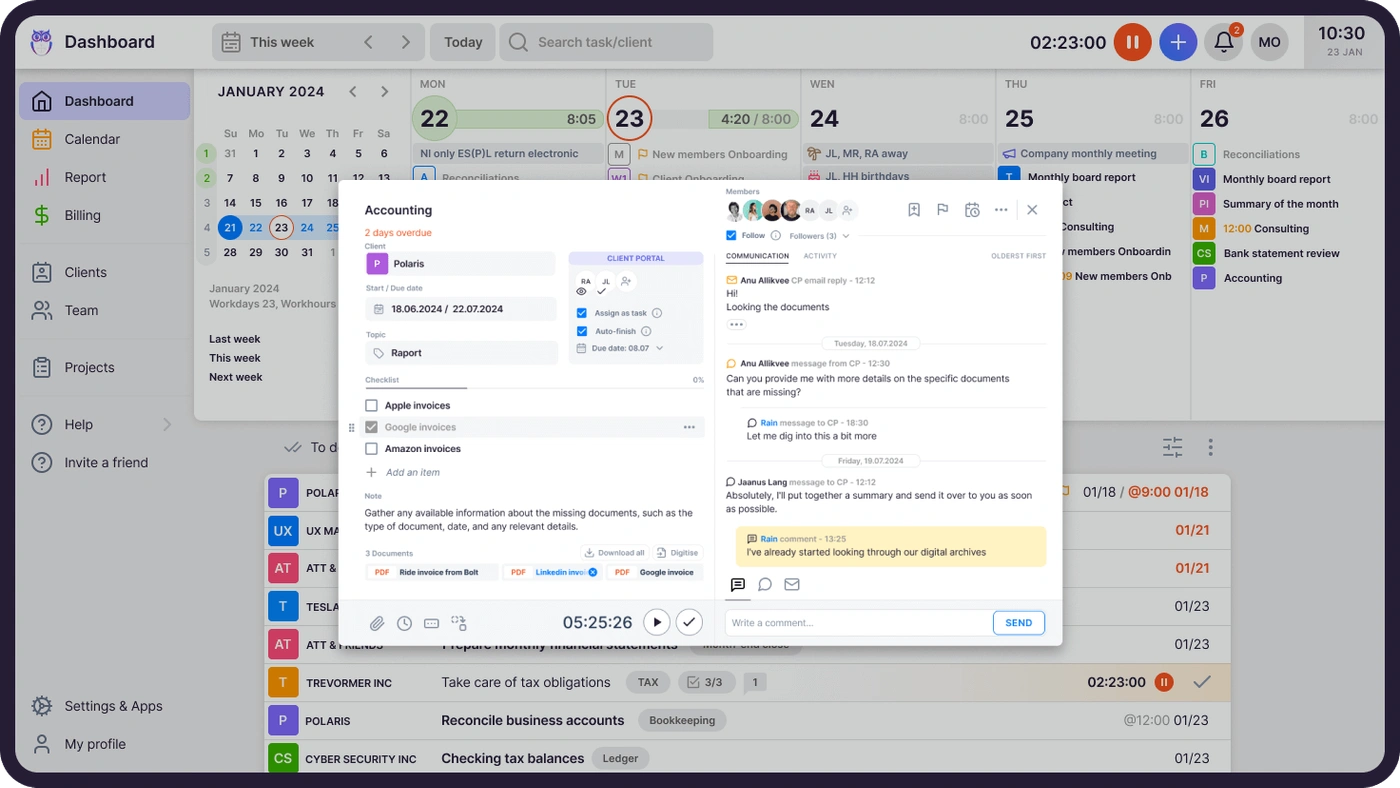
Tools like Uku exist for exactly this: task tracking per client, recurring workflow automation for month-end closes, and a shared view of who’s doing what across your team, so nothing quietly slips between clients. It’s not a bookkeeping or ledger tool — you’ll still run QuickBooks or Xero for the actual accounting — it’s the layer that manages the work of running the practice itself.
The reason a generic project tool doesn’t cover this is worth understanding before you spend a year fighting one. Bookkeeping work isn’t projects with start and end dates; it’s the same set of obligations repeating against a calendar that shifts every month. A client of ours put the distinction better than our own marketing does:
“Accountants need a completely different approach, because their work mostly consists of repetitive tasks scheduled for a specific day of the month.”
That’s the specific thing to test when you evaluate options: not whether a tool can hold a task, but whether it can express “the fifth working day of every month” and roll the whole client base forward without you rebuilding it. Practice management software for bookkeepers compares the tools built for this.
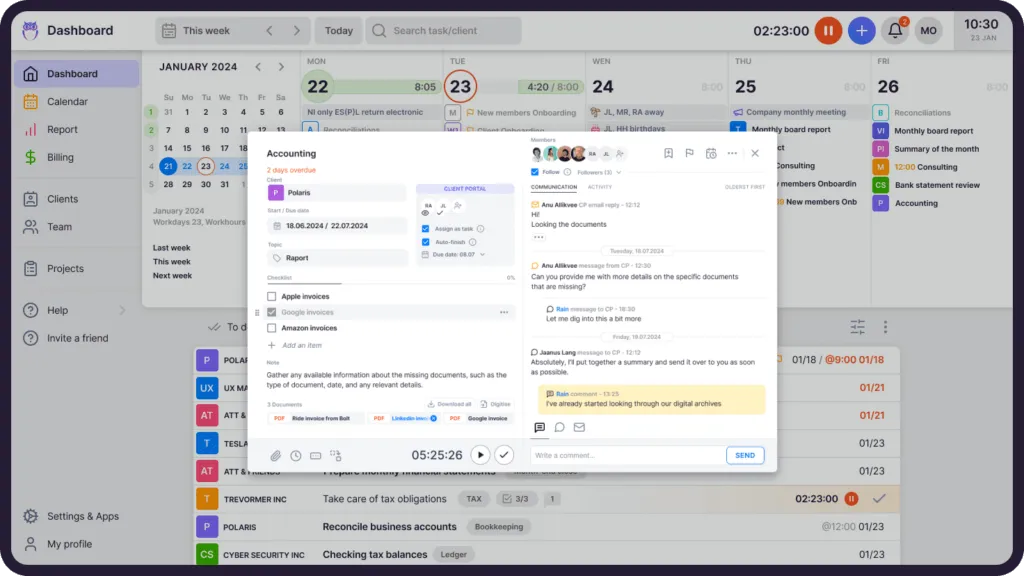
Uku’s client dashboard, showing task status across a bookkeeper’s client list.
Your Website and Online Presence
Your site should state plainly what services you offer, what software you work in, and who you serve — that filters out leads who aren’t a fit before they book a call.
An intake form that asks for transaction volume and payroll needs upfront tells you within minutes whether a lead is a quick cleanup or a deep rebuild.
If you want help building that out, an AI website builder can generate service pages and lead-capture forms faster than starting from a blank template.
Payment and Invoicing Tools
Automated billing handles recurring invoices, follows up on late payers, and reconciles cleared payments against your bank account without manual cross-checking.
Sync this with your accounting software so your P&L stays accurate without a Friday-night reconciliation session against Stripe or PayPal. Look for a platform that supports e-signed contracts and itemized multi-service invoices, so clients see exactly what they’re paying for.
Banking & Budgeting Tools
You need visibility into your own firm’s finances too — not just your clients’. A basic banking and budgeting setup shows you cash runway, flags when your own margins tighten, and helps you set aside money for quarterly tax payments.
Most platforms worth using sync directly to your bank, auto-classify your expenses, and forecast runway a few months out.
To Summarize
Starting a bookkeeping business comes down to a sequence run in order: pick a niche, write a short plan, get certified in the software that niche needs, handle the legal and insurance setup, price in flat tiers by actual workload, and get your first clients from your network before you build marketing for them. None of these steps is hard on its own. The firms that struggle are the ones that skip one and try to fix it later with a client already on the books — usually pricing, occasionally the engagement letter.
The software stack matters as much as the accounting knowledge, and it splits cleanly in two: a ledger tool like QuickBooks or Xero for the books, and a practice management layer for the work of running the practice once you’re past a handful of clients. Get both right and the business scales on client count instead of on your weekends.
Frequently asked questions
What is a bookkeeping business plan?
A bookkeeping business plan is a short working document that defines who you serve, the services you sell, how you price them, and the financial targets you need to hit to stay profitable. It's not a 40-page formality for a bank — it's the operating blueprint you run your practice from. A few pages is plenty, and you revisit it each quarter as you learn what clients will pay for.
What should a bookkeeping business plan include?
A practical bookkeeping business plan covers eight sections: an executive summary, your services and packages, your target market and niche, your competitive edge, your pricing model, a marketing and sales plan, your operations and tech stack, and financial projections such as target monthly recurring revenue, average ticket size, and a break-even number.
How much money do you need to start a bookkeeping business?
A bookkeeping business is low-cost to launch. Many bookkeepers start with a few hundred to a couple of thousand dollars, covering accounting software, a certification course, a document-sharing setup, and liability insurance. Because it bills monthly and recurring, cash flow tends to stabilize faster than in most service businesses.
Is a bookkeeping business profitable?
It can be, and it scales because revenue is recurring — each new client adds monthly income rather than a one-off project fee. Some experienced bookkeepers run portfolios of 80-plus clients at roughly $500 a month each, but that's the high end after years of growth, not a typical first year. Profitability depends on your pricing, how many hours a client actually takes, and how much of your workflow you automate.
Do you need a business plan to start a bookkeeping business?
You're not legally required to have one, but it's worth doing anyway. A short business plan forces you to define your niche, pricing, and financial targets before you spend money — which is how you avoid the price wars and scope creep that sink new firms in their first year.
Do you need a license to start a bookkeeping business?
In most places bookkeeping is not a licensed profession the way public accountancy is — there is generally no state or national license required to keep books for a client, which is why bookkeepers can start taking work almost immediately. Certification is a credibility signal rather than a legal permission slip. Rules do vary by jurisdiction, and the moment you cross into tax filing or audit work the licensing picture changes entirely, so confirm your local requirements before you offer anything beyond bookkeeping.
How long does it take to start a bookkeeping business?
The legal and administrative setup — registering the entity, getting a tax ID, opening a business bank account, buying insurance — usually takes days to a few weeks depending on your jurisdiction. Software certification is the longer piece; budget a few weeks of study per track rather than an afternoon. Most bookkeepers can be invoicing a first client within a month or two, and the real timeline is set by how quickly you find clients, not by paperwork.

Published Jan 13, 2026 · Updated Aug 13, 2026