





Tax Practice Management Software (2026)
The best tax practice management software in 2026, compared by deadline workflows, e-signatures, billing, and price. Honest picks and real reviews for tax firms.


Contents
Tax firms run on deadlines. Between filing dates, quarterly estimates, extensions, and the document chase that precedes all of it, the difference between a profitable season and a brutal one usually comes down to one thing: whether your whole team can see who’s doing what, in one place.
That’s what tax practice management software is for. Not a tax-prep program and not a to-do list, but the operations layer around your returns, recurring deadline workflows, document collection, time tied to billing, and a single source of truth for every client’s status. Here are the best options for tax firms in 2026, with honest pros and cons and what each one is actually best at.
Quick answer: the 5 best tools for tax firms
- Uku — best for firms wanting a single source of truth and real-time profitability monitoring. From $19/member/month.
- TaxDome — best for high-volume tax shops wanting an all-in-one portal with e-signatures. From $700/seat/year on a three-year term ($800 on a one-year term), billed upfront.
- Karbon — best for collaboration-first teams that live in email. From $59/user/month.
- Financial Cents — best for small tax practices under 20 staff on a budget. From $49/user/month.
- Jetpack Workflow — best for simple recurring task tracking. From $40/user/month.
For the full breakdown of all 9 tools — including enterprise platforms like Practice CS (see the alternatives) and IRIS — see our guide to the best accounting practice management software.
How the top tools compare
| Uku | TaxDome | Karbon | Financial Cents | Jetpack | |
|---|---|---|---|---|---|
| Best for (team size) | 10–50 | 200+ | 10–100 | Under 20 | Under 20 |
| Starting price | $19/member/mo | $700/seat/yr | $59/user/mo | $49/user/mo | $40/user/mo |
| Free trial | 14-day (all features) | ✓ | — | ✓ | 14-day |
| Built-in billing | ✓ | ✓ | ✓ | Basic | — |
| E-signatures | Via integration | ✓ | Limited | ✓ | — |
| Client portal | ✓ | ✓ | ✓ | ✓ | — |
| Profitability monitoring | ✓ | Limited | Limited | Limited | — |
| Capterra rating | 4.8 | 4.7 | 4.7 | 4.8 | 4.1 |
What tax firms specifically need
Generic project tools (Asana, Trello, Monday) don’t understand the rhythm of a tax practice. Software built for accountants and tax pros does. The features that matter most:
- Recurring workflow templates tied to filing deadlines. Set up a 1040, 1120, or quarterly-estimate workflow once, and it recurs every season with the right tasks, in the right order, assigned to the right people. During the season crunch, this is the difference between control and chaos.
- Document collection and e-signatures. The single biggest time leak of tax season is chasing clients for documents and signatures. A portal that clients actually use, plus e-signatures for engagement letters and 8879s, claws that time back.
- Time tracking that feeds billing. Realization rate is everything. You can’t bill accurately off memory at the end of a 70-hour week, and you can’t improve what you don’t measure.
- A single source of truth. When a preparer is out sick mid-season, anyone should be able to step in and see exactly where a return stands — no digging through inboxes or pinging three people.
- Tax and accounting integrations. Your practice management tool should connect to your tax software, QuickBooks, and Xero so client data and invoices aren’t re-keyed by hand.
The 5 best practice management tools for tax firms
1. Uku — best for visibility and profitability

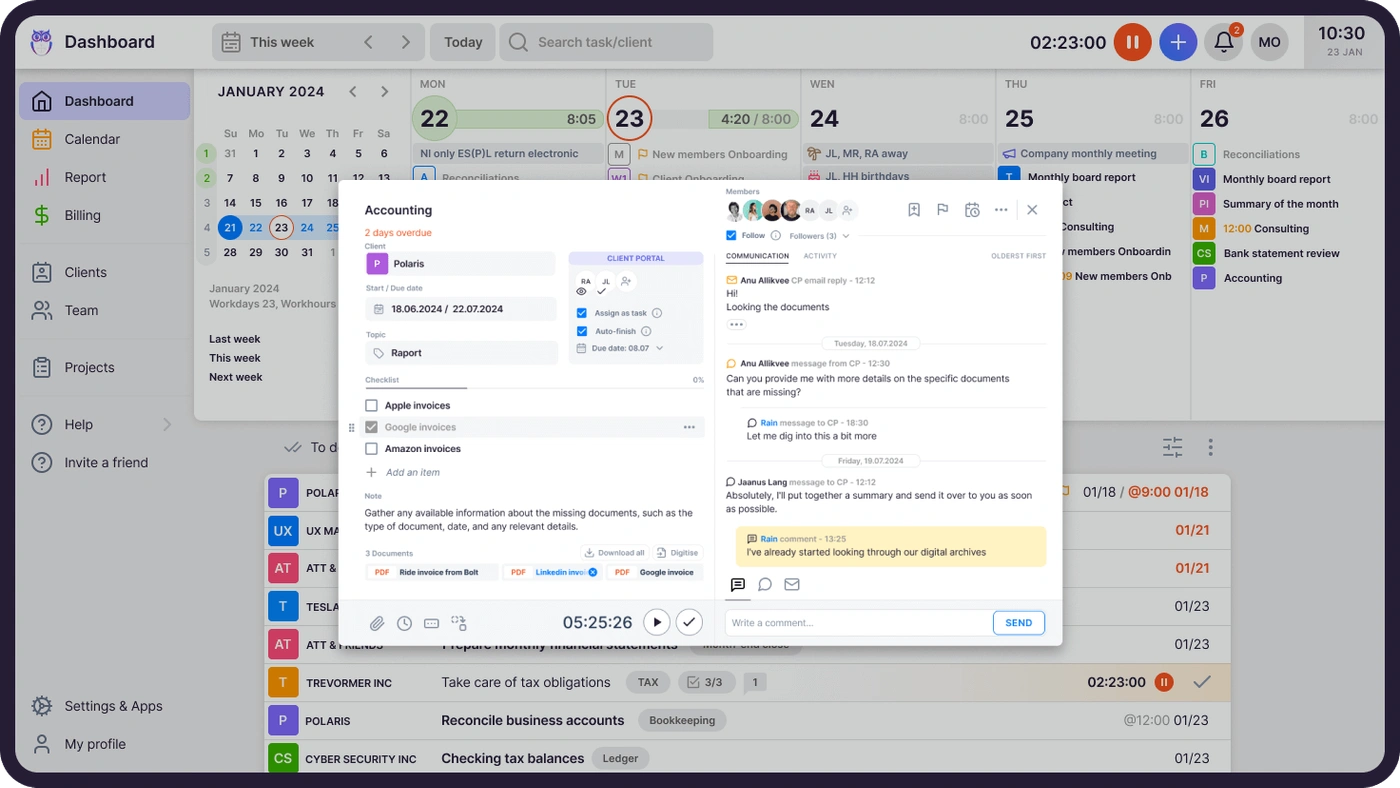
Uku is built specifically for accounting and tax firms. Its standout feature for tax pros is client agreement and profitability monitoring: you see in real time whether each client is actually profitable, not at year-end when it’s too late to fix. Combined with unlimited workflow templates for recurring filings, time tracking, and automated billing that turns tracked hours into invoices, Uku gives managers the single source of truth their team is missing — one place to see who’s doing what across every return. It starts at $19/member/month (Solo, up to 20 active clients), the Team plan adds teamwork tools at $38/member/month billed yearly, and it integrates with QuickBooks, Xero, e-conomic, and Tripletex. A 14-day free trial of all features and free onboarding are included.
| 👍 Uku does best | 👎 Uku’s limits |
|---|---|
| Single source of truth across the team | Fewer third-party integrations |
| Real-time client profitability monitoring | E-signatures via integration, not native |
| Flexible, customizable deadline workflows | No built-in chat |
| Automated billing tied to tracked time | |
| Free trial and free onboarding |
2. TaxDome — best for high-volume tax shops

TaxDome is a strong fit for larger, high-volume tax firms (200+) that want an all-in-one client experience: a polished portal, e-signatures, document management, automated client tasks, and a client mobile app. If the client-facing side of tax season is your priority and you want clients to sign and upload in one place, it’s hard to beat. The trade-off is a steeper learning curve and a busy internal interface — for a small team the breadth can feel like overkill, and onboarding takes longer than with lighter tools.
| 👍 TaxDome does best | 👎 TaxDome’s limits |
|---|---|
| All-in-one portal + e-signatures | Steeper learning curve |
| Document management and client tasks | Busy interface for staff |
| Client mobile app | Overkill for small teams |
3. Karbon — best for email-heavy collaboration

Karbon excels at collaboration. If your tax firm lives in email and you want triage, comments, and shared workflows in one place, Karbon is strong — team members can pick up a colleague’s return mid-conversation, which helps during the crunch. Its Kanban-style workflows and automated client reminders keep recurring engagements moving. The trade-offs: at $59/user/month it’s one of the pricier options, time tracking is comparatively light, and you’re strongly nudged to run all client email inside Karbon rather than your own inbox.
| 👍 Karbon does best | 👎 Karbon’s limits |
|---|---|
| Email and internal communication | Relatively expensive |
| Shared triage across the team | Limited time tracking |
| Several integrations | Can’t send invoices to accounting software |
4. Financial Cents — best for small firms on a budget
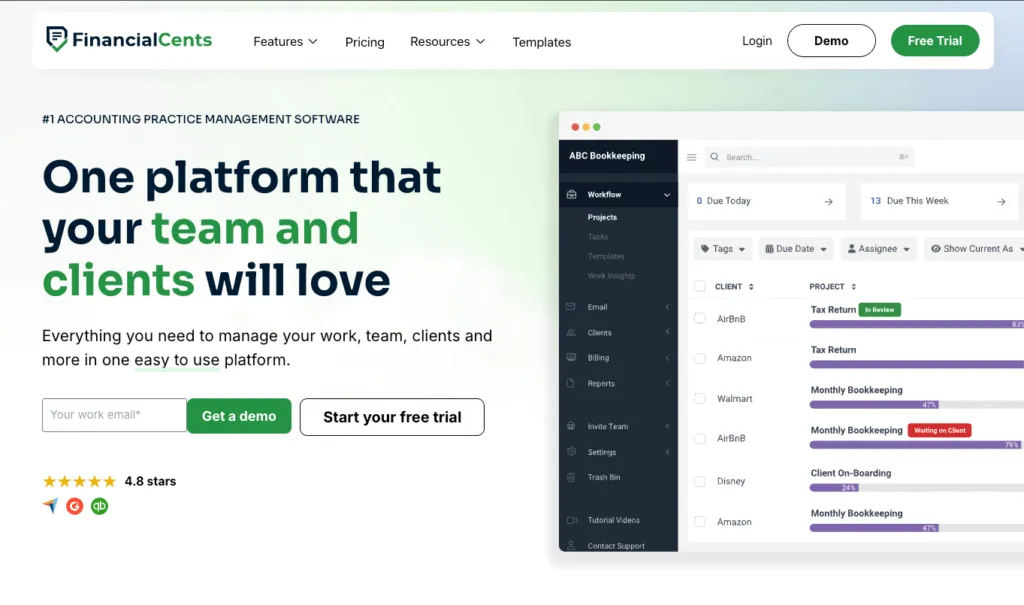
Financial Cents is the budget-friendly pick for small tax practices. It covers workflow and client document requests well, with automated email and text reminders plus a magic-link portal clients actually use. It has basic built-in invoicing with card and ACH payments that syncs to QuickBooks Online; the catch is that reporting is lighter than the heavier platforms. At $49/user/month it’s a solid choice for firms under 20 staff that work in QuickBooks Online and mainly need workflow plus document collection.
| 👍 Financial Cents does best | 👎 Financial Cents’ limits |
|---|---|
| Affordable, simple workflows | Monthly billing needs 5+ users |
| Strong client document collection | Lighter reporting |
| Easy magic-link client portal | Best fit caps out under ~20 staff |
5. Jetpack Workflow — best for simple recurring task tracking

Jetpack Workflow keeps things simple: recurring jobs, customizable checklists, and a clean dashboard, with not much beyond that. It’s good for very small tax firms that just need to stop dropping tasks during the season. It has no client portal and only light time tracking, and you push time to QuickBooks to bill — so while it’s affordable at $40/user/month, it’s a starter tool that growing firms often outgrow once they need billing, profitability, or a portal.
| 👍 Jetpack does best | 👎 Jetpack’s limits |
|---|---|
| Simple recurring job tracking | No client portal |
| Clean, low-learning-curve dashboard | Light time tracking |
| Affordable for tiny teams | No built-in billing |
How to choose the right tool for your tax firm
- You’re a solo preparer or 2–3 person practice: a solo preparer can start on Uku’s Solo plan ($19/month billed annually, one member); a 2–3 person practice starts on Team ($38/member/month billed annually). Either way you get billing, workflows, and a client portal at the price of a task-only tool.
- You’re a growing firm (5–50) losing visibility: Uku is the strongest fit — the single source of truth and profitability monitoring are exactly what breaks first as you scale through a season.
- You’re a high-volume shop and the client portal is everything: evaluate TaxDome for its all-in-one portal and e-signatures.
- You run heavily on email and team collaboration: look closely at Karbon.
- You’re small, budget-conscious, and work in QuickBooks Online: Financial Cents covers the basics well.
For firms that track work, time, and profitability obsessively, see how Uku gives one of the deepest budgeting and profitability views in the category compared to the alternatives.
The bottom line for tax firms
If you want the deepest visibility into firm profitability with the least bloat, Uku is the strongest pick for most tax firms — and the Solo plan makes it realistic even for a one-person practice. If you’re a high-volume shop and the client portal is your priority, evaluate TaxDome. If collaboration is your bottleneck, look at Karbon. Budget-conscious small practices should compare Financial Cents and Jetpack Workflow.
See the full 9-tool breakdown in our best accounting practice management software guide, or book a 30-minute Uku demo to see how it fits your firm’s workflow and deadlines.
Frequently asked questions
What is the best tax practice management software?
For most tax firms, Uku, TaxDome, and Karbon are the top choices. Uku is best for firms that want a single source of truth and real-time profitability monitoring from $19/member/month. TaxDome suits high-volume tax shops wanting an all-in-one client portal with e-signatures. Karbon fits collaboration-heavy teams that live in email. Smaller practices on a budget often pick Financial Cents or Jetpack Workflow.
What should a tax firm look for in practice management software?
Tax firms should prioritize recurring workflow templates built around filing deadlines, e-signatures and a client portal for document collection, time tracking tied to billing, real-time profitability monitoring so season work stays profitable, and integrations with tax software, QuickBooks, and Xero so client data isn't re-keyed.
How much does tax practice management software cost?
Most tax practice management software costs $19 to $60 per user per month. Uku starts at $19/member/month, Financial Cents at $49, TaxDome from about $58 ($700/seat/year on a three-year term, $800 on one year), Jetpack Workflow at $40, and Karbon at $59. Document-heavy platforms add e-signature and storage tiers, so confirm what's included before you commit.
Is tax practice management software the same as tax preparation software?
No. Tax preparation software (like UltraTax, Drake, or Lacerte) prepares and files returns. Tax practice management software runs the firm around that work, recurring deadline workflows, time and billing, client document collection, and profitability monitoring. Most firms run both and connect them so data flows between the two.
Does tax practice management software handle e-signatures and client documents?
The best ones do. TaxDome and Uku both offer a client portal for secure document collection, and several tools add e-signatures for engagement letters and 8879 authorizations. Confirm e-signature support and portal usability before committing, since chasing documents is where most of a tax season's time leaks away.

Published May 29, 2026 · Updated Oct 8, 2026