Top 5 Time and Billing Software for Accounting Firms in 2026
Having a hard time choosing time and billing software for accountants? Here are our top picks for accounting firms in all sizes.

Contents
- What is time and billing software for accountants?
- What to look for in time and billing software for accounting firms
- Why do accountants need time and billing software?
- Why start using a time and billing software in my accounting firm?
- Here’s a look at the 5 time billing solutions in 2026
- Time and billing software for accounting firms reviews:
- 1. Uku
- 2. Financial Cents
- 3. Karbon
- 4. Harvest
- 5. QuickBooks Time
- The verdict of time and billing software for accounting firms
- Frequently asked questions
Using time and billing software in an accounting firm is something employees dread, and managers find it a godsend for accounting firms.
We at Uku have researched how to make work more effective in an accounting firm. One of the most common ways is using work management software. We know that feature-rich time tracking and billing software helps boost productivity by automating tedious manual labour, data collection, and billing.
What is time and billing software for accountants?
Time and billing software for accountants is a tool that records billable and non-billable hours, links those hours to clients and tasks, and turns them into invoices automatically. In a firm setting, the best tools go further than a timer — they connect tracked time to client work, profitability, and billing on a single source of truth, so the whole team can see who’s doing what across every client. The payoff is fewer missed billable hours, faster invoicing, and far less manual spreadsheet work.
What to look for in time and billing software for accounting firms
When you compare options, evaluate each tool against the capabilities that actually move the needle for a firm:
- Flexible time capture – stopwatch, manual entry, and bulk entry so nobody skips logging
- Billable vs. non-billable split – a clear distinction so you bill accurately and measure utilization
- Automated invoicing – bills generated directly from tracked hours, with proofreading before they go out
- Flexible pricing models – time, fixed fee, per item, or a combination, set per client
- Profitability and time-usage reporting – real-time visibility into which clients and engagements actually pay
- Accounting integrations – connects to the software you already run, such as Xero and QuickBooks Online
- A single source of truth – one place where the whole team sees who’s doing what across every client, so anyone can step in and cover an engagement
Why do accountants need time and billing software?
Accountants need time and billing software because manual spreadsheets and paper timesheets leak revenue and swallow hours that should go to client work. Accountants and bookkeepers should spend their time advising clients and building strategy, not chasing entries in Excel. Dedicated software protects billable hours by capturing time as the work happens, speeds up invoicing by generating bills straight from tracked time, and gives managers a real-time view of profitability per client and per team member.
Why start using a time and billing software in my accounting firm?
Traditional spreadsheets or paper-based time tracking and billing methods are unreliable and require a lot of manual work. Accountants and bookkeepers should spend time on advising clients and creating strategies, not filling out Excel sheets.
Time billing software automatically tracks billable hours, generates invoices and sends them out after proofreading.
Yet, choosing the time-tracking software can feel like a gamble. There are countless solutions on the market and choosing just one feels like a big commitment – importing data, setting up your workflows and onboarding your team can take considerable time and effort. It’s not a choice to be taken lightly.
Thankfully, several time billing software for bookkeepers stand out for their features, usability, and integration capabilities.
Here’s a look at the 5 time billing solutions in 2026
- Uku
- Financial Cents
- Karbon
- Harvest
- QuickBooks Time
Time and billing software for accounting firms reviews:
| Uku | Financial Cents | Karbon | Harvest | QuickBooks Time | |
|---|---|---|---|---|---|
| Capterra | 4.7 | 4.8 | 4.7 | 4.6 | 4.7 |
| G2 | 4.8 | 4.8 | 4.8 | 4.5 | 4.5 |
| Most popular plans price (per user/per month) | $38 | $59 | $89 | $10.80 | $10 + $40 monthly fee |
1. Uku
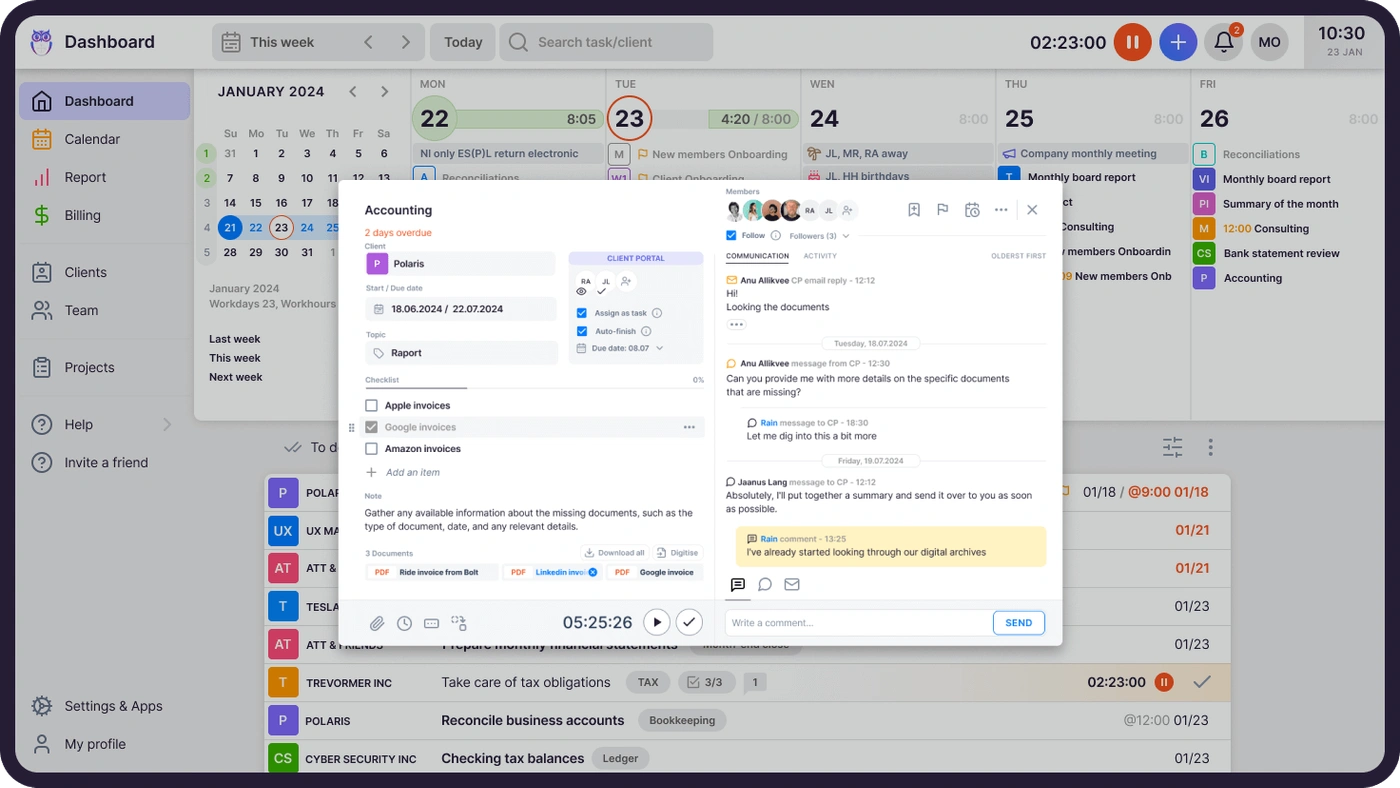
Uku started off as a mainly time tracking and billing solution for accounting firms but has quickly evolved into so much more. It’s a powerful and easy-to-use accounting practice management software with a catchy slogan: “Freedom to do less”.
What sets the best time tracking software for accountants apart isn’t the timer — it’s what the hours connect to. In Uku, tracked time feeds billing and a real-time profitability view, and it all sits on a single source of truth: one place where the whole team can see who’s doing what across every client, so anyone can step in and cover an engagement.
The famous accounting influencer and CPA Jason Staats has praised Uku:
“This planning tool might change your accounting firm’s life!”
Uku’s key time management and billing software features:
- Time tracking – stopwatch, manual entry, bulk entry
- Time estimations and automatic time entries
- Billable and non-billable time entries
- Analytical time-usage reports
- Automated data collection and invoicing
- Master contract templates and company default settings as well as settings by client
- Flexible and personalizable pricing options – time, fixed, item, and a combination of the previous.
- Minimum time and rounding on invoices
- API and integrations with accounting software like Xero and QBO
Why bookkeepers love Uku:
Comprehensive toolkit made for accounting firms
Uku has a well-rounded set of features covering most of the accounting operations, including workflow and task management, time tracking, detailed business analytics, and automated billing.
It integrates well with others
Uku integrates with major accounting software like Xero and QBO, allowing for easy import of clients and products, as well as export of invoices.
Uku has many niche integrations with accounting software as well:
- FreeAgent for smaller firms
- Tripletex for Danish accounting firms
- Fortnox for Norwegian accounting firms
- Merit and SmartAccounts for Estonian accounting firms
- Public API for more advanced integrations
Automated billing
If your team uses Uku to track their work, you can generate and send out tens or even hundreds of invoices in as little as 30 minutes. Export them to your accounting software or send them out directly to your client – the choice is yours.
Flexible pricing options
You can set up specific dynamic pricing for each customer and easily customize the invoices if needed. Choose between several pricing options, set minimum time, use rounding, and create custom fields, etc.
Cons and challenges:
Learning curve
If you have a more complex pricing model, you might find it time consuming to set up by yourself. It’s a good idea to consult the support team. They’ll help you launch your systems in no time.
You need to integrate your accounting software
If you want to automatically track received payments, you’ll need to integrate Uku with your accounting software.
Sounds good? Book a 30-minute personal Uku demo to see it on your own workflow.
Uku’s pricing:
- Solo plan: $19/member/month billed yearly ($25 monthly) — single accountant, up to 20 active clients
- Team plan: $38/member/month billed yearly ($49 monthly)
- Elite plan: $48/member/month billed yearly ($62 monthly)
- Enterprise plan: $88/member/month billed yearly ($99 monthly)
Every signup starts with a 14-day free trial of all features — no credit card required.
2. Financial Cents
Financial Cents is a practical and efficient accounting practice management software with the focus on quick implementation, ease of use and small learning curve. It can also be used as a time and billing software for accountants.
Financial Cents’ key time management and billing software features:
- Time tracking – stopwatch, manual entries
- Time estimatations and budgets
- Billable and non-billable time entries
- Analytical reports to gain insights into profitability
- Billable rates to see how much you are owed
- Invoicing when integrating with QBO
Why accounting firm employees love Financial Cents:
User-friendly interface
Financial Cents focuses on easy design, which makes it simple to navigate, reduces the learning curve and saves time during onboarding.
Powerful workflow management
It simplifies tracking and managing tasks with deadlines and automated reminders.
Affordability
Financial Cents provides essential features for good prices without compromising on quality.
You can give tasks to customers
you can send clients automated requests, e.g. about providing documents and the system automatically follows up until they get it done.
Cons and challenges:
Not very customizable
the options to customize workflows and reports can be limited.
Can fall short on advanced needs
while cost-effective, Financial Cents can lack some advanced features found in more expensive solutions. Assess beforehand if the available features meet your needs and explore complementary tools or workarounds where necessary.
Financial Cents’ pricing
- Team plan: $49/month per user
- Scale plan: $69/month per user
3. Karbon
Karbon has been a serious player in the market since 2014. It’s a collaborative practice management platform for bigger accounting firms.
Karbon’s key time management and billing software features:
- Time tracking – stopwatch and timesheets
- Time estimations and budgets
- Automated invoicing with time based, fixed fee, and recurring billing
- Customizable invoices
- Invoice collaboration with colleagues
- WIP and Realization Reports
- API and integrations
- Payment options and auto-payments
Why bookkeepers and accountants love Karbon:
Collaboration at its core
Karbon’s main focus is on team collaboration, which makes it perfect for bigger accounting teams.
Detailed reporting
Karbon provides reports on time spent, task progress, and team performance, helping you understand your profitability and optimize the billing processes.
Cons and challenges:
Setup takes time and effort
With the wide range of features, setting up Karbon can be overwhelming and time-consuming for new users. It’s triage system is sometimes difficult to get used to and might get overwhelming for not as tech-savvy accountants.
Higher pricing
Karbon’s pricing is relatively higher ($89$ per user/per month) than some competitors’ and may not be suitable for very small firms or solo practitioners.
Karbon’s pricing
- Team plan: $59/month per user
- Enterprise plan: $89/month per user
4. Harvest
Harvest goes beyond being a time and billing solution for accountants. The software is for many industries, including law, construction, marketing, etc.
Harvest’s key time and billing software features:
- Time tracking – Stopwatch, manual time entries, weekly timesheets
- Time tracking integrations – Asana, Slack, Trello, Nifty, and many more.
- Budgets according to time tracking
- Time reports and analyzing
- Creating invoices
- online payments
- Integration with QBO and Xero
Why businesses love Harvest:
Insightful Reporting to See Actionable Insights
It provides reporting features that turn time-tracking data into actionable insights. These reports help businesses understand project profitability, team capacity, and overall business performance, enabling better decision-making and resource management.
A Large Number of Integrations
By integrating with many popular tools, Harvest helps simplify workflows when working on different tasks or programs.
Scalable Prices for Teams of All Sizes
Harvest supports teams of all sizes, offering discounts for large teams and special pricing for nonprofits and educational institutions.
Cons and challenges
Limited Project Management Features
Harvest does not offer comprehensive project management features like task assignments and workflow automation, which are often essential in tools such as marketing automation software. Businesses looking for a full-fledged project management solution might need to integrate Harvest with other tools or consider alternatives.
Dependency on Internet Connection
Harvest requires a stable internet connection for its desktop and web versions to function effectively which can be a limitation in areas with poor connectivity.
Harvest’s pricing
- Harvest plan: Free
- Harvest Pro plan: $10,80/month per user
5. QuickBooks Time
QuickBooks Time is supposed to be the perfect time and billing software for accountants to be used alongside QuickBooks. The seamless integration between the two makes it perhaps the most precise time-tracking tool for QBO users.
QuickBooks Time’s key time and billing software features:
- Time tracking – timesheets, mobile time tracking, and time kiosks
- GPS tracking for employees
- Customizable reports with predictions
- Integrations with QBO, etc.
- Geofences for team management
- Team task management
- Flexible pricing options
Why accounting businesses love QuickBooks Time:
Easy-to-use time tracking
The seamless integration with QuickBooks Online and Desktop simplifies time tracking and invoicing for employees and managers. The mobile app makes QuickBooks Time convenient for remote and on-site workers .
Accurate reporting improves business decisions
QuickBooks Time reports provide insights into project profitability, employee productivity, and overall business performance.
Great integrations with QuickBooks
QuickBooks Time integrates well with QuickBooks Online, QuickBooks Desktop, and other payroll software, providing a unified platform for managing finances and time tracking. This integration eliminates the need for multiple systems, reducing complexity and improving efficiency.
Cons and challenges:
Limited integration options
Compared to some competitors, QuickBooks Time offers fewer integration options. While it connects well with major payroll solutions like Gusto and QuickBooks, businesses needing a wider range of integrations might find this limiting.
Confusing user interface
Some users report that the user interface can be confusing and not always intuitive. Navigating certain features can be challenging and require additional time. The mobile app also tends to require frequent software updates, making the new app always confusing for existing users. Partnering with a mobile app agency can help improve design consistency, streamline navigation, and ensure a smoother update process.
Costly for smaller and very large businesses
The base-plus-subscriber fee model can be costly for large or small businesses. The Elite plan, which includes advanced features like geofencing and mileage tracking, comes at a higher cost, which all companies may not justify.
QuickBooks Time’s pricing
- Premium plan: 20$/month + 8$/month per user
- Elite plan: 40$/month + 10$/per user per month
The verdict of time and billing software for accounting firms
Selecting the right time tracking and billing software is more than just a convenience – it’s a strategic decision that can significantly improve your firm’s efficiency, accuracy, and client satisfaction. Each solution comes with its unique strengths and target audiences, reflecting the diverse needs accounting professionals can have.
Start with assessing your firm’s specific needs, e.g. the need for advanced features, billing customization, or integration with your existing systems. This way you can choose a solution that not only meets your current needs but also supports your company’s growth.
For more detailed information, read more from Karbon, Financial Cents, and Uku.
| Uku | Financial Cents | Karbon | Harvest | QuickBooks Time | |
|---|---|---|---|---|---|
| Capterra | 4.7 | 4.8 | 4.7 | 4.6 | 4.7 |
| G2 | 4.8 | 4.8 | 4.8 | 4.5 | 4.5 |
| Most popular plans price (per user/per month) | $38 | $59 | $89 | $10.80 | $10 + $40 monthly fee |
Frequently asked questions
What is the best time and billing software for accounting firms in 2026?
The top time and billing tools for accounting firms in 2026 are Uku, Financial Cents, Karbon, Harvest, and QuickBooks Time. Uku is built specifically for accounting firms and connects time tracking to billing and a real-time profitability view on a single source of truth. Financial Cents is a budget-friendly practice management option, Karbon suits larger collaborative teams, Harvest is a general-purpose cross-industry tool, and QuickBooks Time fits firms already standardized on QuickBooks. The right pick depends on firm size, billing complexity, and which accounting software you already use.
How much does time and billing software for accountants cost?
Pricing typically ranges from around $10 to $90 per user per month in 2026. From the tools in this guide: Uku starts at $19/member/month (billed yearly), Financial Cents at $49/user/month, Karbon at $59/user/month, Harvest Pro at $10.80/user/month, and QuickBooks Time from $20/month plus $8/user. Per-user cost is only part of the picture — the bigger return comes from recovered billable hours and faster invoicing.

Published Dec 22, 2025 · Updated Jun 8, 2026