





Glossary
Account Reconciliation
Account reconciliation is the process of comparing two independent records of the same account — a ledger balance and a bank statement, vendor statement, or subledger — until every transaction on both sides is matched. Whatever does not match is investigated and either corrected in the books or documented as a known difference. It is the control that catches transcription errors, duplicate charges, and missing entries before financial statements go out on records nobody actually checked.
What actually gets reconciled
Every account that has two independent sources of truth is a reconciliation candidate. Cash gets compared to the bank statement. A credit card balance gets compared to the card issuer’s statement. A loan balance gets compared to the lender’s amortization schedule. Accounts payable and accounts receivable subledgers get tied to the general ledger control account. If there is no independent source — an account that only exists inside the client’s own bookkeeping software with nothing external to check it against — there is nothing to reconcile, only to review.
That distinction matters because firms sometimes bill “reconciliation” for accounts that are really just a review, and clients notice the difference when a real discrepancy shows up somewhere they were never actually checking.
Why it stalls, and it’s rarely the accounting
A reconciliation with three lines left unmatched is a five-minute job. A reconciliation that has been open for six weeks is almost never a technical problem — it is a waiting problem. Someone is waiting on a bank statement PDF the client hasn’t sent, a receipt for a charge nobody recognizes, or an answer to “what is this $340 transfer for.” The accounting work itself — matching line items — takes minutes. The chase for the missing document or the missing answer is what eats the week.
Firms that keep reconciliation moving treat the chase as its own workflow step rather than an informal email that goes stale. A client portal with an open request the client can see and clear themselves moves faster than a message buried in an inbox, and it leaves a record of when the request went out and when it was answered — useful the one time a client disputes how long something sat unresolved.
Reconciliation types and who owns the delay
| Account type | Compared against | Typical delay source |
|---|---|---|
| Bank / cash | Bank statement | Missing statement or unclear deposit |
| Credit card | Card issuer statement | Personal charges mixed with business |
| Accounts payable control | Vendor statements | Vendor statement not requested |
| Accounts receivable control | Customer aging | Disputed invoice, no client answer |
| Intercompany | Sister-entity ledger | Two bookkeepers, two versions of the truth |
| Loans / leases | Lender amortization schedule | Schedule requested once, never updated |
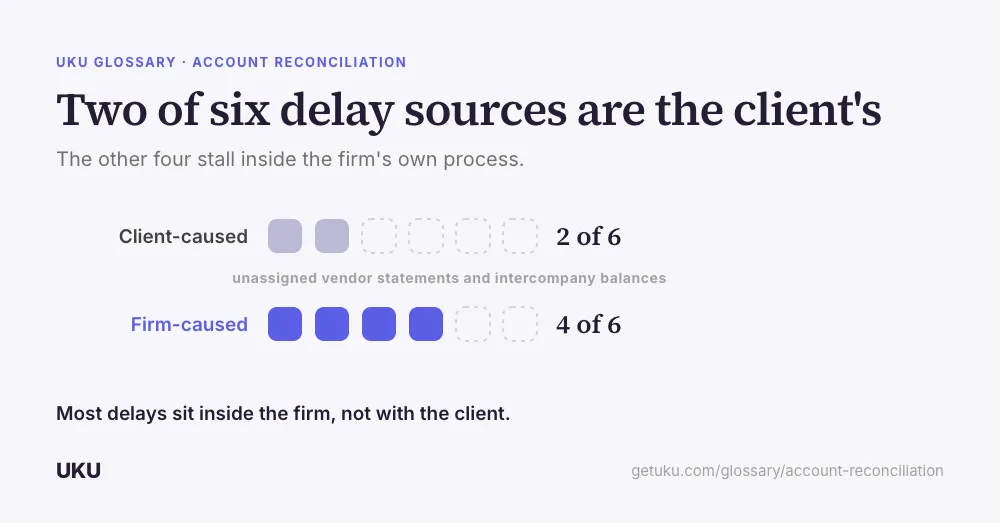
Only the first two rows are client-caused most of the time. The rest usually stall inside the firm — waiting on a vendor statement nobody requested, or an intercompany balance nobody assigned to a single owner.
Building it into the monthly cycle
The firms that never seem to have a reconciliation backlog are not faster at matching transactions. They run reconciliation as a scheduled step in the month-end close, not as a task someone remembers to start. A recurring workflow that generates the reconciliation task on the same day every month, with the supporting statement attached as a subtask, turns “did we reconcile the Amex account” from a question into something visible on a dashboard before it is three weeks overdue.
The other piece is document location. A reconciliation that requires searching three email threads for last month’s statement is a reconciliation that gets postponed. Keeping the source statements in document management next to the working file means the next person — including whoever reviews the file — can pick it up without asking where anything is.
When reconciliation finds something real
Most unmatched items are timing differences that clear themselves next period. A smaller number are genuine errors — a duplicate entry, a transposed digit, a payment applied to the wrong invoice. The rare and important case is the item that turns out to be neither: an unauthorized charge, a payment that was never actually received, a transfer nobody at the client can explain. That is the entire reason the control exists, and it is also the reason a rushed reconciliation is worse than a late one — a variance cleared without investigation because the deadline was close is a control that failed quietly.
The staffing math firms actually watch
Reconciliation is invisible when it goes well and expensive when it doesn’t, which makes it easy to under-resource. The number that matters is not how many accounts a firm reconciles, but how many take longer than the standard close window because of a chase that isn’t visible anywhere. Reporting that shows which client files are still open past the target close date turns that from a monthly surprise into something a team lead can act on mid-month, before the whole close is late because of one unanswered question on one account.
How Uku handles account reconciliation
Last updated September 19, 2026 Reviewed by Rain Allikvee