






Glossary
Accounting Advisory Services
Accounting advisory services are the interpretive work a firm sells on top of compliance and bookkeeping — forecasting, budgeting, tax planning, and business consulting that turns a client's financial records into decisions. The category is broad by design: it covers everything from a single tax-planning session to an ongoing CFO-level retainer, priced separately from the recurring compliance fee.
What sits inside the category
“Accounting advisory services” is a category label, not a single product, which is why it confuses firms trying to price it as one line item. In practice it groups everything a firm sells that goes past recording and reporting the numbers and starts interpreting them:
| Advisory work | Typical shape | How it’s usually priced |
|---|---|---|
| Tax planning | Ongoing or seasonal | Fixed fee per engagement |
| Business consulting | Project-based | Fixed fee |
| Cash flow forecasting | Recurring | Monthly retainer |
| Budgeting & KPI review | Recurring | Monthly retainer |
| Transaction / due-diligence support | Project-based | Fixed fee or hourly |
| Entity structure & succession | One-off | Fixed fee |
Some of these are single projects a client buys once. Others repeat on a schedule and start to look like a standing role inside the client’s business — that recurring, retainer-shaped end of the category has its own name: virtual CFO services or outsourced CFO services, depending on how the firm staffs and sells it.
Why it sits above compliance, not instead of it
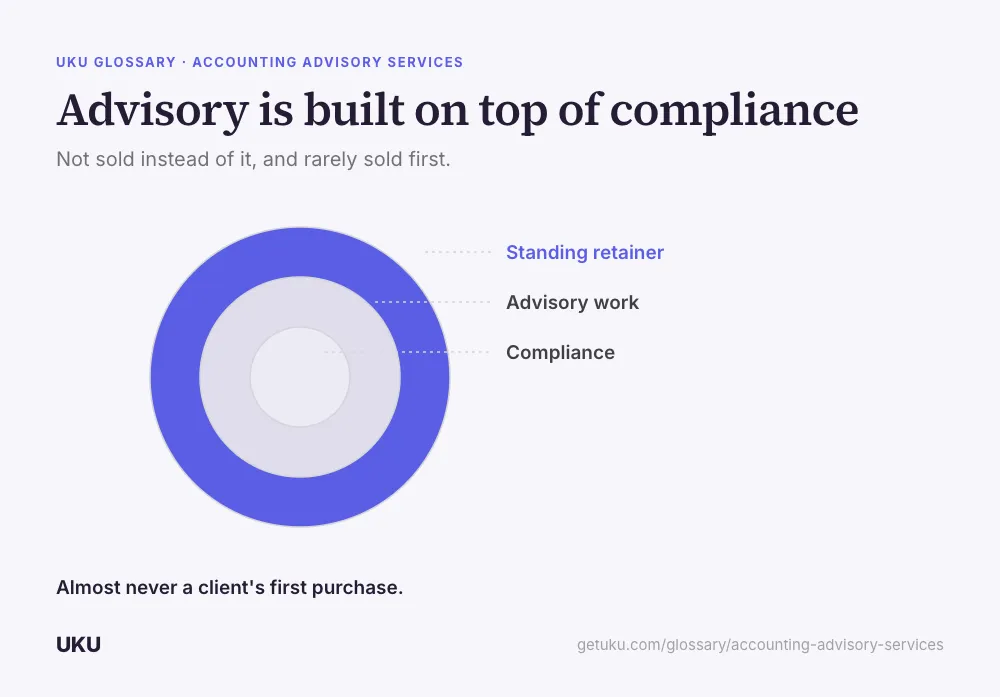
Compliance work — filings, statutory reporting, the recurring bookkeeping cycle — is what most clients think they are buying when they hire an accounting firm. Advisory is what turns that firm from a vendor into a relationship the client renews for reasons beyond obligation. The two are not competitors for the same budget; advisory is usually sold as an addition once the compliance relationship is already trusted.
That sequencing matters commercially. A firm that already holds a client’s client accounting services engagement has the historical numbers, the working relationship, and the credibility to propose advisory work. A firm pitching advisory cold — without first owning the books — is asking a client to trust a forecast built on records nobody at the firm has verified.
Where the deliverable actually lives
The advisory work itself happens in conversation, but the numbers behind it need somewhere the client can see them between meetings. Firms that run this well pull the underlying data from a reporting layer that already tracks realization and client profitability, and put the client-facing view in a client portal rather than a PDF attachment that ages in an inbox. A forecast the client has already glanced at before the call starts from agreement rather than surprise.
How firms price it without punishing themselves
Hourly billing is the wrong instrument for advisory work, because it charges less as the firm gets better at the judgment call that makes the advice valuable. Most firms price advisory one of two ways: a fixed fee for a defined project with a clear end, or a monthly retainer for a standing relationship. The retainer model depends on knowing how much owner-facing time an engagement actually needs — which is measurable, even when the work itself is judgment rather than volume, through the same time tracking discipline that keeps fixed-fee compliance work profitable.
Where advisory engagements go wrong
The scope was never written down. A tax-planning conversation drifts into a budget review, then a hiring question. Each step is small; together they are a retainer nobody is paying for. The fix is a written scope in the engagement letter and a habit of quoting the next request before doing it.
The firm sells it before it can staff it. Advisory work needs a different skill from compliance — modeling, forecasting, and the judgment to answer a question live on a call. A firm that sells advisory and hands it to whoever is available on a given week loses the client’s confidence fast, because the value of the engagement is entirely in the judgment behind it.
The books underneath it are not actually clean. Advisory built on records nobody has reconciled is a guess wearing a deck. The firms that sell this reliably require, or already run, the bookkeeping layer the advice depends on.
Where it fits in a firm’s service line
Accounting advisory services is almost never a client’s first purchase. It is the top of a ladder that starts with a compliance relationship — bookkeeping, statutory filings — and grows into interpretation once the firm has earned the trust and has the numbers to back a recommendation. Firms that try to sell it as a standalone entry point are selling judgment nobody has asked them to apply yet.
How Uku handles accounting advisory services
Last updated September 19, 2026 Reviewed by Rain Allikvee