





Glossary
Accounts Payable
Accounts payable is what a business owes to its vendors and suppliers for goods or services already received but not yet paid. It appears on the balance sheet as a liability and, in the subledger, as a list of open bills waiting on approval or payment. Managing accounts payable well means the business pays what it owes on time, captures every deductible expense, and never pays the same bill twice.
The liability, and the process, are two different things
Accounts payable means two related things depending on who’s asking. To a CFO reading a balance sheet, it’s a single number: what the business currently owes. To the bookkeeper running the process, it’s a queue of individual bills, each one somewhere between “just arrived” and “paid,” and the queue is where the actual work — and the actual risk — lives.
That queue is also where the accounts payable control account in the general ledger gets its balance from. If the subledger and the control account drift apart, it usually means a bill was entered without going through the standard intake, which is exactly the kind of gap a monthly account reconciliation is built to catch.
Where the bottleneck actually sits
Bookkeepers new to a firm sometimes assume accounts payable slows down because bills are complicated to enter. In practice, entering a bill is the fast part. The slow part is everything that has to happen before payment can go out:
| Stage | What happens | Typical bottleneck |
|---|---|---|
| Capture | Bill arrives by email, mail, or portal | Bill sent to the wrong inbox or person |
| Coding | Expense category, vendor, amount confirmed | Ambiguous line item needs a decision |
| Approval | Second person signs off | Approver unavailable or bill forgotten in queue |
| Payment | Funds released | Cash timing, or waiting on approval to finish |
| Reconciliation | Bill matched to payment in the ledger | Payment method not recorded consistently |
Three of the five rows depend on someone other than the bookkeeper acting — the person who has to answer what a charge was for, the approver who has to sign off, the client who controls when cash goes out. That’s why “why hasn’t this bill been paid” is usually a workflow question, not an accounting one.
Turning the chase into a system
Firms managing accounts payable for multiple clients get the queue moving by treating intake and approval as a recurring workflow with a defined path — a bill that lands anywhere except the standard intake channel is a bill at risk of sitting unnoticed. A client portal request that routes an ambiguous bill to the client for a quick answer, with a reminder if it goes unanswered, replaces the email that quietly ages for two weeks.
Every bill also needs a document behind it. Keeping vendor invoices in document management attached to the entry means approval and reconciliation both happen against the actual invoice, not a description someone typed from memory.
Where this ends, and where it doesn’t
Accounts payable is the client’s liability, not the firm’s own billing process — the bookkeeping firm is processing what the client owes its vendors, which is a different flow entirely from how the firm itself invoices its own clients for the bookkeeping work. The two get confused occasionally in conversation, but they run through completely separate systems and separate approvals.
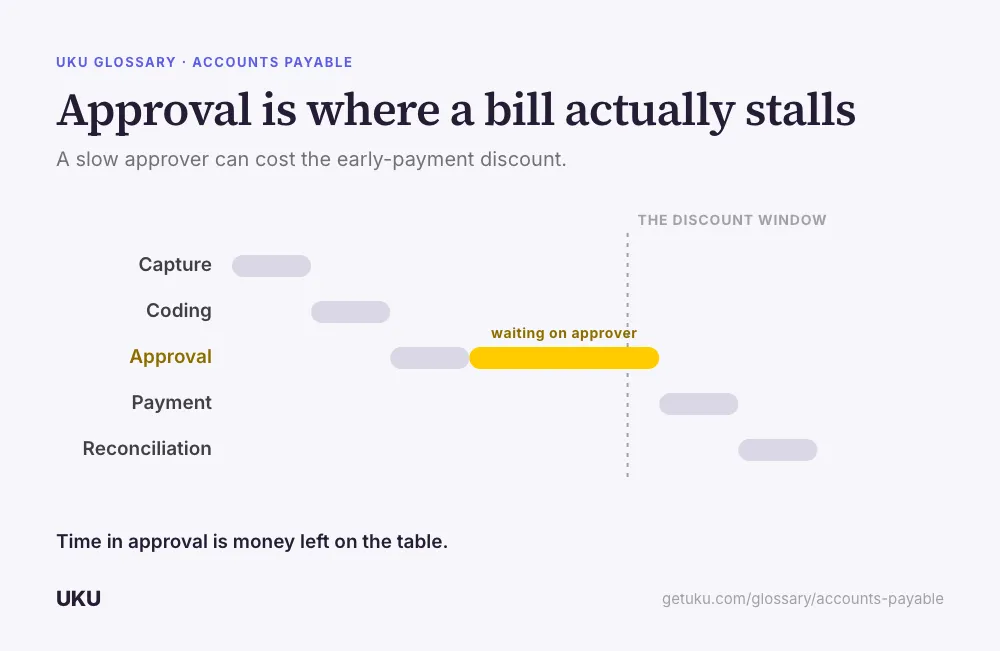
Early payment discounts and the cost of a slow approval
Some vendors offer a discount for paying early — a common term is 2% off if paid within ten days instead of the standard thirty. That discount is only capturable if a bill clears approval fast enough to hit the window, and a bill that sits three weeks in an approver’s inbox has already missed it by the time anyone notices. Firms rarely calculate what a slow approval queue actually costs in missed discounts across a full client book, but for a business with meaningful vendor volume, it adds up to real money left on the table every single month, quietly, with nothing on a report flagging that it happened.
The same slowness has a second cost that’s easier to see: late fees and damaged vendor relationships when a bill misses its due date entirely because it was stuck waiting on someone to approve it, not because the business couldn’t pay.
What good AP management buys the client
A business with tight accounts payable rarely misses an early-payment discount, never pays a duplicate invoice, and has an accurate cash-flow picture because it knows exactly what it owes and when it’s due. Time tracking on how long each bill spends in each stage — capture, coding, approval, payment — is what lets a firm show a client the process is actually working, rather than just asserting it.
How Uku handles accounts payable
Last updated September 19, 2026 Reviewed by Rain Allikvee