





Glossary
Accounts Receivable
Accounts receivable is money a business is owed by its customers for goods or services already delivered but not yet paid for. It appears on the balance sheet as an asset and, in the subledger, as a list of open invoices at various stages of being collected. How quickly a business turns receivables into cash — not how much revenue it books — is what actually determines whether it can pay its own bills on time.
An asset that isn’t cash yet
Accounts receivable sits on the balance sheet as an asset, which is technically correct and also the source of a lot of confusion for business owners who read “asset” as “money I have.” A dollar in receivables is a promise, not cash, and the gap between the two is exactly where cash-flow problems hide inside profitable-looking businesses. A company can grow revenue every quarter and still miss payroll if customers are taking longer and longer to pay.
The receivables subledger rolls up into the accounts receivable control account in the general ledger, the same way accounts payable does on the other side. When that control account and the subledger drift, it’s usually a sign an invoice was adjusted or credited outside the normal process — one more reason account reconciliation matters for receivables, not just for cash.
Where an invoice actually gets stuck
| Stage | What’s supposed to happen | Where it stalls |
|---|---|---|
| Invoice sent | Customer receives the bill | Sent to the wrong contact or address |
| Due date passes | Payment is expected | No automatic reminder triggered |
| First follow-up | A reminder goes out | Nobody owns sending it |
| Dispute raised | Customer questions a line item | Sits unresolved, payment withheld |
| Collection | Payment is chased directly | Relationship tension slows escalation |
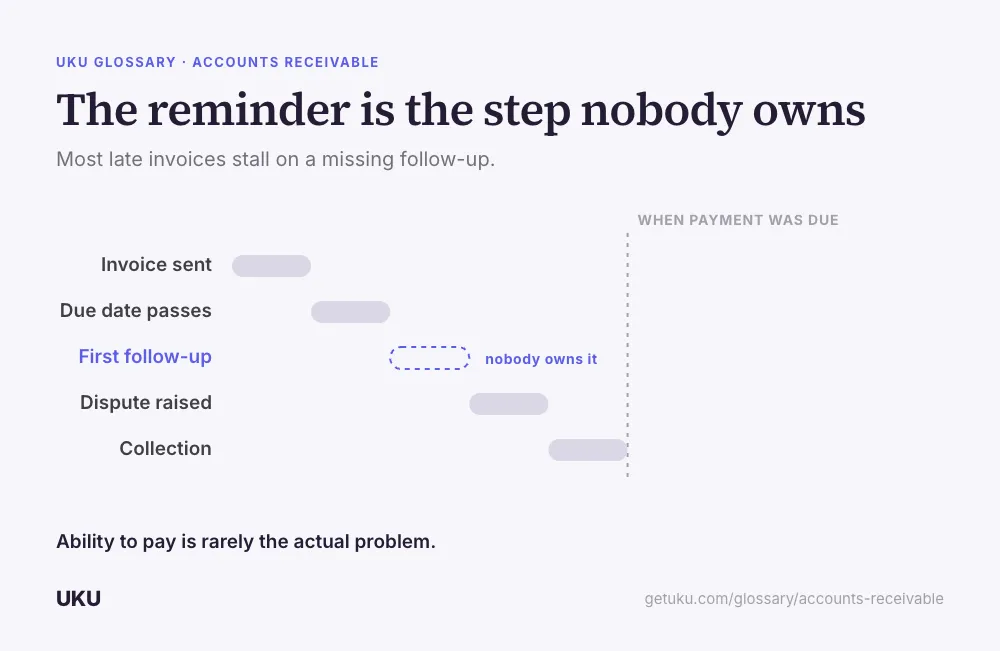
Most invoices that go unpaid past 60 days aren’t stuck because the customer can’t pay — they’re stuck because a reminder never went out on schedule, or a small dispute over one line item quietly blocked the entire invoice. Neither of those is a collections problem yet; both are process gaps that turned into one.
Aging as the early-warning system
An aging report is the single most useful view a firm can hand a client, because it turns “we might have a cash problem eventually” into “these three customers, this much money, this many days overdue.” The report only works if it’s current, though — an aging report run off a receivables ledger that hasn’t been reconciled in a month is showing stale numbers with false confidence attached.
Firms that keep it current build the review into the closing cycle as a scheduled check rather than something pulled only when a client asks. It’s one of the clearest examples of where bookkeeping stops being record-keeping and starts being early warning — the number itself isn’t the value, catching the trend before it becomes a shortfall is.
What belongs to bookkeeping, and what doesn’t
Recording invoices, applying payments, and reporting aging is core bookkeeping. Actively chasing a customer for payment — phone calls, payment plans, escalation — is a different service with different labor and different risk, and pricing it separately from the base bookkeeping fee keeps the firm from quietly absorbing collections work it never agreed to do. This is also the point where a client’s own outbound billing sometimes gets confused with the firm’s — the client invoicing their customers is receivables; the firm invoicing the client for the bookkeeping work is a completely separate flow.
Credit terms are a decision, not a default
Many small businesses extend the same payment terms to every customer without ever deciding to — thirty days because that’s what the invoice template defaulted to, not because anyone assessed whether a given customer is a good credit risk. Receivables problems concentrate disproportionately in a handful of customers who were extended terms they can’t reliably meet, while the majority pay close to on time regardless of the stated terms.
A firm that reviews aging by customer, not just in total, can flag that pattern to a client directly — tightening terms for the slow payers instead of tightening terms for everyone, which is the blunt version of the same fix and usually costs the business some of its better relationships along with the slow ones.
Turning receivables into a client-retention advantage
A client whose firm proactively flags a slipping aging report before it becomes a cash crunch remembers that call. Reporting that surfaces receivables trends alongside the rest of the close, and BI Analytics that turns the same underlying data into a cash-flow view, are what let a firm have that conversation from data instead of a hunch — the difference between advisory work a client pays for and a guess that happens to be right.
How Uku handles accounts receivable
Last updated September 19, 2026 Reviewed by Rain Allikvee