





Glossary
Bank Reconciliation
Bank reconciliation is the process of comparing a company's cash ledger against its bank statement, transaction by transaction, until the two agree at the ending balance. Differences are explained by timing items — deposits in transit, checks not yet cleared — or corrected as errors when they are not. It is usually the first reconciliation performed each month, because every other closing step depends on cash being right.
The reconciliation everything else depends on
Bank reconciliation gets done first in most closing sequences for a simple reason: almost every other number in the books assumes the cash balance is correct. If cash is wrong, the trial balance is wrong, and time spent on anything downstream — accruals, journal entries, reporting — is time spent on numbers that will need to be revisited. It is also usually the cleanest reconciliation to run, because most accounting software auto-matches a connected bank feed against ledger entries with little manual work.
What makes bank reconciliation deceptively simple is that the easy 95% of transactions auto-match themselves. The reconciliation is really the remaining 5% — the deposit that hasn’t hit the bank yet, the check still in the mail, the bank fee the client never recorded, the duplicate a connected app pushed in twice.
The four things that actually cause a variance
| Reconciling item | What it is | Resolves itself, or needs action? |
|---|---|---|
| Deposit in transit | Recorded in books, not yet on bank statement | Resolves itself next statement |
| Outstanding check | Written and recorded, not yet cashed | Resolves itself, unless stale |
| Bank fee or interest | On the statement, not yet in the books | Needs a journal entry |
| Genuine error or duplicate | Miscoded, missing, or double-entered transaction | Needs correction |
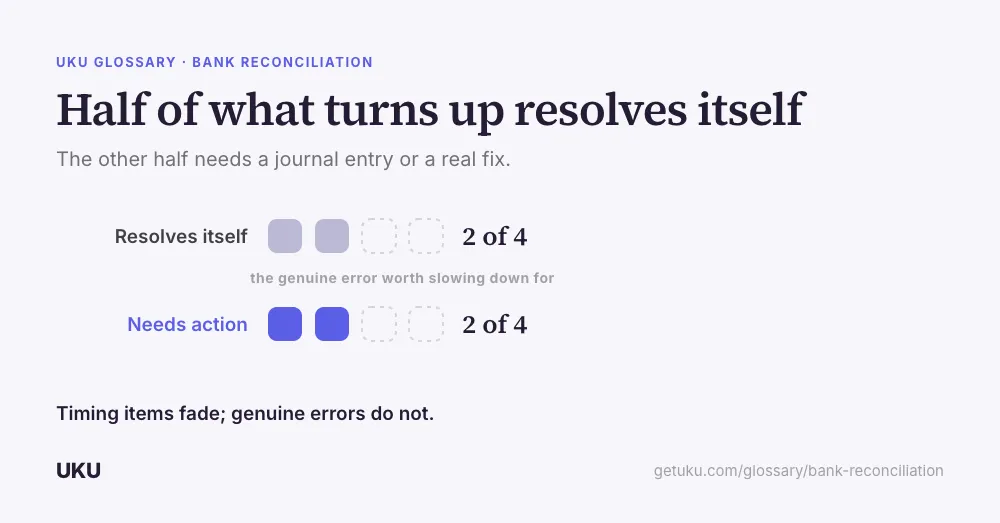
The first two rows are timing, not errors, and a reconciler who understands that difference stops chasing things that were never actually wrong. The last row is the one worth slowing down for — a check outstanding for four months is not a timing difference anymore, it is either lost, voided and never recorded as such, or evidence of something that needs a closer look.
Where the delay actually lives
Ask a bookkeeper why a bank reconciliation is still open in week three and the answer is rarely “I haven’t matched the transactions.” It’s usually “I’m waiting on the client to tell me what a specific charge was for,” or “the bank statement for that account didn’t get uploaded.” The fix for both is the same: make the request visible somewhere the client actually checks. A client portal request with a due date and an automatic reminder clears faster than a question sitting in an email thread, and it gives the firm a record of exactly how long the client sat on the answer — useful the one time it’s disputed.
Making it a scheduled step, not a memory
Firms that reconcile every account, every month, without a backlog are running bank reconciliation as a recurring workflow step generated on the same day each cycle, not as a task someone has to remember to open. The statement itself lives in document management attached to that task, so the person doing the reconciliation — and whoever reviews it after — isn’t hunting through a downloads folder or an old email for a PDF from three weeks ago.
That structure matters more as client count grows. A firm reconciling five accounts by memory is fine. A firm reconciling eighty accounts across thirty clients without a system will lose track of which ones are actually done versus which ones were opened and never finished — and the two look identical from the outside until someone checks.
The multi-account reality
A client with one business checking account is the easy case. Most clients past a certain size have several: an operating account, a savings buffer, a payroll account, sometimes a card processor’s holding account that behaves almost like a bank account but reports differently. Each one needs its own reconciliation, on its own schedule, and a firm juggling several accounts per client across dozens of clients is running a lot of small, similar tasks that are easy to lose track of individually even when none of them is hard on its own.
The practical fix isn’t a smarter reconciler — it’s naming, up front, which accounts exist for a client and which cadence each one gets, so “did we reconcile all of this client’s accounts” has a checklist answer instead of requiring someone to remember the full list from memory every month.
What good bank reconciliation buys the firm
A clean, monthly bank reconciliation is the cheapest fraud and error control a firm can run, and it is also what makes every later report trustworthy. Reporting that shows a client’s month as “closed” only means something if the cash behind it was actually checked against the bank, not assumed correct because nothing looked obviously wrong. The reconciliation is boring by design — when it surfaces something interesting, that’s the signal something in the client’s business actually needs attention.
How Uku handles bank reconciliation
Last updated September 19, 2026 Reviewed by Rain Allikvee