





Glossary
Billable vs Non-Billable Hours
Billable hours are time spent on work a client is directly charged for, or that counts toward a fixed-fee scope of work. Non-billable hours are everything else staff are paid for — internal meetings, training, business development, and administration — that no client invoice covers. The split matters because it is the only way to see how much of a firm's paid time actually produces revenue, and how much is the overhead of running the practice.
The distinction, and why it survives fixed fees
Billable hours are time a client is paying for, whether the invoice is itemized by the hour or the work sits inside a fixed monthly fee. Non-billable hours are time the firm is paying its staff for but no client invoice covers — a team meeting, a training session, drafting a proposal for a prospect who has not signed yet, filing the firm’s own accounts.
The distinction sounds obvious until a firm moves to fixed-fee pricing and someone assumes it stops mattering. It does not. A fixed fee hides whether a client’s work took two hours or twelve, but it does not change the fact that one of those outcomes is profitable and the other is not. Tracking billable against non-billable time is still the only way to see which.
What goes on each side, and why
The line is drawn by whether the time is caused by a specific client’s needs, not by whether an invoice line exists for it.
| Category | Examples | Why it belongs there |
|---|---|---|
| Billable | Bookkeeping, reconciliations, tax prep, client calls about their account | Work exists because that specific client needs it |
| Billable | Setup and migration after an engagement letter is signed | Directly attributable to one client, even before the recurring fee starts |
| Non-billable | Internal team meetings, firm admin, invoicing your own clients | Necessary for the firm to run, not caused by any single client |
| Non-billable | Sales calls and proposals before a contract exists | No client relationship yet to attribute the time to |
| Non-billable | Training, certification, learning new software | Builds the firm’s capability, not a specific deliverable |
| Ambiguous — needs a firm rule | Scoping conversations, minor out-of-scope favors | Firms differ; the important part is deciding once and applying it consistently |
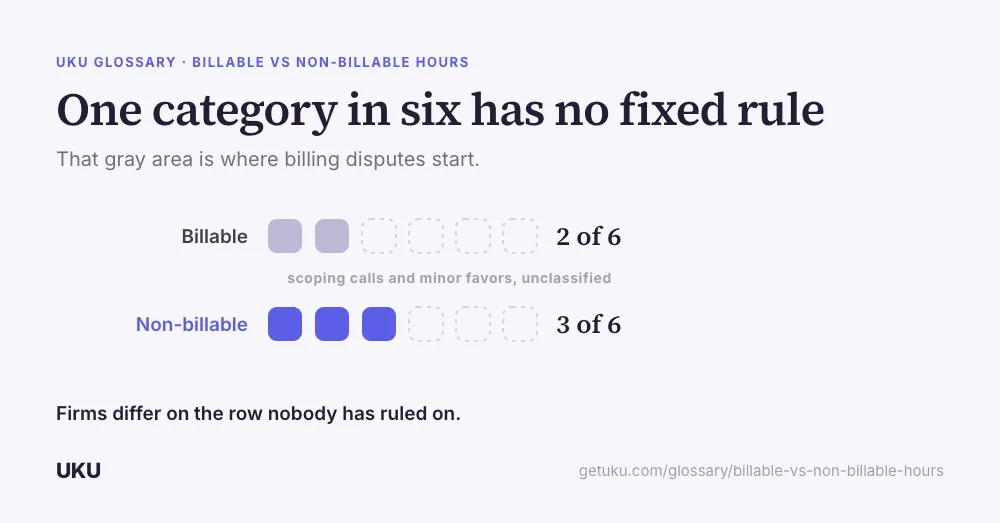
That last row is where most disputes actually happen. A firm without an explicit rule ends up classifying the same kind of work differently depending on who logs it, which quietly corrupts every report built on top of the split.
Why the split matters even when nothing is invoiced by the hour
The practical payoff of tracking the split shows up in three places. It tells a firm whether a fixed fee is still profitable once the real mix of billable and non-billable time behind it is visible. It tells a manager whether someone who looks “fully booked” on a client list actually has free capacity, because non-billable time consumes hours just as surely as client work does. And it is the input automated billing needs wherever contracts are priced by the hour or against a capped scope that can be exceeded.
Without the split, all three of those questions get answered by assumption instead of by data — and the assumption is usually optimistic.
What commonly gets misclassified
A handful of gray areas cause most of the drift between how a firm intends to classify time and how staff actually log it. Answering a client’s one-line email question feels too small to log and often gets skipped entirely, which quietly erases genuinely billable time from the record. Reviewing a colleague’s work on a shared client sometimes gets logged as internal when it should be billable, and sometimes the reverse. And time spent researching an unusual tax or accounting question for one client gets logged as general professional development when it was, in fact, caused entirely by that client’s situation.
None of these are large individually. Across a firm with dozens of clients and a full year of work, they are large enough to distort both realization numbers and the accuracy of future pricing.
Making the split reliable
The fix is the same one that makes time tracking in general reliable: reduce the friction of logging correctly at the moment the work happens, rather than relying on someone to remember and reclassify it later. A clear written rule for the gray-area categories, applied the same way by every staff member, removes most of the inconsistency. What is left after that is a data set a firm can actually trust when it asks whether a client, a service line, or a person’s week is paying for itself.
How Uku handles billable vs non-billable hours
Last updated September 19, 2026 Reviewed by Rain Allikvee