





Glossary
Capacity Planning
Capacity planning is the practice of comparing a firm's available staff hours against the hours its committed client work will actually take, so a manager can see a bottleneck weeks before a deadline forces it into view. It weighs two numbers against each other — the hours a team has to give this period, and the hours the workload on its plate requires — at the level of a person, a week, or the whole practice. Done well, it turns an overloaded month from a surprise into a decision made in advance.
What capacity planning actually compares
Capacity planning sounds like a scheduling exercise, but at its core it is arithmetic on two numbers for the same window of time: the hours a team has available, and the hours the work already on its plate will take. Neither number is obvious on its own. Available hours are not the same as scheduled hours once vacation, sick leave, training, and the unavoidable overhead of running client relationships are subtracted. Demand is not the task count — a client review that takes six hours and one that takes forty both show up as “one open engagement” on a list.
The firms that plan capacity well are not doing something exotic. They are just insisting on comparing the two numbers on a regular cadence instead of reacting when someone is visibly underwater.
Why headcount is not capacity
“We have twelve people” answers a different question than “we have enough hours next week.” A firm with twelve people and three on leave, two split across an onboarding project, and one new hire still ramping is not operating at twelve people’s worth of capacity, even though the org chart says otherwise. Capacity planning subtracts the parts of a person’s week that are not available for the work in front of the firm, which is why the real hours worked — not the contract — is the input the comparison needs.
A new hire is the clearest example of the gap between headcount and capacity. Someone freshly through staff onboarding is on the team but is not yet producing at full speed, and a capacity plan that treats week one the same as month six will overstate what the firm can actually deliver.
Signs a firm is planning capacity by feel
Most firms without a formal process are not ignoring capacity — they are inferring it from symptoms after the fact: a partner who is always the one absorbing overflow, a recurring scramble in the week before quarterly deadlines, or staff quietly working evenings that never show up as logged time. Each of these is capacity planning happening reactively, at the moment the shortfall becomes a person’s problem instead of a number on a dashboard.
The tell is timing. Capacity planning done by feel notices the shortfall the same week it happens. Capacity planning done deliberately notices it before the workload is assigned, when there is still room to move a deadline, redistribute a client, or bring in help.
Capacity versus demand
The comparison itself is simple once the inputs are defined consistently. A basic version looks like this for a given period:
| Measure | What it tells you | What it misses if not kept current |
|---|---|---|
| Headcount | How many people are on the team | Whether they are all available for billable work |
| Scheduled hours | Contracted hours per person per week | Vacation, sick leave, and admin overhead |
| Available capacity | Scheduled hours minus time off and non-billable time | Nothing, if the schedule is up to date |
| Demand | Hours the committed client workload requires this period | Nothing, if the workflow plan is complete |
| Gap | Capacity minus demand | Whether the shortfall is one overloaded person or firm-wide |
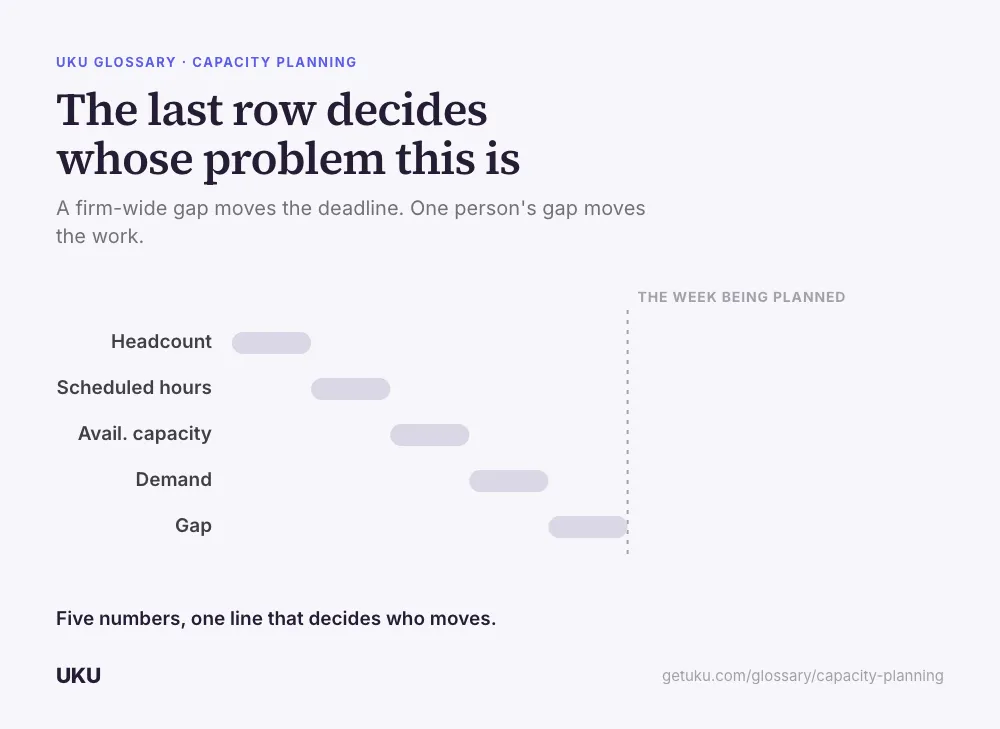
The last row is the one that actually drives a decision. A firm-wide gap means the workload needs to shrink or the deadline needs to move. A gap concentrated on one person usually means the work needs to move to someone else, which is a very different fix.
Where capacity planning breaks down
Two things quietly wreck a capacity plan. The first is stale scheduling data — vacation requests approved outside the system that runs the plan, so the “available” column is wrong before anyone reads it. The second is demand that is measured in task counts instead of hours: two clients with the same deadline can require wildly different effort, and a plan built on task counts treats them as identical load.
Both failures share a fix. The demand side has to come from actual billable and non-billable hours tracked against real work, not an estimate made once and never revisited, and the capacity side has to reflect leave and absence as they are approved, not as they were originally scheduled months earlier.
Turning capacity into a decision
A capacity plan that only produces a chart is not worth maintaining. It earns its keep when the gap it surfaces changes what a manager does that week — moving a deadline, reassigning a client, delaying a new engagement, or pulling in temporary help before the shortfall becomes visible to a client. Firms that review the comparison on a fixed weekly or monthly rhythm, rather than only when someone is already struggling, are the ones that catch the gap while it is still cheap to fix.
How Uku handles capacity planning
Last updated September 19, 2026 Reviewed by Rain Allikvee