





Glossary
Client Onboarding
Client onboarding is the process of moving a new client from a signed engagement letter to the point where the firm's recurring service is running normally — access granted, records received, expectations set, and the first cycle completed. It is a sequence with distinct stages, not a single event, because each stage depends on information or access that usually has to come from the client rather than the firm alone. A firm's own steps can be finished in a day; the process as a whole rarely is, because it waits on the slower party.
Onboarding as a sequence, not an event
It is tempting to think of client onboarding as a single kickoff — a call, a welcome email, and the client is “in.” In practice it is a sequence of stages, and each one has a dependency that has to clear before the next can start. Access cannot be granted before an engagement letter is signed. Records cannot be assessed before access exists. The recurring cycle cannot start before records have been assessed, because starting on incomplete books just moves the problem downstream.
Treating onboarding as a sequence rather than an event is what lets a firm answer a simple but often unasked question: which stage is this client actually in, and what is it waiting on?
The stages, and what each depends on
| Stage | What has to happen | Who it typically waits on |
|---|---|---|
| Engagement signed | Scope, fees, and responsibilities agreed | Client signature |
| Access granted | Bank feeds, accounting software, prior systems | Client credentials |
| Records received and assessed | Prior-year files handed over, books reviewed for gaps | Client handover, then firm review |
| Expectations confirmed | Communication cadence, named contact, reporting preferences | Both sides |
| First cycle run | The recurring service completes its first full pass | The firm |
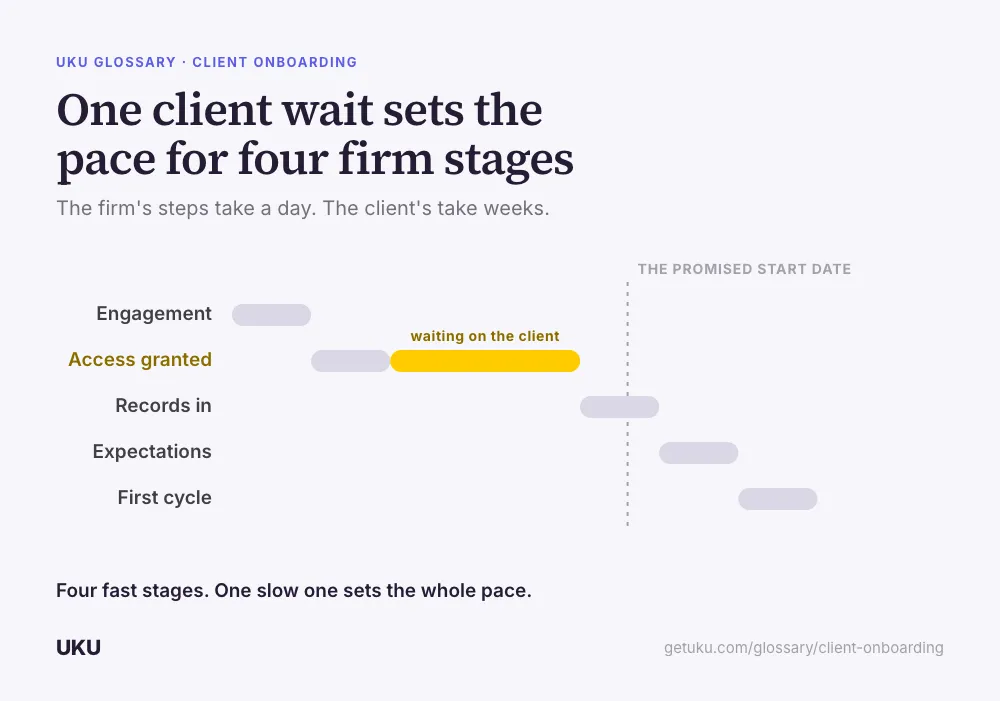
Most of the rows a firm controls are fast. Most of the rows that stall are the ones waiting on the client — which is why onboarding speed is rarely a measure of how organized the firm is, and more often a measure of how quickly the firm surfaces what it is waiting on.
Where onboarding differs from a checklist
A client onboarding checklist is the operational tool built to run this process consistently — the specific line items, who owns each one, and by what date. The process described here is what the checklist is trying to standardize: the stages themselves, the order they depend on each other in, and why each one exists. A firm can understand the process perfectly and still fail at it without a checklist, because the process alone does not assign ownership or make a stalled stage visible — that is what the checklist is for.
Why the client’s side is the bottleneck
Almost every delay in client onboarding traces back to the same pattern: a stage is ready to move, and it is waiting on something only the client can provide — bank credentials, a login to their prior software, an answer to a question about an unusual transaction. None of this reflects badly on the firm’s own process; it reflects the reality that onboarding a new client is, structurally, a two-sided handoff and only one side is being paid to prioritize it.
The practical response most firms land on is making the client’s open items visible to the client directly, through a client portal with a request list they can see, rather than relying on a follow-up email that competes with everything else in their inbox. A visible request does not make a client respond faster on its own, but it removes the excuse that they did not know something was outstanding.
Where onboarding meets the recurring service
Client onboarding is not really finished when access is granted and records are in. It is finished when the first recurring workflow for that client runs the way every future occurrence should — the right checklist, the right owner, the right deadline. A firm that rushes past this last stage to declare a client “onboarded” often discovers the gap two or three cycles later, when a step that was never properly set up quietly fails for the third time.
What tends to get skipped
The stage most often shortened under time pressure is confirming expectations — communication cadence, who the client’s named contact is, how questions will be routed. It feels less urgent than access and records because nothing is technically blocked without it. But it is usually the stage whose absence causes the most friction later, once the recurring service is running and nobody agreed in advance how a routine question should get answered.
How Uku handles client onboarding
Last updated September 19, 2026 Reviewed by Rain Allikvee