





Glossary
Expense Management
Expense management is the process of capturing a cost as it happens, routing it through approval, and recording it against the right account and the right period. It sits upstream of bookkeeping: the ledger only ever knows about an expense once someone has submitted it, which is the step most firms find hardest to control.
What the process actually is
Expense management is what happens to a cost between the moment someone pays it and the moment it appears correctly on the books. It has three steps, and each one is owned by a different person:
| Step | Who does it | What goes wrong if skipped |
|---|---|---|
| Submit | The person who incurred the cost | The expense never enters the process at all |
| Approve | Someone other than the submitter | No check on amount, category, or legitimacy |
| Record | Bookkeeping | Expense sits approved but not in the ledger |
The reason expense management is treated as its own process, rather than just a bookkeeping task, is that the first step happens outside the accounting system entirely — in someone’s wallet, on a personal card, in a glovebox full of receipts — and nothing about the ledger changes until that person reports it.
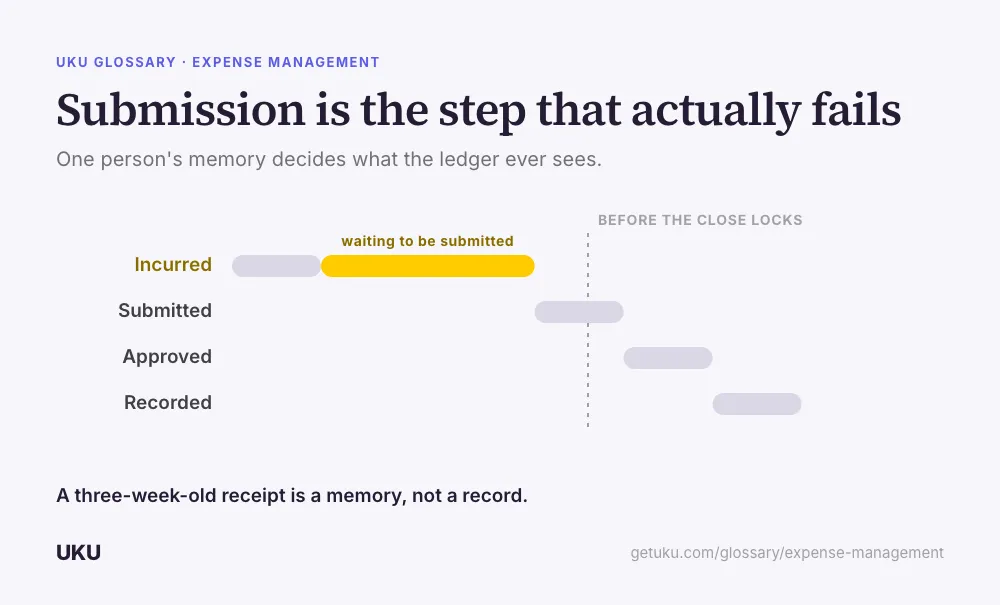
Why the submission step is the hard one
Approval and recording are procedural once a claim exists. Getting the claim submitted in the first place, with a receipt attached and the right category, is where most expense processes actually fail. A person who paid for something three weeks ago is reconstructing memory, not reporting a fact, and the receipt — if it still exists — is often a faded thermal-paper slip rather than a usable document.
Firms that get ahead of this treat the receipt itself as the trigger: capturing it at the moment of purchase, through a photo or an upload, rather than asking someone to remember and report it later. That’s the same logic behind document management generally — a document that is filed the moment it exists doesn’t need to be found later.
Why approval has to be a separate person
Approval only functions as a control if the person approving is not the person who submitted the claim. Without that separation, expense management collapses into “record whatever was submitted,” which removes the one check that catches a miscategorized cost, a personal purchase on a business card, or a duplicate claim before it reaches the books.
This is the same principle firms apply to client accounting services more broadly — the person recording a number and the person who created it shouldn’t be the same person, because the check only works from the outside.
Where it connects to the rest of the cycle
An unapproved expense sitting in a queue at month-end is a decision the close can’t make on its own — which period it belongs to, whether it’s even valid — and either has to wait or gets estimated and corrected later. Firms that keep that queue near zero heading into month-end close avoid reopening entries after the period is supposed to be locked.
The other connection is to reimbursement, which is functionally an invoice management problem pointed inward — the firm or the business owes its own staff money the same way it owes a supplier, and an approved-but-unpaid expense claim is the same kind of overdue liability an unpaid vendor invoice is, just smaller and easier to lose track of.
Routing it through the client, not around them
For firms managing expenses on a client’s behalf, the submission step usually means a client’s staff member sending in a receipt from somewhere outside the firm’s own systems. A client portal that accepts that upload directly — rather than routing it through email first — keeps the receipt and its approval trail in one place from the moment it exists, instead of arriving as an attachment that has to be moved before anyone can act on it.
What makes categorization consistent
A submitted expense still needs a decision about which account it belongs to, and that decision is where inconsistency creeps in fastest — the same type of cost coded three different ways by three different people, none of them technically wrong. Firms that keep categorization consistent usually do it with a fixed, short list of categories tied to the chart of accounts, rather than leaving the field free-text for whoever is submitting the claim to describe in their own words.
The cost of treating it as occasional
Expense management is easy to under-invest in precisely because most individual claims are small. A single unsubmitted receipt is not worth building a process around. The pattern only becomes visible in aggregate — a firm running dozens of clients, each with staff submitting claims irregularly, accumulates enough unrecorded or miscategorized expenses that the books stop reflecting reality by a meaningful margin. The fix isn’t chasing individual receipts harder; it’s a submission step light enough that people actually use it the same week the cost occurs, instead of batching it for a rainy day that keeps getting pushed back.
How Uku handles expense management
Last updated September 19, 2026 Reviewed by Rain Allikvee