





Glossary
Financial Reporting
Financial reporting is the practice of turning closed accounting records into statements — income statement, balance sheet, cash flow, and supporting notes — that a client or their stakeholders can read and act on. It is the client-facing output of a close, built to a standard like GAAP or IFRS when the audience requires it.
The deliverable, not the process
Financial reporting is the output a client actually sees: the statements that turn a period’s closed records into something readable — what the business earned, what it owns and owes, and how cash moved. Everything that happens before it — capturing transactions, reconciling accounts, posting adjustments — is the process. Financial reporting is the artifact that process produces.
That distinction is worth being precise about, because “reporting” also gets used inside firms to mean something different: the operational reports a firm runs on itself — hours logged, tasks completed, team capacity. If that’s what you’re looking for, Uku’s reporting covers time, tasks, and team productivity — a different, internal-facing use of the same word. This entry is about the client-facing financial statements, not that operational layer.
What determines whether it’s trustworthy
| Depends on | Because |
|---|---|
| A completed month-end close or year-end close | Reporting presents whatever the close produced — it can’t correct it |
| A reporting standard, when the audience needs one | Comparability across periods and between firms |
| An agreed cadence | A client’s expectation is set in the engagement letter, not assumed |
| A consistent format | Recurring clients read faster when the shape doesn’t change each period |
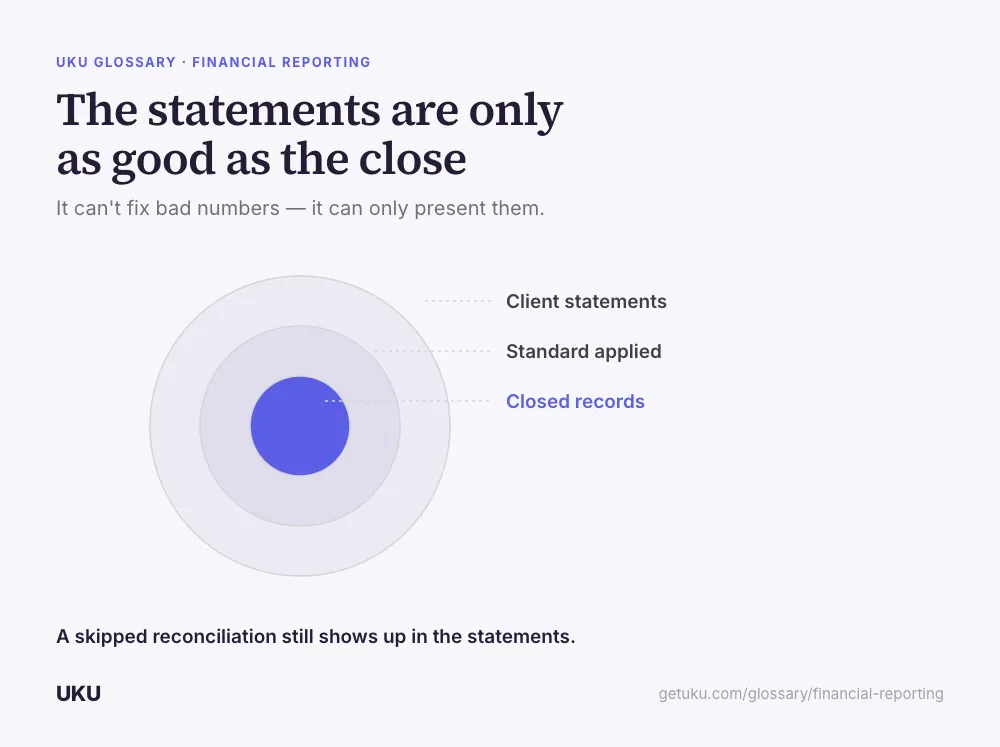
The first row is the one that actually breaks reporting quality at most firms. Financial reporting has no independent way to catch an error in the underlying books — a mis-posted adjustment or a skipped reconciliation shows up in the statements exactly as wrong as it was in the ledger. This is why firms that care about reporting quality invest in close discipline first; reporting is downstream, not a separate safeguard.
Where a standard comes in
Whether the statements need to follow GAAP or another framework depends on who’s reading them. A lender or investor typically requires it; an owner using the numbers to run their own business often doesn’t strictly need it, though many firms apply a standard consistently across all clients rather than deciding case by case. That decision belongs in scoping, ideally documented somewhere the client can see it — a client portal that lists what’s included avoids the later conversation about why a statement wasn’t built to a standard nobody had actually asked for.
Format matters less than clients think it should
Firms sometimes spend disproportionate effort on how a statement package looks — branding, layout, cover pages — while the thing that actually determines whether a client trusts the numbers is consistency period over period. A client comparing this month’s statement to last month’s is looking for the same structure, the same groupings, the same line items in the same order, so a change jumps out as meaningful rather than cosmetic. A firm that redesigns its report template every few months, even with good intentions, makes every comparison harder for the client reading it. The plainest, most repetitive format a firm can commit to is usually the most useful one, even though it’s the least impressive to look at on its own.
Making the deliverable repeatable
The firms that deliver financial reporting on a predictable cadence, every period, without a scramble, are almost always running it as a recurring workflow tied directly to the close that produces it — the reporting step isn’t a separate task someone remembers to do, it’s the last step of a cycle that already has an owner and a due date. That’s what turns financial reporting from an event a client waits on into something they can plan their own decisions around.
Why the deadline matters as much as the numbers
Two statement packages with identical numbers are not equally useful if one arrives on the fifth of the month and the other on the twenty-fifth. Most of the value in financial reporting is in the client being able to act on the numbers while they’re still current — adjusting spending, chasing a receivable, deciding on a hire. A client who gets accurate statements three weeks late is getting a historical document, not a decision-making tool, even though nothing in the statements themselves is wrong. Firms that treat the reporting deadline as seriously as the reporting accuracy are the ones whose clients actually use what they’re sent, instead of filing it away unread.
Beyond the statements
Some clients want more than the standard statement package — trend analysis, per-client or per-project profitability, forward-looking dashboards. That kind of analysis sits a level above financial reporting and is closer to what BI Analytics is built for; financial reporting stays focused on the statements themselves.
How Uku handles financial reporting
Last updated September 19, 2026 Reviewed by Rain Allikvee