






Glossary
Fractional CFO
A fractional CFO is a finance executive who works for a business part-time or on a set number of hours per month rather than as a full-time hire, typically splitting their week across several clients at once. The label describes the employment and time arrangement — a slice of a CFO's capacity — rather than the delivery channel or the firm structure providing it.
What the word “fractional” is actually describing
Job titles borrowed from full-time roles carry an assumption of full-time hours, which is exactly what “fractional” is correcting. A fractional CFO does the same category of work a full-time CFO would — forecasting, budgeting, cash-flow oversight, the strategic conversation with ownership — but sells a defined slice of a week instead of all of it. That slice is usually the unit the retainer is priced around: a day a week, ten hours a month, a fixed meeting cadence.
It is worth being precise about what the word does and does not describe:
| Term | What it describes | The other axis it says nothing about |
|---|---|---|
| Fractional | Time allocation — part of a CFO’s capacity | Whether delivery is remote or on-site |
| Virtual | Delivery channel — remote relationship | How much time the client gets |
| Outsourced | Contract structure — vendor, not employee | Whether it’s part-time or full-time hours |
A fractional CFO is usually also delivered virtually and is, by definition, outsourced rather than employed — the three labels describe the same engagement from three different angles, and firms tend to lead with whichever one their buyers are actually searching for.
Why the model works for the client
A growing business often reaches a point where it needs finance-executive judgment before it can justify a finance-executive salary. A full-time CFO is typically the most expensive hire on a leadership team; a fractional arrangement gets the same category of judgment at a fraction of the annual cost, because the business is buying hours, not headcount. The trade-off is availability — a fractional CFO is not in the building when an unplanned question comes up on a Tuesday afternoon — which is the main reason some businesses eventually convert the retainer into a full-time hire once they can justify one.
Why the model works for the firm
For the firm supplying the role, the fractional structure is what makes the economics work at all. One senior person’s judgment does not scale linearly with client count the way bookkeeping hours do, but splitting that person’s week across several retainers lets the firm sell the same expertise more than once without duplicating the person. The constraint is real, though: the firm’s capacity is that one calendar, and every hour a client takes beyond their retainer is an hour taken from someone else’s.
That is why firms that run several fractional CFOs across a client roster depend on knowing, concretely, how each person’s time is actually spent — not estimated after the fact, but tracked, through the same time tracking discipline that protects any fixed-scope engagement from quietly expanding.
Where the retainer breaks
The time split gets ignored. A client who books “a call whenever I need one” instead of a defined cadence will use more of the CFO’s time than the fee covers, and the firm absorbs the difference. The fix is the same one that protects any retainer: a written allocation and a habit of naming when a client has gone past it.
The numbers arrive late or unclean. A fractional CFO who spends most of their allotted hours reconstructing a dashboard instead of discussing it is being paid for report assembly, not judgment. Firms that keep this role efficient pull the underlying numbers from a reporting layer that already tracks client profitability, so the fractional hour goes to the conversation.
One person becomes a single point of failure. A retainer built entirely around one individual’s calendar has no backup if that person is out for two weeks. Firms that scale this past a handful of clients usually pair the fractional CFO with a client portal the client can check independently, so a gap in the CFO’s calendar is not also a gap in what the client can see.
How it connects to the rest of the service line
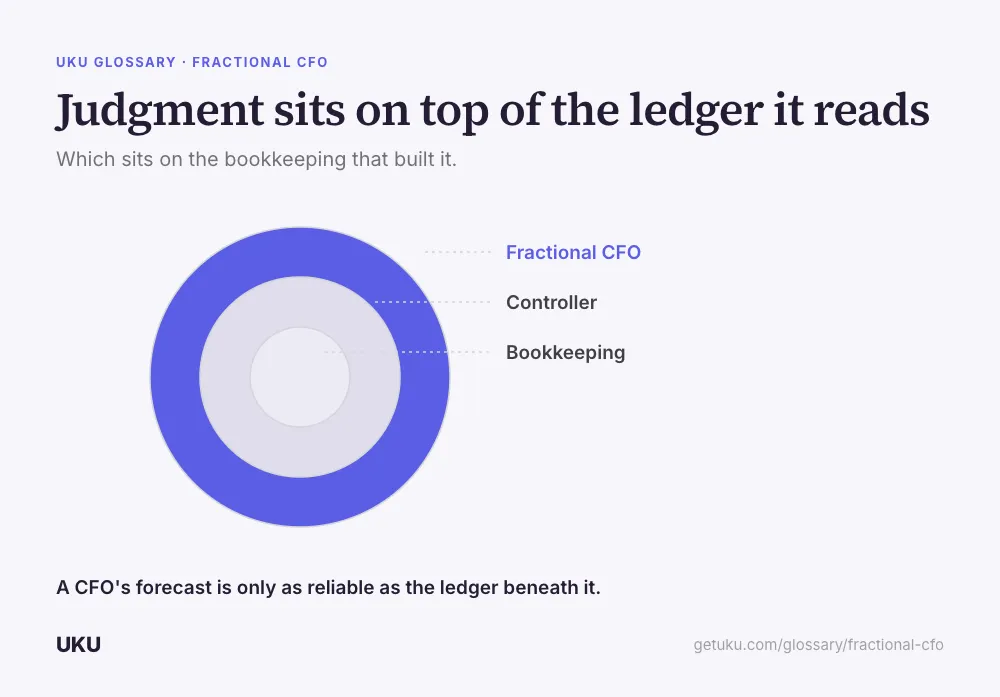
A fractional CFO retainer rarely stands alone. It sits on top of a client’s existing bookkeeping or client accounting services relationship, because the forecast is only as reliable as the records underneath it, and it is close kin to outsourced CFO services — the difference being whether the firm frames the sale around a time allocation or around the function being handed off entirely.
How Uku handles fractional cfo
Last updated September 19, 2026 Reviewed by Rain Allikvee