





Glossary
GAAP
GAAP (Generally Accepted Accounting Principles) is the standard framework of rules and conventions used to prepare financial statements — the shared set of assumptions that lets two firms' statements be compared on the same terms. It sets how transactions should be recognised and reported, not how a firm should run its own workflow to get there.
What the standard actually covers
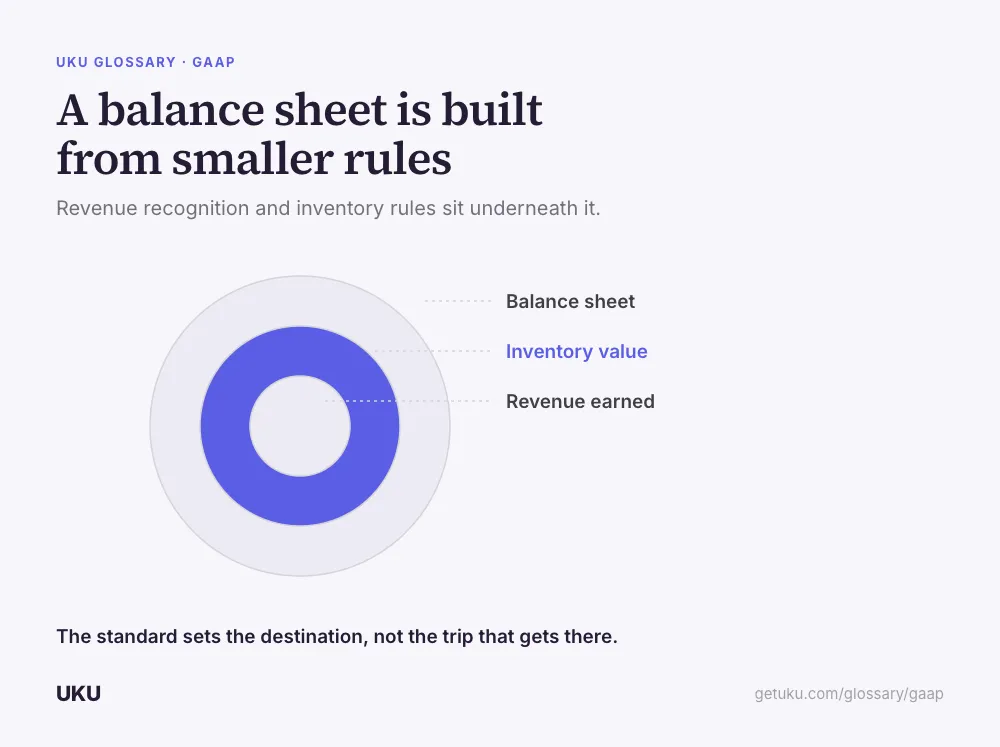
GAAP is a framework for how transactions get recognised and reported, not a description of how a firm should organise the work of producing those reports. It answers questions like when revenue counts as earned, how inventory should be valued, and how a lease shows up on a balance sheet — questions about the numbers, not about the process that produces them.
That distinction matters for a firm’s workflow more than it first appears. A firm can follow GAAP correctly and still run an unpredictable, late close, because GAAP has nothing to say about deadlines, ownership, or how queries get answered. The standard sets the destination; it doesn’t manage the trip.
GAAP vs IFRS, at the level that matters operationally
| GAAP | IFRS | |
|---|---|---|
| Where it’s used | Primarily the US | Most countries outside the US |
| Who sets it | FASB | IASB |
| Approach | More rule-based, more specific guidance | More principle-based, more judgment |
| Where firms feel the difference | Inventory valuation, lease accounting | Same areas, different treatment |
For a firm with clients across borders, the practical question is rarely “which is better” — it’s knowing which framework applies to which entity, and not assuming a template built for one works unmodified for the other. This entry doesn’t attempt to catalogue every point of divergence, because the standards themselves are maintained and updated by their respective boards; a firm working across both should treat the specific divergences as something to verify against current guidance, not something to memorise from a glossary page.
For the acronym itself and where it sits next to other accounting abbreviations, see the accounting abbreviations guide; this entry focuses on what following GAAP changes about a firm’s day-to-day work, not the full glossary of standards-setting terms.
What actually changes at the firm level
Following a reporting standard well depends less on knowing the rules and more on the process that gets the numbers to a state where the rules can be applied correctly. Statements built on a month-end close that skipped a reconciliation step, or a year-end close that rushed the adjustment entries, can technically follow GAAP’s categories while still being wrong — the standard tells you where a number belongs, not whether the underlying number is accurate.
This is why firms that take reporting standards seriously invest as much in their close discipline as in technical GAAP knowledge. A recurring workflow that runs the same reconciliation steps every period, in the same order, is what keeps the numbers a standard is applied to actually trustworthy.
Where the requirement comes from
Whether a specific client’s statements need to be GAAP-compliant — and to what degree — usually comes down to who’s going to read them: a lender, an investor, a regulator, or just the owner. That’s a scoping conversation, and it belongs in the engagement letter rather than being assumed. A client portal that makes the agreed scope visible to both sides avoids the awkward conversation later about why a statement wasn’t prepared to a standard nobody had actually asked for.
A common mistake worth naming
It’s easy to treat “GAAP-compliant” as a stamp of quality on its own, and some firms lean on it that way when talking to clients. It isn’t one — it’s a statement about which categories and treatments were used, not a guarantee the underlying numbers are right. A client can reasonably assume that “GAAP-compliant” means “accurate,” and a firm that doesn’t correct that assumption is setting up a conversation it doesn’t want to have later, when a restated number surfaces and the client’s first question is how something GAAP-compliant could have been wrong. The honest answer — that GAAP governs presentation, not the close process behind it — is better explained before that moment than during it.
Reading GAAP-compliant statements
Once records are closed to a standard, what a firm and a client actually do with the numbers is a separate question — see financial reporting for how firms turn closed, standard-compliant records into something a client or stakeholder can act on.
How Uku handles gaap
Last updated September 19, 2026 Reviewed by Rain Allikvee