





Glossary
General Ledger
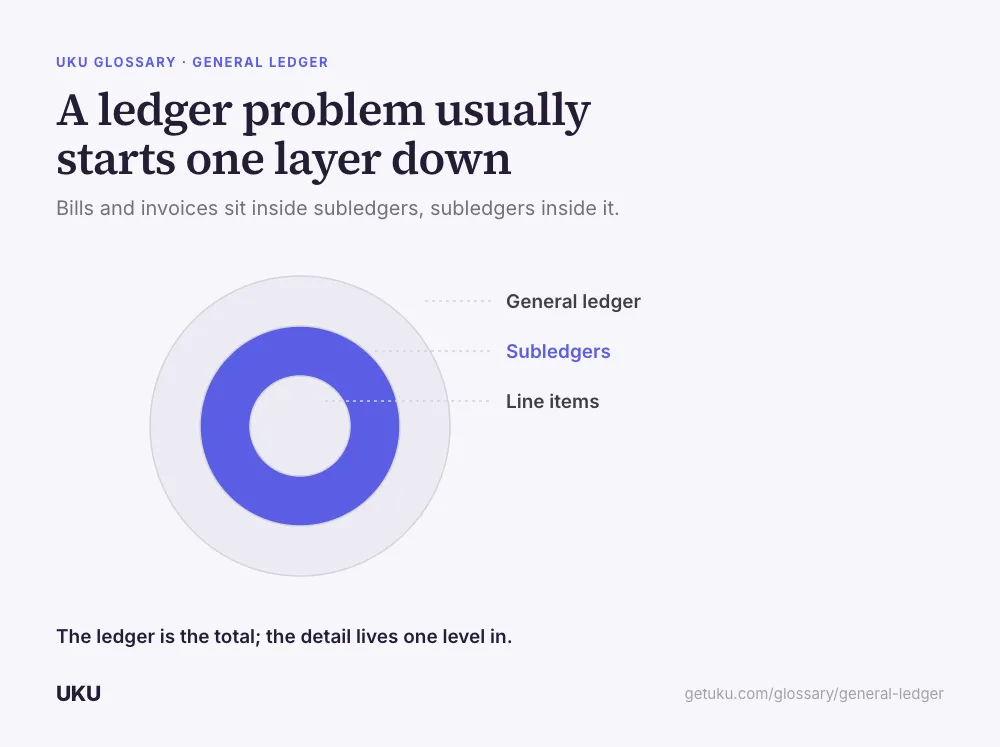
The general ledger is the complete record of every financial transaction a business has recorded, organized by account. Every journal entry posts to it, and every financial statement — the balance sheet, the income statement — is a summary pulled from it. Subledgers like accounts payable or fixed assets feed their totals into the general ledger through a control account, so the ledger stays the single, reconciled source for the company's financial position.
The ledger is the answer key, not the working file
Every accounting system a firm uses — Xero, QuickBooks, or a client’s own tool — is built around the general ledger, but almost nobody works directly in it day to day. Bills get entered in accounts payable, invoices in accounts receivable, payroll in a payroll module. Those subledgers post their totals to the ledger through a control account. The ledger is where everything lands, not where the daily work happens — which is exactly why a problem in the ledger is so often a symptom of something upstream, in a subledger or a journal entry that posted wrong.
That distinction is worth explaining to clients who assume “the books” means one flat list of transactions. It is closer to a set of connected registers, each one someone’s job to keep clean, all rolling up into one ledger nobody edits directly except to fix what the subledgers got wrong.
What “clean” actually means in practice
A balanced ledger — where total debits equal total credits — is the bare minimum, and it’s automatic in double-entry software; it doesn’t prove anything is right, only that the arithmetic didn’t break. A clean ledger is a higher bar:
| Check | What it catches |
|---|---|
| Every account reconciles to an outside source | Errors, omissions, unauthorized transactions |
| No stale suspense or clearing balances | Entries posted “temporarily” and forgotten |
| Trial balance reviewed for unusual movement | Miscoding, duplicate entries, wrong period |
| Subledger totals tie to control accounts | A subledger drifting from its ledger balance |
Firms that skip straight to “is it balanced” and call the ledger done are the ones who find a two-year-old suspense account balance during an audit, long after whoever created it has left.
Why ledger problems are usually a process problem
A messy general ledger is rarely one big mistake. It is usually a slow accumulation of small ones — a bookkeeper who left mid-quarter and whose open items nobody picked up, a client who made their own entries directly in the accounting software between visits, a “temporary” adjustment from three periods ago that was never cleared because nobody owned clearing it. None of those are accounting errors in the traditional sense; they are handoffs that didn’t happen.
Firms that keep the ledger consistently clean treat the review as a recurring workflow step with a named owner every period, not something that happens only when a client asks for a report or a tax return is due. A ledger reviewed monthly catches a miscoded entry while the person who made it still remembers why. A ledger reviewed once a year at tax time is catching things that are now impossible to explain.
Supporting documentation, not just entries
An entry without a document behind it is a claim, not a record. Invoices, receipts, and bank statements that support the numbers in the ledger belong in document management attached to the transaction or period they relate to, so a reviewer — or an auditor, or the client’s own lender — can trace a number back to its source without a separate email asking “where did this come from.”
Chart of accounts is the other half of the problem
A general ledger can be perfectly reconciled and still be nearly useless if the chart of accounts behind it is a mess — too many overlapping categories, inconsistent naming between similar clients, or expense accounts nobody has used correctly in two years. That’s a different problem from a dirty ledger, but it produces the same symptom: reports a client doesn’t trust, because the numbers don’t map cleanly to anything they recognize about their own business.
Firms that keep this under control standardize a chart of accounts template across similar clients and change it deliberately, not by letting each new bookkeeper add an account whenever an entry doesn’t have an obvious home. An unused or duplicate account left in the chart for years is nearly as common a source of ledger confusion as a genuine posting error, and it’s a much easier one to prevent.
What the ledger buys the firm that sells clean books
Firms that can point to a consistently reconciled, reviewed general ledger have an easier time selling advisory work, because every recommendation built on top of it is only as good as the numbers underneath. A profitability conversation, a cash-flow forecast, or a lending package all draw from the same ledger. Reporting that surfaces which client files are still open past the target close date is one of the cheapest ways to keep that ledger current across a whole client book instead of finding out it slipped when a client asks for something urgently.
How Uku handles general ledger
Last updated September 19, 2026 Reviewed by Rain Allikvee