





Glossary
Invoice Management
Invoice management is the process of creating an invoice, getting it to the client, tracking whether and when it gets paid, and reconciling the payment against the books. It covers both sides of the relationship a firm can be in: billing its own clients, and processing the invoices its clients receive from suppliers.
What the cycle actually covers
Invoice management is not one task — it is a cycle that starts before the invoice exists and doesn’t finish until the payment is confirmed in the ledger. Treating it as “generate and send” is the most common reason firms lose track of money they were owed or should have paid.
A typical cycle looks like this:
| Step | What happens | Where it breaks |
|---|---|---|
| Create | Draft the invoice from delivered work or a received bill | Work delivered but never turned into a draft |
| Send | Deliver it to the payer through a channel they’ll actually see | Sent to an inbox nobody checks |
| Track | Monitor whether and when it’s paid | No visibility until someone asks |
| Follow up | Chase what’s overdue | Chasing happens irregularly, if at all |
| Reconcile | Match the payment to the invoice in the books | Payment recorded but never tied back to the invoice |
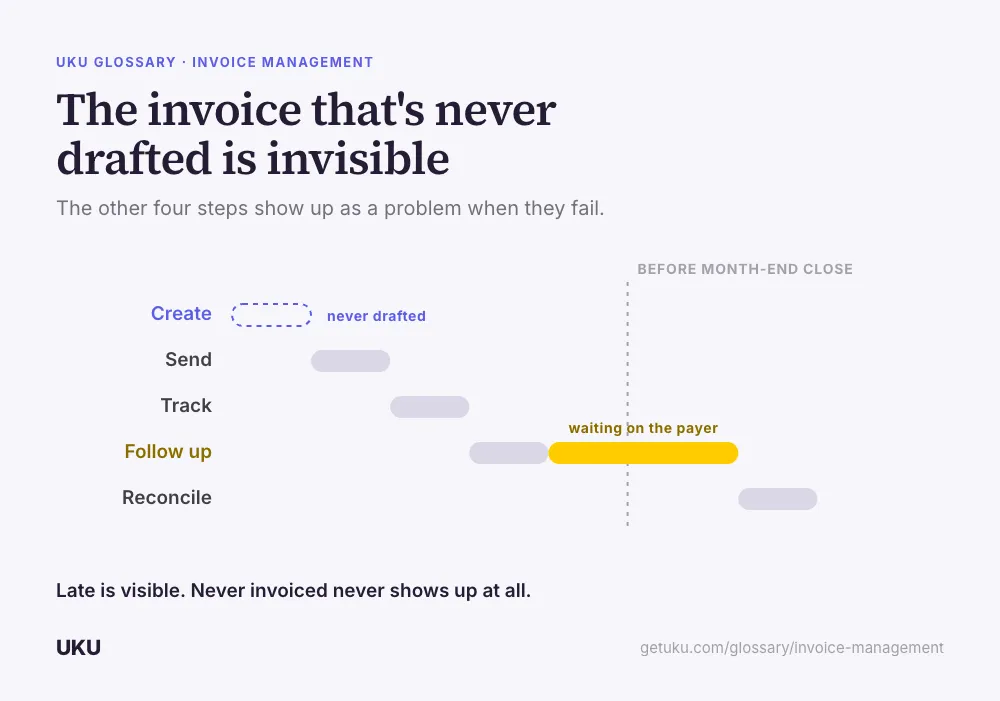
The step that costs firms the most money is the first one. An invoice that is late is at least visible as a problem. Work that was delivered but never turned into an invoice at all doesn’t show up as overdue anywhere — it just never happened, from the ledger’s point of view.
Two directions, one shape
Invoice management runs in two directions that use the same steps but face opposite ways:
Accounts receivable — invoices the firm or its client sends out and needs to collect on. The risk here is under-billing: work done that never gets invoiced, or invoices sent that never get followed up when they go unpaid.
Accounts payable — invoices coming in from suppliers that need to be checked against what was actually delivered, approved, and paid on schedule. The risk here is duplicate or incorrect payments, and missing early-payment discounts because approval sat in someone’s inbox too long.
A firm offering client accounting services often manages both sides at once: its own billing to the client, and the client’s accounts payable as part of the engagement.
What causes the leak in practice
Three patterns account for most of the revenue that goes uncollected or unbilled:
Delivered work with no invoice trigger. If invoicing depends on someone remembering to raise it, it will eventually be forgotten for a client who doesn’t ask. Firms that fix this tie invoicing to a contract or a recurring schedule so the invoice generates from the work itself rather than from memory — this is the core idea behind automated billing.
No single source of truth for what’s outstanding. When invoice status lives in email threads and a spreadsheet gets updated inconsistently, nobody can answer “what’s overdue right now” without a manual pull. The fix is one place both the invoice and its payment status live, checked against the bank feed rather than against memory.
Follow-up that depends on someone noticing. An overdue invoice that nobody is specifically responsible for chasing tends to stay overdue. Reminder cadences that fire automatically close this gap without needing a person to watch a due-date column every day.
Reconciling it against the books
The cycle isn’t finished when the client pays — it’s finished when that payment is matched against the invoice in the ledger, ideally against the bank feed rather than a manual note that it was received. This is the same discipline behind account reconciliation more broadly: a payment that isn’t reconciled is a payment the books don’t actually know happened, which is exactly the gap that shows up as a surprise at month-end close.
Who clients should give access to
Whoever needs to see invoice status shouldn’t need to ask for it. A client portal that shows the client their own outstanding invoices removes one of the more common reasons a firm’s phone rings — “did you get my payment” — by putting the answer somewhere the client can check themselves.
Timing versus the rest of the practice
Invoice management doesn’t sit on its own — it depends on other records being accurate first. An invoice built from time nobody logged, or from a task nobody marked complete, is either wrong or has to be reconstructed by hand before it can go out. Firms that tie billing to time tracking close that gap: the hours behind an invoice are the same hours the team already recorded doing the work, not a separate number someone estimates at the end of the month.
What a firm should be able to answer at any time
A working invoice management process can answer three questions on demand, without a manual pull: what’s currently outstanding, how long each open invoice has been unpaid, and which delivered work hasn’t been billed yet. If any of those three takes more than a few minutes to answer — because it means opening a spreadsheet, cross-checking email, or asking a colleague — the cycle is running on someone’s attention rather than on a system, and it will eventually miss something when that attention is elsewhere.
How Uku handles invoice management
Last updated September 19, 2026 Reviewed by Rain Allikvee