




Glossary
Journal Entry
A journal entry is a recorded transaction in double-entry accounting — at least one debit and one matching credit, always equal in total, posted to the general ledger. Most entries are created automatically by everyday activity like an invoice or a bill. A manual journal entry is one a person types in directly, usually for something the routine system doesn't handle: an accrual, a correction, or a non-cash adjustment like depreciation.
Most entries are never typed by a person
The majority of journal entries a business generates in a month never involve anyone sitting down and typing debits and credits. An invoice creates an accounts receivable entry. A paid bill creates an accounts payable entry. Payroll runs create a batch of entries automatically. These routine entries are low-risk precisely because a system generated them consistently, the same way, every time.
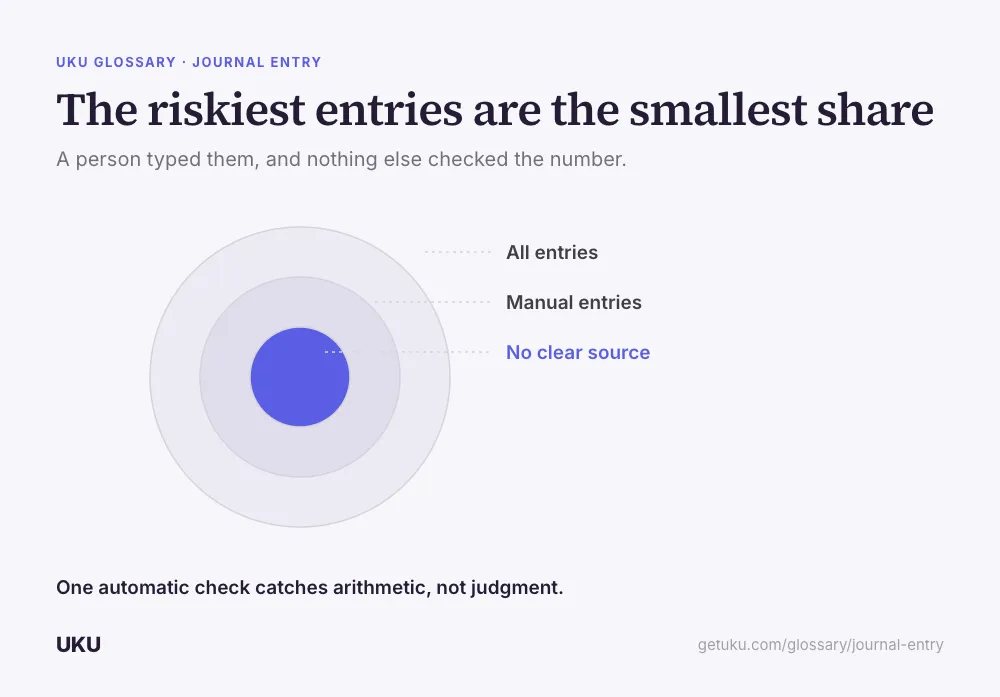
The entries worth paying attention to are the ones a person typed directly: accruals for expenses not yet billed, corrections to something coded wrong, depreciation, reclassifications, and adjusting entries at month-end close. That’s a small share of total entries and a large share of where errors — and disputes — actually originate.
Why manual entries deserve more scrutiny
A manual entry only has to satisfy one automatic check: debits equal credits. Everything else — which accounts, what amount, what period — was a judgment call by whoever made it, and nothing in the system stops a plausible-looking entry that is simply wrong. That’s why review processes weight manual entries so heavily, and why a firm with no consistent review step for manual entries is carrying more risk than its balanced trial balance suggests.
| Entry type | Who/what creates it | Review priority |
|---|---|---|
| Invoice, bill, payroll (system-generated) | Accounting software, automatically | Low — matches a source document by design |
| Accrual | Bookkeeper, at close | Medium — needs a documented basis |
| Correction / reclassification | Bookkeeper, ad hoc | High — needs a stated reason |
| Non-cash adjustment (depreciation, etc.) | Bookkeeper, at close | Medium — should follow a schedule |
| One-off manual entry with no clear source | Anyone with posting access | Highest — the entry auditors go looking for first |
The documentation habit that actually matters
An entry with a one-line description like “adjustment” is functionally unexplainable six months later, even to the person who made it. The habit that saves the most time downstream is attaching the reason at the moment of entry — the invoice the accrual is based on, the email that authorized a correction, the depreciation schedule an entry follows. That backup belongs in document management linked to the period it affects, not in a separate spreadsheet nobody remembers to check.
Building review into the close, not around it
Firms that catch entry errors before a client ever sees them don’t rely on someone happening to notice something odd in the general ledger. They build a second-reviewer step into the closing checklist as a recurring workflow task — someone who didn’t make the entries looks at the manual ones before the period is marked closed. That step is cheap when it’s scheduled and expensive when it’s skipped, because the alternative is finding the error during tax prep, or worse, after a client has already made a decision based on the wrong number.
Recurring entries: the automation firms actually miss
Some manual entries aren’t really one-off judgment calls at all — they’re the same entry, posted the same way, every single month. A monthly insurance accrual, a fixed depreciation charge, a prepaid expense being recognized on schedule. Treating those as fresh manual entries every period wastes time and invites the exact inconsistency review is supposed to catch, since a slightly different amount or account each month looks like a mistake until someone confirms it isn’t.
The fix is templating them once — same accounts, same logic, adjustable amount — so the recurring portion of manual entries stops competing for attention with the genuinely judgment-heavy ones, like a correction or a one-off reclassification that actually needs a second look before it posts.
What good entry discipline is actually worth
A firm that can show a clean, documented trail of manual entries has an easier time in three situations that all eventually come up: a client audit, a lender’s due-diligence request, and a staff transition where someone new has to pick up a file mid-year. Reporting that flags which client files still have open manual entries past the close date turns entry discipline from a hope into something a team lead can actually check — before it’s the thing a reviewer finds three months later.
How Uku handles journal entry
Last updated September 19, 2026 Reviewed by Rain Allikvee