





Glossary
Month-End Close
Month-end close (also called the monthly close or month end closing) is the recurring cycle a firm runs after each period ends: transactions are categorised, accounts are reconciled, adjustments are posted, and the period is locked so the resulting statements can be trusted. It repeats every month, for every client, on a schedule the firm controls.
What actually happens during a close
A month-end close is not one task — it is a short sequence that has to happen in order, because each step depends on the one before it finishing cleanly. Month end itself is simply the last day of the month (or of the client’s accounting period); the month end close is the work that follows it, finished on whatever schedule the firm sets. Unlike a year-end close, it repeats every month.
| Step | What it depends on | Where firms lose time |
|---|---|---|
| Transaction capture | Bank feeds, receipts, supplier invoices arriving | Feed not connected, receipts not forwarded |
| Categorisation | Capture being complete | Uncoded or duplicate transactions |
| Client queries | An unclear transaction | Client takes days to answer |
| Reconciliation | Queries resolved | Balances that will not tie out |
| Adjustments | Reconciliation being clean | Accruals discovered late |
| Lock & report | Everything above | Nobody has actually confirmed it’s done |
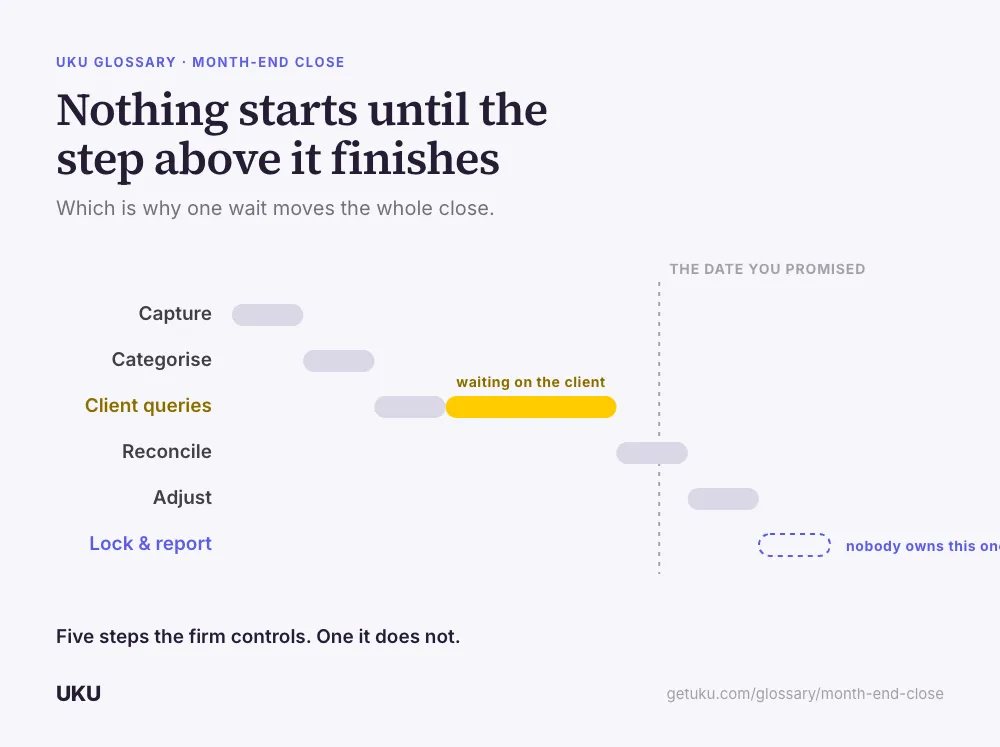
Firms that run a fast, predictable close almost always run the same six steps for every client, in the same order, rather than treating each close as a fresh piece of work. That consistency is what turns “close the books” into something a checklist can carry instead of a person’s memory.
Why the close slips
The step that breaks a close is rarely the accounting itself. It is whichever step depends on someone outside the firm. A query that sits unanswered for four days pushes the reconciliation four days, which pushes the lock four days, and the close that should have finished on the 5th finishes on the 12th — every month, for a slightly different reason, which is why it feels unpredictable even though the cause is the same shape every time.
The second most common cause is invisible work. A close across dozens of clients has no single deadline that raises an alarm on its own — each client’s close is a private, unwatched thing until someone asks for the statements. Firms that fix this generate the close as a recurring workflow per client with a due date and an owner, rather than trusting that someone remembers where each one stands. An unstarted close is visible on day two instead of discovered on day twenty.
Where the query bottleneck actually lives
The single highest-leverage fix most firms can make is moving client queries out of email. An email thread ages quietly — nobody is embarrassed by a three-day-old message sitting in an inbox. A client portal with an open, visible request list works differently: the unanswered question is sitting there every time the client logs in, and the firm can see exactly which client is the reason a close is stuck instead of guessing.
This connects directly to tax compliance work downstream — a close that finishes late pushes every filing built on top of it late as well, so the pressure a firm feels in filing season is often a symptom of closes that slipped months earlier.
Measuring whether the close is actually under control
The only honest measure of a close process is the spread between the fastest and slowest client, not the average. A firm can have a healthy average close time and still be one unanswered query away from a client whose books are never current, because the average hides exactly the clients most at risk.
Time tracking on close-related tasks gives a second signal: if the hours behind a close keep growing while the fee stays fixed, the close is not actually under control — it is being subsidised by whoever is doing the work.
What a checklist buys that a memory can’t
A close checklist looks like paperwork, but its real job is to make a stuck step visible to someone other than the person doing the work. Without one, a partner finds out a client’s close is stalled when the client calls asking where their statements are — by which point the delay has already become a client-facing problem. With a checklist tied to due dates, the same stall shows up as a red item on day three, while it is still an internal matter the firm can fix quietly.
This matters more as a firm grows, not less. A single bookkeeper juggling eight clients can hold the state of each close in their head. A team running close across eighty clients cannot, and the firms that struggle hardest with “the close always seems to slip somewhere” are usually the ones that scaled the client list without ever moving the process out of someone’s memory and into something the whole team can see.
Building a close that repeats on schedule
The firms with a genuinely predictable close treat it as a template, not a fresh decision every month: the same steps, the same order, the same owner per client, with the client-facing query step made visible instead of buried in an inbox. None of that changes the accounting. It changes whether the close finishes on the 5th or the 15th, which is usually the difference clients actually notice.
How Uku handles month-end close
Last updated October 8, 2026 Reviewed by Rain Allikvee