






Glossary
Outsourced CFO Services
Outsourced CFO services (also called contract CFO services or CFO outsourcing) are a contract arrangement where a business hands the finance-leadership function to an external provider — a firm or agency — instead of hiring a CFO as an employee. The provider, not a single named individual, is accountable for the deliverable, which means the work behind the retainer can be staffed by a team rather than one person's calendar.
What “outsourced” is describing here
The word answers a specific question: who is accountable for the work. In an outsourced arrangement, the client’s contract is with a provider — a firm or agency — not with an employee. That distinction sounds procedural, but it changes how the engagement actually runs day to day.
| Question | In-house CFO | Outsourced CFO services |
|---|---|---|
| Who is the client’s counterparty? | An employee | A firm or agency |
| Who is accountable for quality? | The individual’s manager | The provider’s engagement lead |
| Can the specific person change without renegotiation? | No — that’s a resignation | Often yes, within the contract |
| Who covers absence or turnover? | The business has to plan for it | The provider’s problem to solve |
| What’s the exit mechanism? | Termination, notice period | Contract notice period |
That last row is the one clients underweight when comparing the options. Ending an outsourced arrangement is a contract event; ending an employment relationship carries obligations and disruption an outsourced contract does not.
Who actually does the work
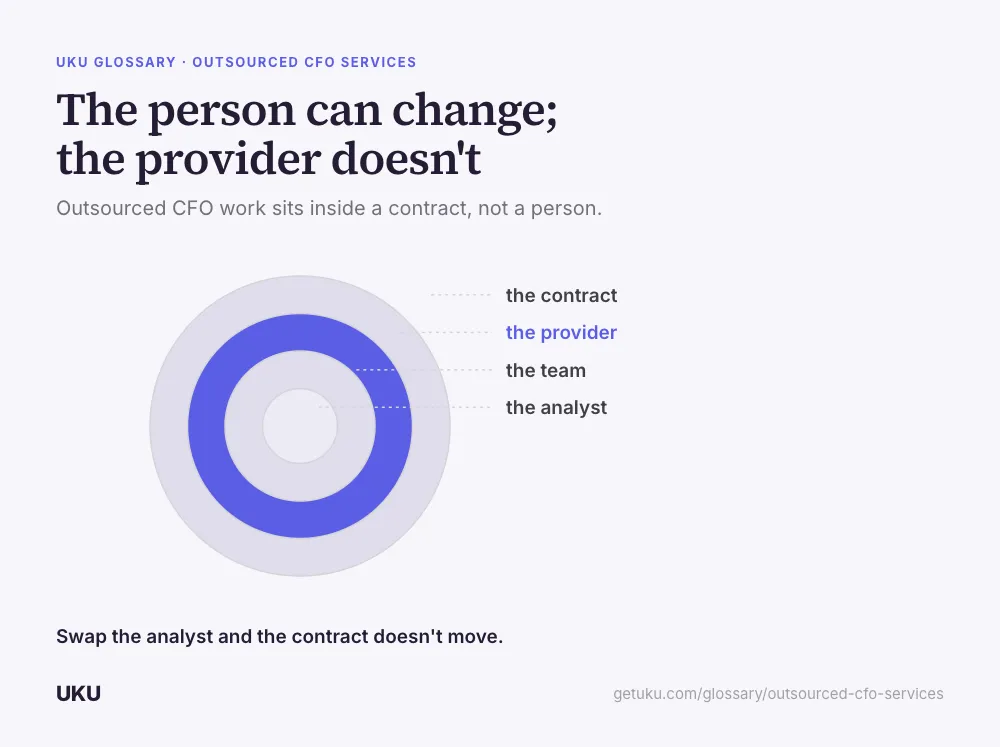
Because the client’s relationship is with the provider rather than a named individual, the staffing behind an outsourced CFO retainer varies by firm size. A small shop may put one senior person on the account who handles everything the contract covers — this is where the term overlaps heavily with a fractional CFO, since a firm frequently fulfills an outsourced contract by allocating one person’s fractional time to it. A larger provider may split the work: a partner owns the client relationship and the strategic conversation, while analysts build the models and prepare the numbers that feed it.
That split is invisible to the client and is exactly the point — the client bought a function, not a person’s calendar, and the firm is free to staff it however keeps the deliverable consistent.
What the retainer actually covers
Outsourced CFO services sit on top of clean numbers; they do not produce them. The provider assumes the books are current and interprets what they show:
- Cash flow forecasting and runway modeling
- Budget creation and budget-vs-actual review
- KPI reporting the owner checks between meetings
- Scenario planning — hiring, pricing, expansion decisions
- Board or investor-facing reporting, where relevant
Firms that also handle the client’s outsourced bookkeeping or client accounting services have an advantage here: they already own the numbers, so the CFO conversation starts from a verified position instead of a handoff between two providers who have to reconcile whose numbers are correct.
How the contract is structured
Most outsourced CFO agreements run as a monthly retainer with a named scope — a defined set of deliverables and a meeting cadence — rather than open-ended hourly work. What tends to be written explicitly, because there is no employment relationship to fall back on if it isn’t, is what happens if the assigned person leaves the firm or the account, what counts as included work versus a billable addition, and how either side exits the arrangement.
The numbers behind the retainer need to be visible to the client between meetings, not just delivered in a call. Firms running this well pull the underlying reports from a reporting layer with live client profitability, and surface the client-facing view in a client portal rather than an email attachment.
Where these engagements go wrong
The client never knows who’s actually doing the work. If the assigned analyst changes mid-quarter without notice, the client notices the quality shift before they notice the reason. Naming the team, not just the retainer, protects the relationship.
Scope creep has no natural brake. Because there’s no employee pushing back on an unreasonable ask the way a direct report might, an outsourced retainer can absorb extra requests silently until the fee no longer covers the actual hours. The defense, as with any advisory retainer, is a written scope and a habit of quoting anything past it.
The underlying books are assumed clean and aren’t. A forecast is only as good as the bookkeeping feeding it. Providers that offer outsourced CFO services without controlling the bookkeeping layer are exposed to a data quality problem they did not create and cannot fully verify.
How Uku handles outsourced cfo services
Last updated October 8, 2026 Reviewed by Rain Allikvee