





Glossary
Payroll
Payroll is the recurring process of calculating what each employee is owed for a period, withholding what the law requires, paying the net amount, and filing the related reports with the relevant authorities. The specific rates, thresholds, and deadlines are jurisdiction-specific and change often, which is why payroll is usually run from a template or a specialist system rather than recalculated from first principles each cycle.
What the process covers
Payroll is the recurring cycle of turning hours or a salary agreement into a paid, compliant outcome for each employee, every period, without fail. The shape of the process is consistent regardless of jurisdiction:
- Calculate gross pay for the period, from a salary or from hours worked.
- Apply the withholdings the jurisdiction requires.
- Pay the net amount to the employee.
- File the related reports with the relevant tax and social authorities.
What fills in steps two and four — the actual rates, thresholds, and filing deadlines — is jurisdiction-specific and changes on its own schedule. This page describes the shape of the process; it is not tax or legal guidance, and the numbers that apply to a specific employer should come from a current, jurisdiction-specific source, not from a general description like this one.
| Step | What it produces | Where it usually comes from |
|---|---|---|
| Calculate gross pay | A per-employee amount for the period | Salary agreement or logged hours |
| Apply withholdings | Net pay, plus amounts owed to authorities | Current jurisdiction-specific rules |
| Pay net amount | Funds to the employee, on the agreed date | Payroll run, bank transfer |
| File reports | Compliance record for the period | Filed with the relevant tax/social authority |
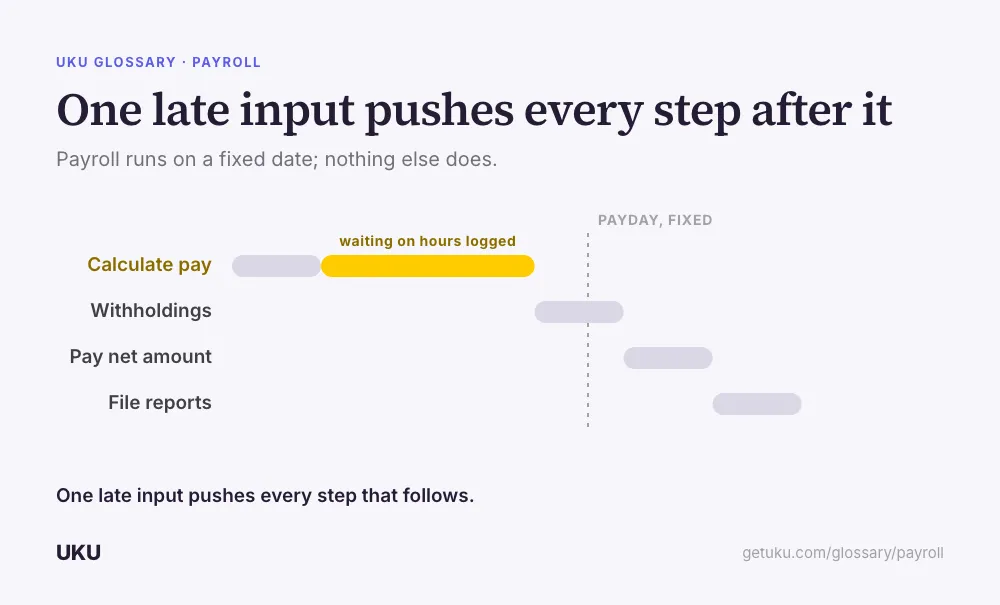
Each row depends on the one above it being correct. A miscalculated gross figure doesn’t just misstate one employee’s pay — it carries through withholding and filing, so the error has to be found before the run closes, not after.
Why it behaves differently from other recurring accounting work
Most accounting work has some slack in it — a reconciliation that runs a day late is inconvenient, not a compliance event. Payroll doesn’t have that slack. Employees expect to be paid on a fixed date, and filings tied to that pay date usually carry a penalty if they’re late, regardless of the reason. That combination — a hard external deadline plus a direct financial consequence for missing it — is what makes payroll get treated as its own discipline rather than a category of bookkeeping.
It is also why classification errors (treating someone as a contractor who should be an employee, for instance) are taken seriously: the rules that depend on classification tend to compound, so a mistake made once often recurs every period until it’s caught.
What has to be true for the cycle to run cleanly
A single source for hours worked. For hourly and salaried staff whose pay depends on time logged, payroll needs an unambiguous number for the period — not a spreadsheet reconstructed after the fact. Time tracking run through the same system as the rest of a firm’s work removes the step of chasing down hours separately for payroll.
A cycle that runs the same way every time. Payroll benefits more than almost any other recurring task from being a fixed sequence rather than something rebuilt from memory each period. Firms that turn it into a recurring workflow reduce the chance that a step — a filing, a withholding update — gets skipped under deadline pressure.
Records that survive a later question. Payslips, filed reports, and the calculations behind them need to be retrievable well after the period closes, both for the employer’s own records and because tax authorities can ask about a prior period years later. This is the same discipline as document management applied to a category of file with an unusually long retention requirement.
Where to go for the specifics
Because the rates and deadlines are jurisdiction-specific and change on their own schedule, this glossary entry stops at the shape of the process rather than the numbers. For period-specific guidance, see the payroll processing templates and best payroll practices — and for anything involving a specific withholding rate, deadline, or classification decision, confirm it against current guidance from the relevant tax authority rather than a general reference.
How it connects to the rest of the practice
Payroll is often the first recurring, deadline-bound process a firm automates end to end, because the cost of missing it is so much clearer than the cost of a bookkeeping delay. The same cycle discipline — a fixed sequence, a single source of truth for the inputs, records that survive scrutiny — is what firms then apply to expense management and the rest of the recurring close, once payroll has proven the pattern works.
Where the cycle actually slips
The failure pattern with payroll is rarely a wrong calculation — most systems that run the math get the math right. It’s the inputs feeding the calculation arriving late or inconsistent: a new hire whose contract terms weren’t finalized before the run, a rate change that wasn’t communicated to whoever prepares the payroll, or hours that were logged in one place for billing and a different, unreconciled place for pay. None of those are payroll problems in the narrow sense — they’re upstream process gaps that only become visible when payroll, on its fixed deadline, can’t wait for them to be resolved.
Why it’s often the first process a firm won’t let slip
Ask an owner which recurring task they’d never let run a day late, and payroll is usually the answer before bookkeeping or billing — employees notice immediately, and the authorities involved don’t offer the same informal grace a client relationship might. That asymmetry is why payroll tends to be the proving ground for whatever recurring-workflow discipline a firm eventually applies everywhere else: if a checklist and a fixed cycle can be trusted with payroll, they can be trusted with the rest of the close.
How Uku handles payroll
Last updated September 19, 2026 Reviewed by Rain Allikvee