





Glossary
Staff Onboarding
Staff onboarding is the structured process of bringing a new hire from a signed offer to full, independent productivity — access provisioning, client and system training, and a defined ramp of increasing responsibility. At an accounting firm it is not finished on day one; it typically runs through the first 90 days, since client-specific knowledge and software fluency both take longer than general orientation to build. A firm without a defined process gets the same outcome eventually, but at a slower and less predictable pace, and with more depending on which manager happened to do the training.
Why onboarding does not end in week one
Most staff onboarding checklists are really access checklists: set up the laptop, create the login, walk through the software. That work matters, but it is finished in days, and it answers a narrower question than firms usually assume. Knowing how to use the practice management system is not the same as knowing that a particular client always pays late, or that another one needs a phone call instead of an email, or which colleague to ask when a filing looks unusual.
That second kind of knowledge — client-specific, built from experience — is what actually determines when a new hire reaches full productivity, and it does not arrive with the login credentials. It is the reason well-run onboarding at an accounting firm is measured in months, not days.
The first 30, 60, and 90 days
The shape of a working onboarding process is close to the same across most firms, even when the exact steps differ:
| Phase | Focus | What “done” looks like |
|---|---|---|
| First 30 days | Access, systems, shadowing | Independently navigates the software; understands the firm’s recurring workflow |
| Days 30–60 | Supervised client work | Handles assigned clients with review, not from scratch each time |
| Days 60–90 | Increasing independence | Owns a small client set with normal, not extra, oversight |
| Beyond 90 days | Full integration | Contributes to peer review, is a resource for the next new hire |
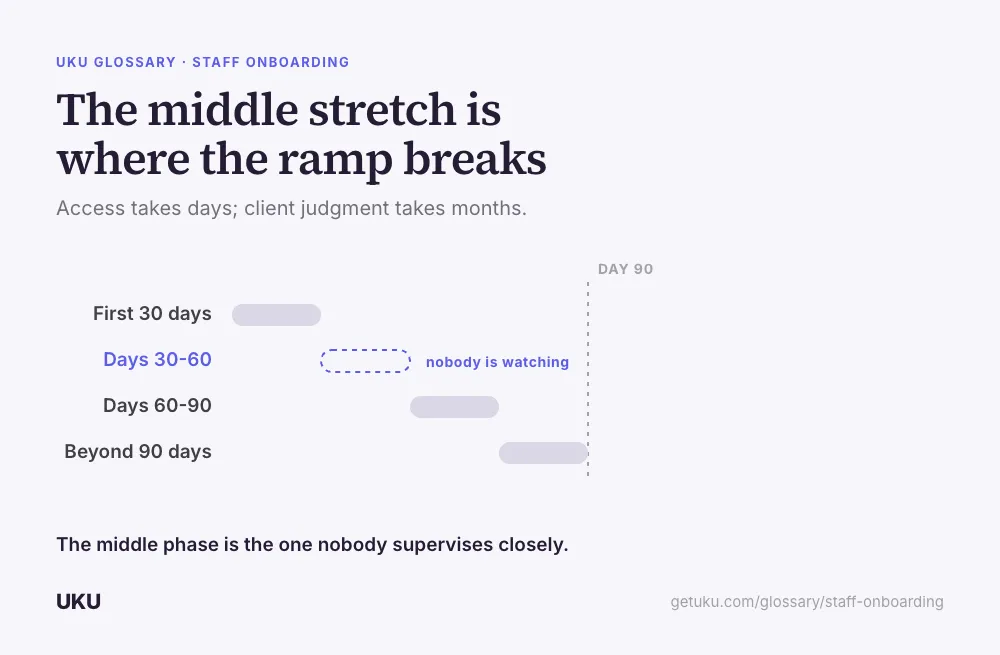
The middle phase is where most onboarding processes are weakest, because it requires someone to actually watch the work and give feedback rather than assuming access plus time equals competence.
What breaks without a defined process
An accounting firm without a structured onboarding process does not usually fail to onboard people at all — it produces wildly inconsistent results depending on who happened to train the new hire. One manager walks a new hire through every client personally; another hands over a login and a task list and assumes the rest will follow. Both new hires eventually reach productivity, but at very different speeds, and the gap shows up as inconsistent client service in the months between.
The other common failure is treating a new hire as full capacity from day one. Capacity planning that counts a first-week hire the same as an experienced staff member overstates what the team can deliver during exactly the period when the firm most needs an accurate number — right after a hire is made specifically because the team was already stretched.
Client-specific knowledge is the part that does not transfer easily
The hardest part of staff onboarding to systematize is also the part that matters most: what a specific client expects, prefers, and has already been told. That knowledge usually lives in one person’s head, in scattered email threads, or in notes attached to a client record that only the previous owner ever read closely. A new hire who inherits a client without that context re-learns, by trial and error, things the firm already knew.
Firms reduce this by keeping client history — notes, past issues, preferences, and documents — centralized in one place through client management rather than scattered across individual inboxes, so a new hire inherits the context along with the account instead of starting from nothing.
Onboarding and client onboarding are not the same process
It is easy to conflate staff onboarding with client onboarding because both use the word, but they run on different tracks. Staff onboarding brings a new employee up to speed on the firm; client onboarding brings a new client into the firm’s systems. The two intersect when a new hire’s first assignment is a client who is also newly onboarded — in which case neither side has established history yet, and the ramp for both should be treated as slower than normal, not layered on top of each other as if either were routine.
Making the ramp visible
The most useful thing a firm can do for staff onboarding is not writing a longer checklist — it is tracking time and progress during the ramp so a manager can see, concretely, whether a new hire at day 45 is where day-45 hires usually are, rather than guessing from general impressions. A ramp that is visible can be adjusted. One that is assumed usually is not corrected until it has already cost a client’s confidence.
How Uku handles staff onboarding
Last updated September 19, 2026 Reviewed by Rain Allikvee