





Glossary
Tax Compliance
Tax compliance is the ongoing work of preparing and filing what a jurisdiction requires on schedule — returns, statements, and supporting documentation — based on records a firm has already closed. It is a recurring, deadline-driven workload rather than a single event, and its risk comes from volume and timing as much as from technical difficulty.
What compliance actually is, operationally
Tax compliance is not one task — it is a queue. Every client has a set of filings due on a set of dates, and the firm’s job is to prepare each one from records that are already closed and get it filed before the date arrives. None of that is conceptually hard. What makes it hard is running the same process correctly, on time, across every client on the list, without any one of them slipping through because nobody was watching it.
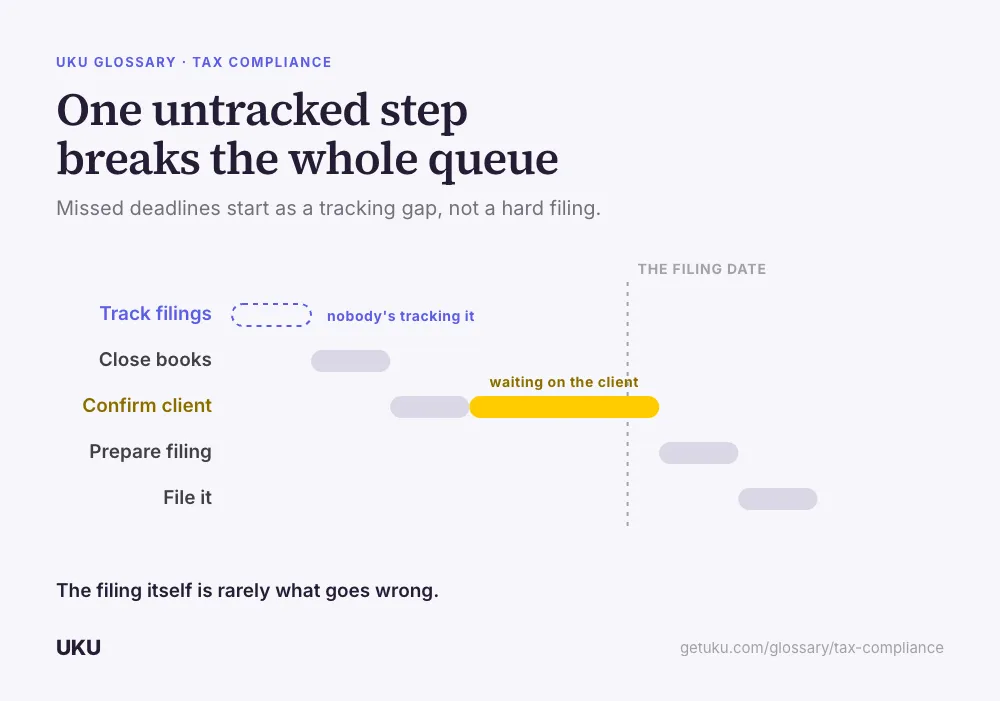
That distinction matters because it changes what actually breaks a compliance season. It is almost never that a preparer didn’t know what to file. It is that a filing wasn’t on anyone’s list, or a client’s records weren’t ready when the deadline arrived.
Where the risk actually is
| Risk | What causes it | What catches it |
|---|---|---|
| Missed deadline | No single tracked list of obligations per client | A recurring workflow per filing |
| Late-arriving records | Books not closed in time to file from | A tight month-end close upstream |
| Wrong preparer overload | Deadlines cluster by entity type or jurisdiction | Staffing planned around the calendar, not reacted to |
| Client can’t confirm a detail | No visible way to ask and get an answer | A client portal request queue |
The table’s first row is doing most of the work. A firm that can answer “what is due, for which client, by when” at any point in the year has already solved most of its compliance risk. A firm that reconstructs that answer manually every filing season is one busy week away from a missed date.
Why compliance work depends on the close, not the other way around
Filings are built from finished financial records, which means compliance work inherits every delay upstream of it. A month-end close or year-end close that runs late doesn’t just delay a set of statements — it delays every filing built on top of those statements, often into a window where the firm now has less time than it needs. Firms that treat their close and their compliance calendar as connected, rather than as two separate teams’ problems, are the ones whose filing season is actually predictable.
This piece deliberately stays out of what is owed, when, or under which rules — those vary by jurisdiction and change, and stating a figure or a date here would be wrong somewhere the moment it was written. What stays constant across jurisdictions is the operational shape: a recurring obligation, a fixed date, and a records dependency upstream of it.
Why one missed filing costs more than the fine
The immediate consequence of a missed deadline is usually a penalty or interest charge, but the bigger cost at most firms is the trust it burns with the client. A client who finds out their filing was late because nobody caught it internally starts wondering what else isn’t being watched, and that question is expensive in ways a late fee isn’t — it’s the reason a client starts shopping for another firm. Compliance failures are rarely about technical competence in the client’s eyes; they read as a firm that wasn’t paying attention.
This is also why compliance tends to be the wrong place for a firm to compete on price alone. A cheap compliance service that misses deadlines is more expensive to the client than a slightly pricier one that doesn’t, once the penalty, the stress, and the trust cost are counted together. Firms that price compliance on reliability — a visible, tracked process — rather than the cheapest available hourly rate are selling the thing clients actually value about the service.
Turning compliance from reactive to scheduled
The firms with the calmest filing seasons run compliance the same way they run any other recurring service: every obligation is a recurring workflow with an owner and a due date, the whole list is visible months ahead rather than reconstructed under pressure, and staffing decisions get made against the known calendar instead of against whichever deadline is loudest this week. None of that changes what is owed. It changes whether the firm finds out about a filing gap in January or discovers it on the deadline itself.
How Uku handles tax compliance
Last updated September 19, 2026 Reviewed by Rain Allikvee