




Glossary
Tax Planning
Tax planning is the forward-looking work of structuring a client's decisions ahead of time — timing, entity structure, transaction shape — so a future filing turns out better than it would by default. Unlike compliance, it is optional, advisory, and only as good as the financial picture it is based on.
Two different jobs, often confused
Tax compliance and tax planning get talked about together so often that firms sometimes price and staff them as one thing, but they run on different clocks and require different skills.
| Tax compliance | Tax planning | |
|---|---|---|
| Direction | Backward-looking | Forward-looking |
| Obligation | Mandatory, fixed date | Optional, client-initiated |
| Output | A filed return or statement | A decision or structure change |
| Pricing shape | Recurring fee, predictable | Engagement or retainer, variable |
| What it depends on | Closed books | Current, accurate books |
The last row is where most of the operational risk lives. Compliance can be done from records that are a bit behind, as long as they’re right by the filing date. Planning can’t — a recommendation built on a two-month-old picture of a client’s position may already be wrong by the time it’s acted on, because the underlying numbers have moved.
Why planning is harder to systemise than compliance
Compliance repeats: the same filing, the same client, the same shape, every period. That repetition is exactly what makes it possible to run as a recurring workflow with a template and a due date. Planning doesn’t repeat the same way — every client’s situation is a little different, and the value is in judgment applied to that specific situation, not in executing a known checklist.
That doesn’t mean planning can’t be made efficient. It means the efficiency comes from a different place: having the client’s numbers already current and visible, so the advisory conversation starts from a real picture instead of a data-gathering exercise. Firms that can pull up a client’s actual position in reporting or BI Analytics during the conversation are having a different quality of conversation than firms that have to go collect the numbers first.
What planning is built on
Good tax planning is downstream of everything else a firm already does well. A client whose books close on schedule and whose records are current gives a firm an accurate picture to plan against; a client whose month-end close is chronically behind gives a firm a picture that’s already stale by the time anyone looks at it. This is one of the reasons planning tends to arrive as an upsell to clients whose bookkeeping a firm already runs — the firm already has the current numbers, rather than having to request them specially for a planning conversation.
Keeping it turn-neutral
This entry deliberately does not name any rate, threshold, deduction, or jurisdiction-specific rule, because those vary by country and change on their own schedule — a number written here today would be stale or simply wrong somewhere the moment a reader from a different jurisdiction opened the page. What’s constant is the shape of the service: forward-looking, optional, dependent on records the firm keeps current, and priced differently from the recurring compliance work it usually sits alongside.
When to introduce it to a client
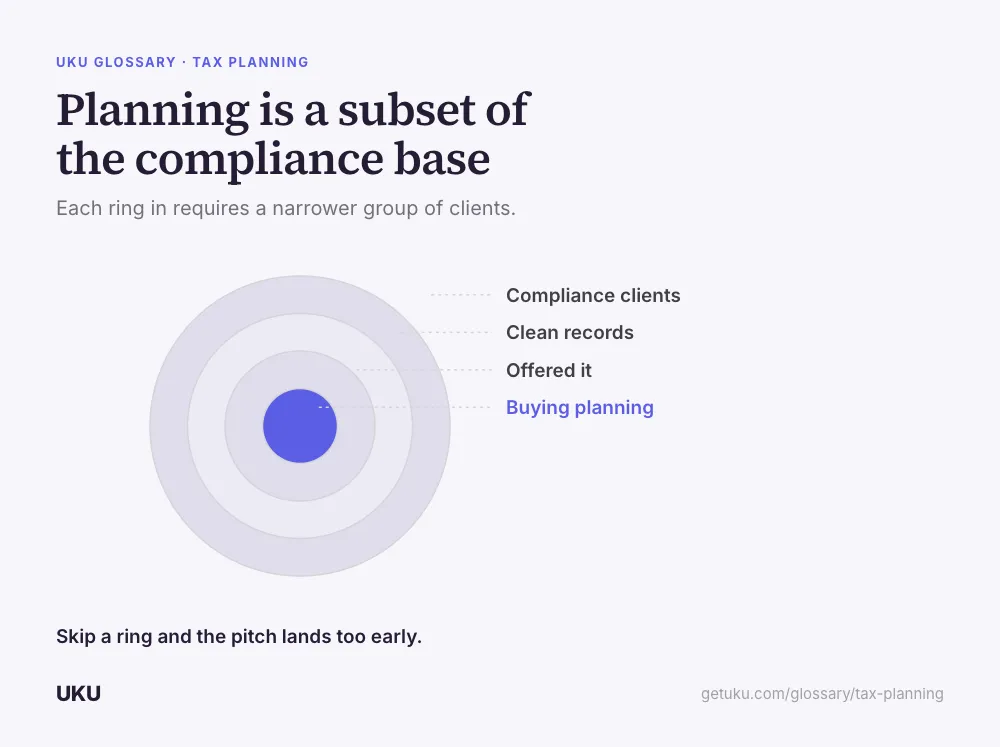
Firms often hesitate to offer planning because it feels like a bigger ask than the compliance relationship the client already trusts. In practice, the easiest moment to introduce it is right after a compliance engagement has run cleanly for a period — the client already trusts the firm with their numbers, the firm already has current records to plan from, and the conversation is a natural next step rather than a cold pitch. Firms that wait for a client to ask for planning outright tend to under-offer it; firms that raise it once the compliance relationship is solid tend to find clients receptive, because the alternative — going to find a separate advisor with none of the firm’s context — is more work for the client, not less.
Where the two connect back together
Planning decisions eventually become compliance obligations — a structure change made in a planning conversation shows up as a filing requirement later. Firms that keep planning and compliance visible to the same team, rather than run by entirely separate people who don’t talk, are the ones where a planning decision doesn’t get lost before it reaches the return it was supposed to affect.
How Uku handles tax planning
Last updated September 19, 2026 Reviewed by Rain Allikvee