





Glossary
Time Tracking
Time tracking is the recording of how long staff spend on each piece of client work, entered as it happens or shortly after, and tied to a specific client and task rather than logged in a general block. At an accounting firm it exists whether or not the firm bills by the hour, because it is the only reliable source for what a piece of work actually costs to deliver. Without it, pricing, staffing, and profitability are all estimates dressed up as facts.
What time tracking actually records
Time tracking is the log of how long specific work took, attached to the client and task it was spent on rather than to a general day. That attachment is what separates it from a diary of hours worked. A firm that knows staff worked forty hours this week but not which clients those hours went to has attendance data, not time tracking.
The record is only useful if it is close to when the work happened. Reconstructing a week from memory on Friday afternoon reliably loses the short interruptions — the ten-minute phone call, the quick email reply — which is exactly the work that adds up across a portfolio of clients and never shows up on an invoice.
Why it matters even without hourly billing
The obvious reason to track time is to bill by the hour. The less obvious reason, and the one that matters more to firms that have already moved to recurring workflows and fixed monthly fees, is that a fixed fee hides its own unprofitability. Two clients on the same $400 monthly plan can look identical on the invoice while one takes two hours and the other takes twelve. Only tracked time surfaces that gap.
This is the reason firms that sell fixed-fee work still track time internally: not to change how the client is billed, but to find out which fixed fees were priced wrong before renewal comes around.
How it feeds the rest of the practice
Tracked time is a single input that several other decisions depend on. Capacity planning needs it to know how many hours are actually available once real workload is accounted for, not just scheduled hours. Billing needs it where contracts are hourly or where overages against a fixed scope have to be identified. And firm-level reporting on realization and utilization — the split between how busy a team is and how much of that time converts into revenue — has no other source than logged hours; there is no way to infer it from a task list.
| Where tracked time goes | What it answers |
|---|---|
| Invoicing | What to bill, on contracts priced by the hour |
| Capacity planning | How many hours are actually available this period |
| Client profitability | Which clients cost more to serve than they pay |
| Staff performance conversations | Where a person’s time is actually going |
| Pricing new work | What similar engagements have historically taken |
What makes people stop logging time
Time tracking fails for a predictable reason: the entry method costs more attention than the task it is recording. A bookkeeper who has to switch screens, find the right client, and fill in a form to log a three-minute email will eventually stop logging the email, and the gap in the data is not random — it is concentrated on exactly the small, frequent tasks that add up fastest across a client list.
Firms that keep time data reliable usually reduce the entry to one of a small number of low-friction habits: a stopwatch started from inside the task itself, bulk entry against several tasks at the end of a block of work, or automatic entry where a forecasted duration becomes the logged time for predictable work. The method matters less than making it close to zero effort at the moment the work happens.
Billable and non-billable in the same record
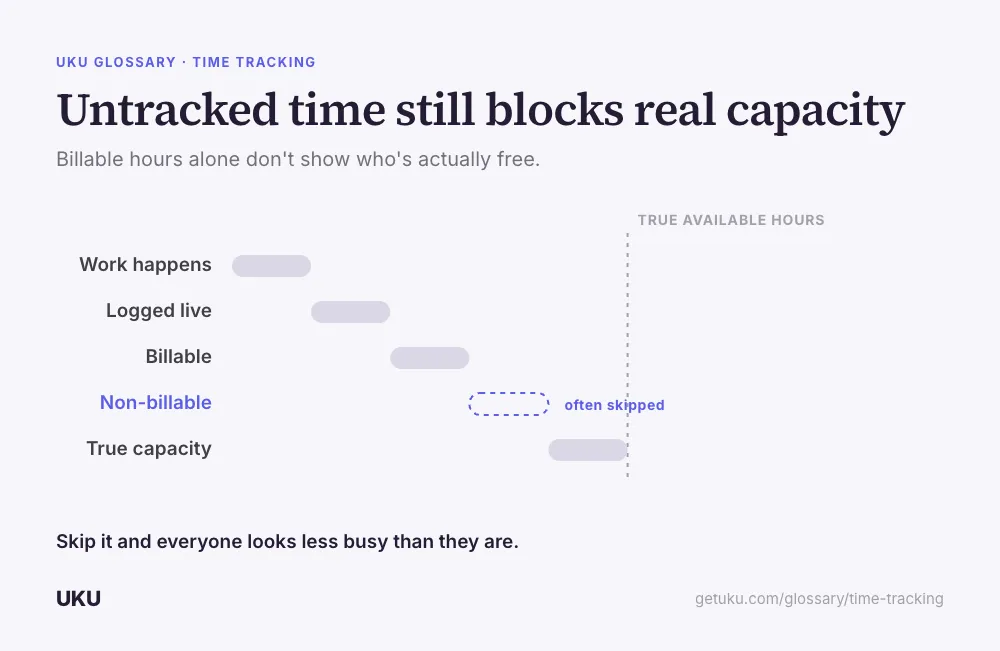
Time tracking is only half the picture if it only records client-billable work. A firm that ignores internal meetings, training, and administrative time in its tracking ends up with a distorted view of capacity — someone who is fully booked with non-billable obligations looks, in the data, like someone with free hours. Distinguishing billable from non-billable hours inside the same tracking habit, rather than tracking one and guessing at the other, is what makes the resulting reports trustworthy.
Reading the data instead of just collecting it
Logged time that nobody reviews is a compliance exercise, not a management tool. The value shows up once someone regularly looks at the aggregate — which clients consume more time than their fee justifies, which types of work are consistently underestimated, which team members are close to their limit — and adjusts pricing, staffing, or scope in response. Firms that track productivity against this data, rather than filing it away after invoicing, are the ones that turn a routine habit into a pricing and staffing advantage.
How Uku handles time tracking
Last updated September 19, 2026 Reviewed by Rain Allikvee