




Glossary
Virtual Bookkeeping Firm
A virtual bookkeeping firm is a practice that delivers only the recurring bookkeeping cycle — transaction coding, reconciliation, monthly close — to clients remotely, without a shared office and usually without the tax or advisory services a full-scope firm also sells. It is a narrower business than a virtual accounting firm: fewer service lines, higher client volume per staff member, and pricing built around a repeatable, standardized cycle.
A narrower business than “virtual accounting firm”
“Virtual” describes the same thing in both labels — no shared office, a client relationship that runs entirely through software rather than in person. What changes is the word in front of it. A virtual accounting firm is a general term for a remote-delivered practice that can include bookkeeping, tax and advisory. A virtual bookkeeping firm is a specific, narrower business: it sells the recurring bookkeeping cycle and usually only that.
| Virtual accounting firm | Virtual bookkeeping firm | |
|---|---|---|
| Typical service lines | Bookkeeping, tax, advisory | Bookkeeping only |
| Client relationship | Often long-term, multi-service | Often volume-driven, single-service |
| What grows revenue | Selling more service tiers per client | Adding more clients on the same cycle |
| Staffing model | Mix of seniority levels | Skews toward standardized, junior-friendly roles |
| Where margin comes from | Advisory and tax, at higher rates | Throughput per bookkeeper |
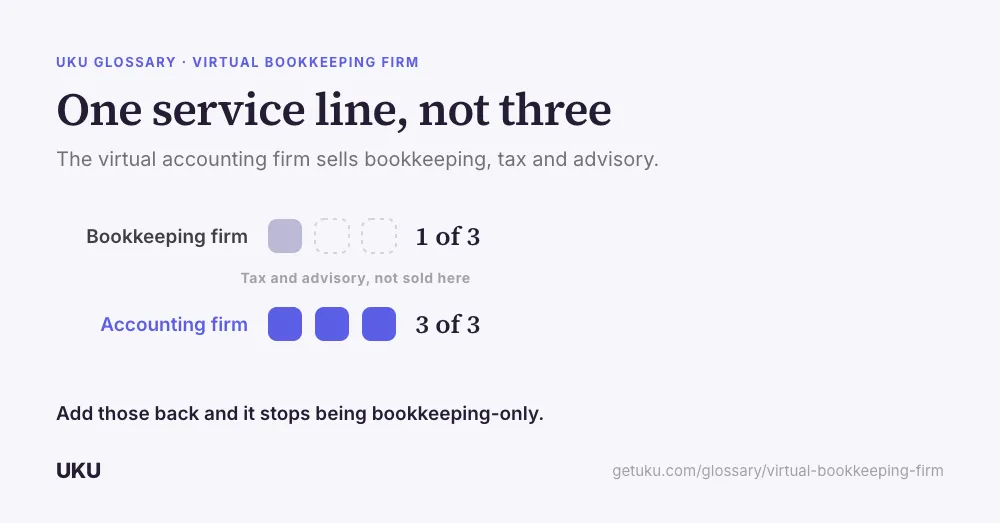
Neither structure is better in the abstract — they’re different businesses built around different growth levers. A virtual bookkeeping firm that tries to grow by adding tax and advisory is, at that point, becoming a virtual accounting firm; the label changes with the scope.
Why the narrow scope is a deliberate choice
Bookkeeping is the most repeatable service in the profession: the same steps run every month, in the same order, for every client. That repeatability is what makes it possible to run at real volume with a leaner, more junior-heavy team than tax season or advisory work would allow. A firm that commits to staying bookkeeping-only can build its entire operation — hiring, training, workflow, pricing — around one repeatable process instead of managing several service lines with very different rhythms at once.
That focus is also the business’s growth ceiling. Revenue per client is capped by what the bookkeeping fee can bear; the only lever left is adding more clients on the same standardized cycle, which is why throughput per bookkeeper is the number that actually determines whether the firm is profitable.
What staying virtual actually requires
Removing the office does not remove the coordination the office used to do informally. A virtual bookkeeping firm running client volume without a shared room needs an explicit replacement for everything a physical desk used to handle by default — a client portal for document upload instead of a folder handed across a desk, a tracked cycle per client instead of a shared whiteboard, and billing that fires from the contract instead of from someone remembering to invoice. Skip that layer and the firm ends up running volume bookkeeping through email threads and personal habit, which caps growth long before staffing does.
Where the model breaks
Throughput is assumed instead of measured. A firm scaling client count without knowing actual hours per client is guessing at its own margin. The fixed monthly fee looks identical on every invoice regardless of how messy a given client’s inputs are, which is exactly why the gap only shows up once someone measures it.
Standardization slips one exception at a time. A process that stays identical across clients is what makes bookkeeping-only volume work. Every “just this once” customization — a different reconciliation cadence, a special report format — erodes the throughput advantage the narrow scope was built to protect.
No natural upsell path is built in. A firm that stays strictly bookkeeping-only, with no route into outsourced bookkeeping’s natural next tier of client accounting services or advisory work, leaves growth entirely to new-client acquisition instead of deepening existing relationships — a choice some firms make deliberately and others make by default, without noticing the revenue left on the table.
Where it fits in the broader landscape
A virtual bookkeeping firm is usually either a starting point — a practice that will expand its service lines as it matures — or a permanent, deliberate specialization built around volume and process discipline. Both are legitimate businesses; the risk is drifting between the two without deciding, which produces a firm that has neither bookkeeping’s throughput advantage nor a full-service firm’s higher-margin work.
How Uku handles virtual bookkeeping firm
Last updated September 19, 2026 Reviewed by Rain Allikvee