





Glossary
Year-End Close
Year-end close is the final period close of a fiscal year: the same reconciliation and adjustment work as a month-end close, plus the entries that only happen once a year — depreciation, inventory counts, final accruals, and the reversal of temporary entries — so the books are ready to become tax filings and, where required, audited statements.
Same cycle, higher stakes
A year-end close runs the same six-step shape as a monthly close — capture, categorise, query, reconcile, adjust, lock — but nothing about it is routine. Every account gets reconciled against its opening balance for the coming year, not just against last month, and the entries only made once a year — depreciation, inventory adjustments, accrual reversals — all land in the same window.
| Step | Monthly close | Year-end close |
|---|---|---|
| Reconciliation | Against last month | Against the full year and next year’s opening balances |
| Adjustments | Routine accruals | Depreciation, inventory, one-off corrections |
| Client input | An answer to a query | A fixed-asset list, inventory count, sign-off |
| Deadline pressure | Internal cadence | Statutory filing behind it |
| What’s exposed | One month of drift | Twelve months of uncorrected drift |
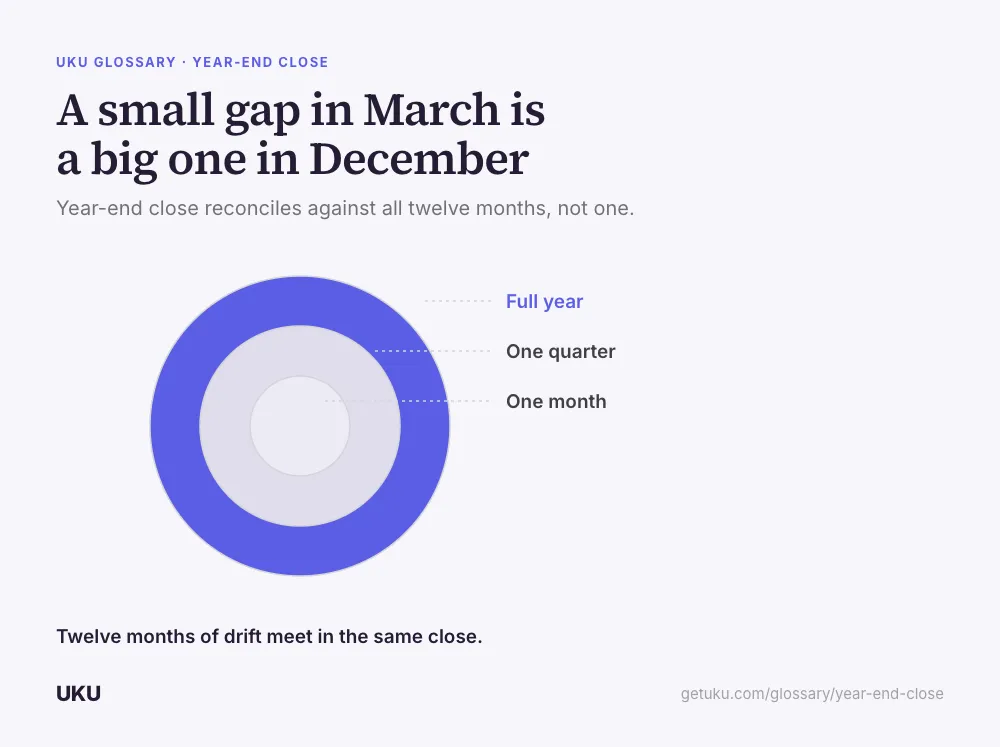
That last row is the real difference. A small reconciling item that gets carried forward unresolved in March is invisible in April. By December it has compounded across nine more months, and the year-end close is where it finally has to be found and explained.
Why it concentrates risk
Most clients on a comparable fiscal calendar close around the same window, which means a firm’s busiest and highest-stakes period lands all at once rather than spreading across the year. Firms that treat each year-end as an individual project discover this the hard way every December; firms that plan team capacity months ahead see the volume coming and staff for it before the work arrives, not after it is already late.
The other concentration is dependency. A year-end close needs client input a monthly close doesn’t — an asset list, an inventory count, confirmation of anything unusual in the year. A client portal with a tracked request list turns “we’re still waiting on the client” from a vague excuse into a specific, visible item with a name attached, which is the difference between a close that’s a week late and one that’s a month late.
What breaks first
The most common failure isn’t the accounting — it’s sequencing. A firm that starts every year-end close the same way, in the same order, for every client catches the ones that are going to run late early, while there is still time to react. A firm that starts wherever the loudest client is asking finds out a quiet client’s close is three months behind only when the filing deadline is already close.
This is also where a month-end close habit pays off directly: a firm that reconciles cleanly every month arrives at year-end with twelve already-clean periods to roll up, not twelve months of deferred problems. The firms that dread year-end are almost always the ones whose monthly close was never actually tight.
The part that catches firms by surprise
Even firms that run a tight monthly close can be surprised by year-end, because a few of its entries genuinely only happen once a year and are easy to under-prepare for. Depreciation schedules need to be current, not reconstructed in December. Inventory counts need to be scheduled with the client well ahead of the close, not requested the week statements are due. A firm that treats these as routine line items rather than special cases tends to ask for them early enough that they arrive on time; a firm that only thinks about them once the close is already underway is the one chasing a client for an inventory count with the filing deadline a week away.
The pattern is the same one that breaks monthly closes — a step that depends on the client, discovered too late to matter — just concentrated into a period where there’s less slack to absorb it.
Getting from close to filing without losing the month
Year-end close and tax filing are two different pieces of work with one handoff between them — the close produces the statements the filing is built from, and it needs to finish with enough runway that filing isn’t rushed on top of it. A firm’s year-end schedule should put a real date on “books closed” that sits weeks, not days, before the filing deadline, and recurring workflows built for this once and reused every year are what make that runway possible instead of aspirational.
How Uku handles year-end close
Last updated September 19, 2026 Reviewed by Rain Allikvee