

Choosing between Jetpack Workflow and Karbon for your accounting practice management often comes down to these fundamental questions:
- Do you need a streamlined workflow tool or a comprehensive practice management suite?
- Is your priority getting organized quickly or building a sophisticated, AI-powered practice?
- Are you willing to invest significant time and money for advanced features you might not use?
- Do you want to manage primarily internal workflows, or do you need robust client collaboration tools?
- Would you rather have focused simplicity or all-in-one complexity?
In short, here’s what we recommend:
👉 Jetpack Workflow is the workflow management specialist, perfect for firms that want to standardize processes, track deadlines, and ensure nothing falls through the cracks. With over 70 pre-built templates and a clean, familiar interface, it gets you organized in days, not weeks. While it includes basic client task management and time tracking capabilities, firms seeking advanced features like comprehensive client portals, robust document management, and sophisticated reporting may need to look elsewhere.
👉 Karbon positions itself as the premium all-in-one solution, combining email management, workflow automation, and AI-powered “Practice Intelligence” in one platform. Its deep email integration through the “Triage” feature and sophisticated collaboration tools make it powerful for larger firms. However, the complexity comes with a steep learning curve, premium pricing starting at $59 per user per month, and features that smaller firms may find overwhelming rather than helpful.
Both platforms are solid choices for their target markets. But here’s what most comparisons miss: there’s a third option that combines simplicity with comprehensive features.
👉 Uku delivers the ease of use that makes Jetpack Workflow popular, while offering a comprehensive feature set comparable to Karbon, all at a competitive price point. With automated billing that reduces invoicing from days to just 30 minutes, a highly customizable client portal, and BI Reporting that drives business decisions, Uku has helped accounting firms discover they were underbilling by ~20% and improve their overall efficiency. The platform’s modular approach means you can start with just the features you need and scale up gradually. It starts free for solo practitioners and scales affordably as your firm grows, with support for 12 languages and multi-currency capabilities (€, $, £).
Ready to see why accounting firms are choosing the platform that balances power with simplicity? Start your 14-day free trial of Uku (no credit card required).
Table of contents:
- Jetpack Workflow vs Karbon vs Uku at a glance
- The philosophical divide: Simplicity vs complexity vs balance
- Workflow management capabilities reveal each platform’s DNA
- Client collaboration shows who really understands modern accounting
- Billing and invoicing separate the comprehensive from the basic
- The real cost of “practice management” software
- Time tracking and profitability insights drive firm growth
- The learning curve dramatically affects your ROI
- Which platform scales with your ambition?
- Jetpack Workflow vs Karbon vs Uku: Which should you choose?
Jetpack Workflow vs Karbon vs Uku at a glance
Let’s cut through the marketing and look at what each platform actually delivers:
| Jetpack Workflow | Karbon | Uku | |
|---|---|---|---|
| Core Focus | Workflow & deadline management | All-in-one practice management | Complete yet simple practice management |
| Ease of Use | Very intuitive | Learning curve required | Intuitive with depth |
| Workflow Automation | Good for recurring tasks | Advanced with AI capabilities | Comprehensive with modular deployment |
| Client Portal | Basic task assignments | Integrated client tasks | Highly customizable portal |
| Email Integration | Basic capabilities | Deep integration with Triage | Solid integration |
| Billing & Invoicing | Time export to QuickBooks | Integrated billing | Automated billing (~30 min for 100+ clients) |
| Time Tracking | Basic functionality | Comprehensive | Stopwatch, manual, bulk allocation |
| Reporting | Basic analytics | AI-powered insights | BI Reporting with business analytics |
| Multi-language Support | Limited | Limited | 12 languages |
| Starting Price | From $40/user/month | From $59/user/month | Free (Solo) / From $38/user/month (Team) |
| Best For | Small firms wanting simplicity | Larger firms needing everything | Growing firms wanting balance |
The philosophical divide: Simplicity vs complexity vs balance
The fundamental difference between these platforms isn’t features, it’s philosophy.
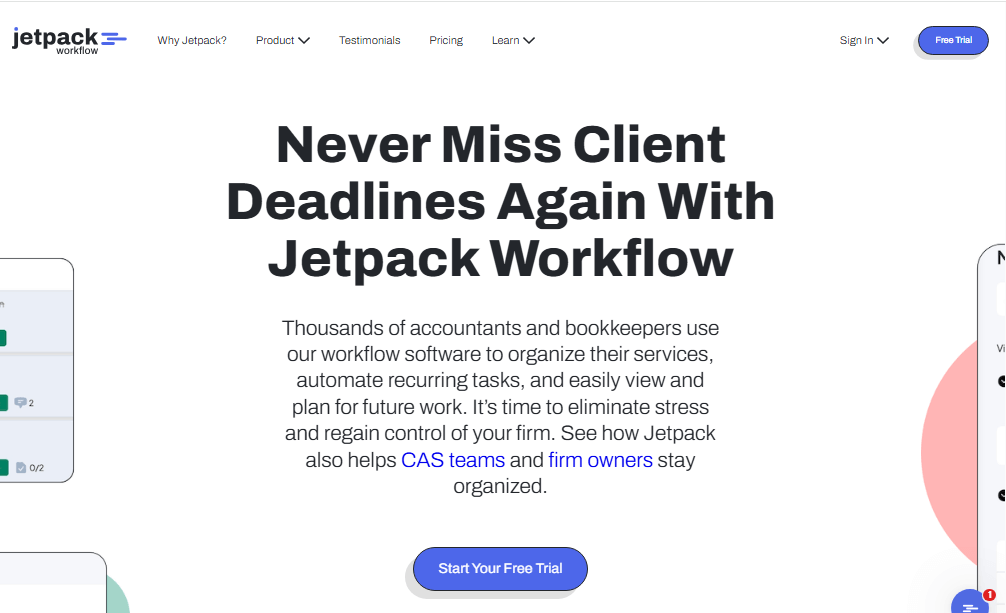
Jetpack Workflow believes in doing one thing exceptionally well: managing workflows and deadlines.
Founded by David Cristello after pre-selling the concept to a dozen firms for $5,000, it was built to solve the “checklist problem” for recurring client work. The platform focuses on being the most reliable and straightforward tool for ensuring work gets done on time. This laser focus is both its greatest strength and its most significant limitation.
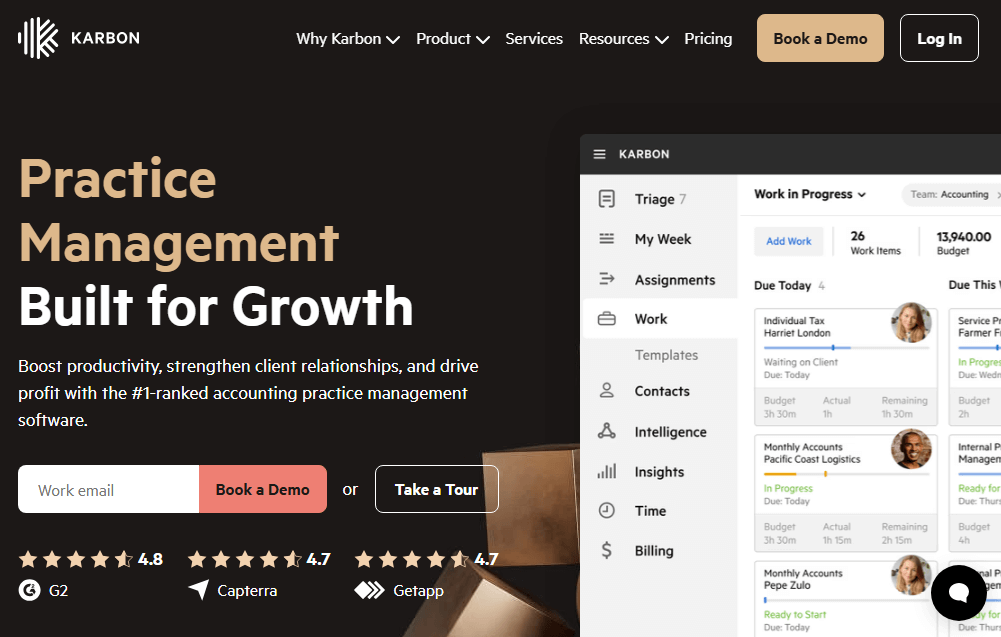
Karbon takes the opposite approach, aiming to be the central nervous system of your entire practice.
The platform, founded by former Xero executives, believes that scattered tools create scattered teams. Their solution? Integrate everything (email, workflows, documents, billing, analytics) into one unified platform.
The recently introduced “Practice Intelligence” with AI capabilities shows their ambition to not just manage but actively optimize your practice. The trade-off? Complexity that many smaller firms find challenging, with substantial upfront configuration required.
Uku represents a third philosophy: powerful doesn’t have to mean complicated.
Founded in Estonia by designers who found existing software “unhandy, impractical and unsightly,” Uku was created from the ground up to be international, especially for UK and US markets. The platform’s modular approach allows firms to start working on day one with just the features they need, then gradually add capabilities as they grow.
This approach eliminates the substantial upfront configuration that competitors require. Many firms report discovering they were underbilling by ~20% after implementing Uku’s automated billing and business analytics.

Workflow management capabilities reveal each platform’s DNA
All three platforms offer workflow management, but their approaches reveal their core nature.
Jetpack Workflow’s strength lies in its template library with over 70 pre-built templates covering everything from monthly bookkeeping to complex tax returns, allowing firms to standardize processes quickly.
The recurring job features automatically create work items, while cascading task deadlines help ensure work flows in the right order. The interface is designed to be immediately familiar to accountants. While primarily focused on internal workflows, it does offer basic client task capabilities.
Karbon’s workflow management is sophisticated and deeply integrated with email.
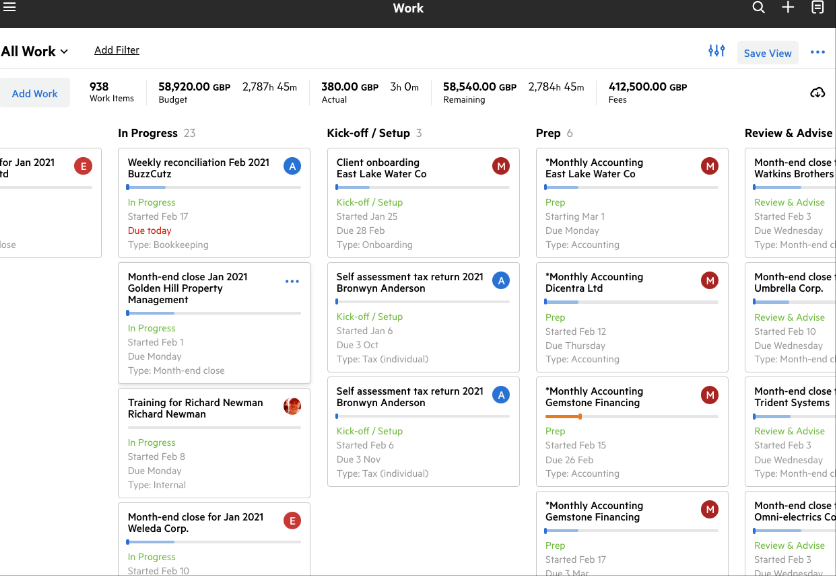
Work items serve as central hubs containing tasks, emails, notes, and documents. The “My Week” view helps individuals manage their workload, while the Kanban board provides firm-wide visibility.
The platform is designed for complex workflows with multiple team members, though the abundance of features requires significant time investment for setup and can make simple tasks feel more complicated.
Source: Karbon
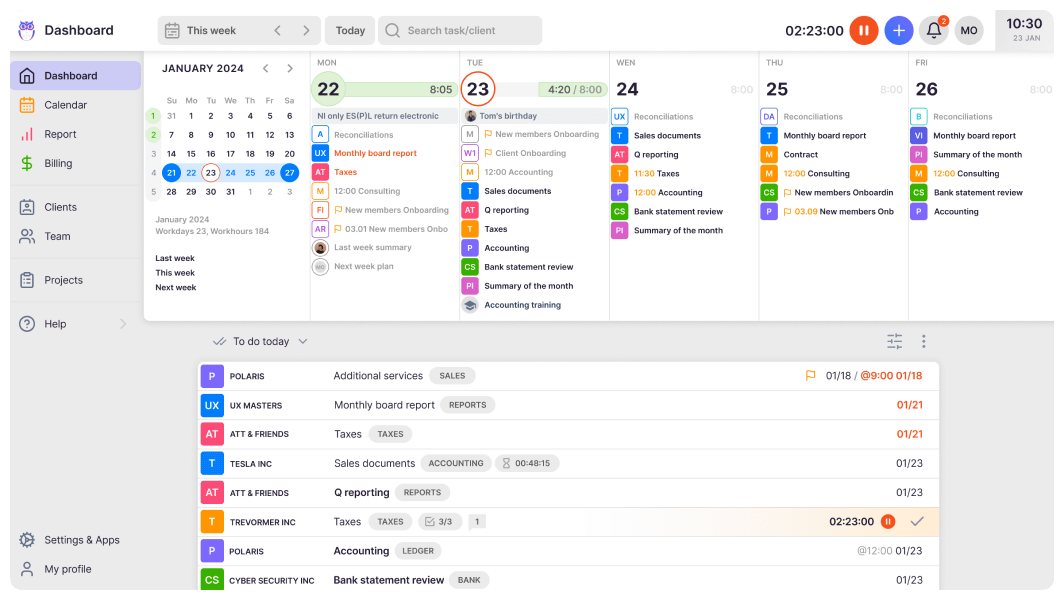
Uku takes a structured yet flexible approach to workflow automation with its three-tier system (task templates, client task plans, individual tasks) that provides both standardization and adaptability.
What sets Uku apart is its modular deployment – firms can start with just CRM and tasks, then activate additional modules as needed. This eliminates the weeks of configuration required by other platforms. The dynamic due date calculation allows deadlines based on business rules rather than just calendar dates.
The “Mini Uku” browser plugin lets you manage tasks from any website, while custom fields capture client-specific information. With 90% of actions being one-click, the platform emphasizes speed and efficiency in daily use.
Client collaboration shows who really understands modern accounting
The approach to client collaboration is where these platforms diverge significantly.
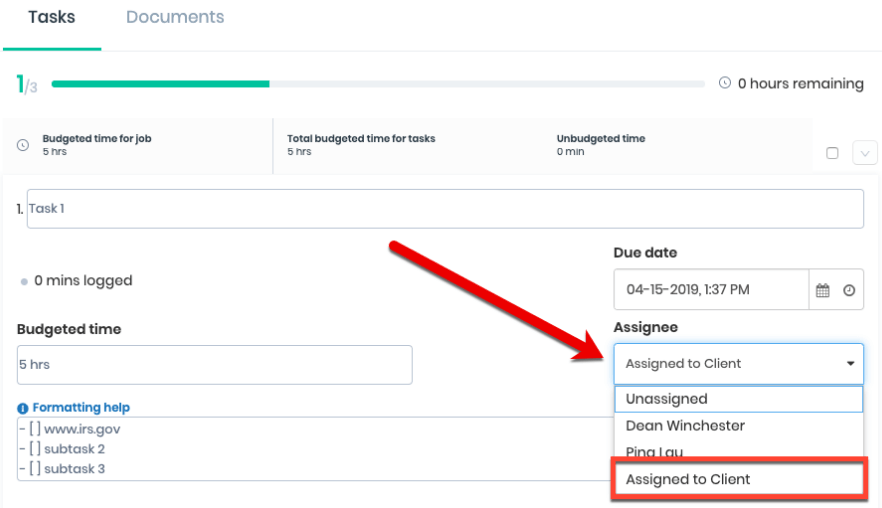
Jetpack Workflow offers basic client collaboration through its task assignment feature.
Firms can assign tasks to clients who receive them via email links. While functional for simple client requests, firms requiring more sophisticated client interaction, secure document exchange, or branded portal experiences may need to supplement with additional tools.
Source: Jetpack Workflow
Karbon includes client collaboration through its “Client Tasks” feature, accessible via magic links that eliminate password requirements.
Clients can view and complete assigned tasks, upload documents, and communicate with the firm. The integration with internal workflows is seamless, and the platform now offers advanced branding options to customize the client experience. The magic links make access simple while maintaining security.
Uku’s client portal stands out as a primary differentiator with extensive customization options.
Unlike traditional portals where tickets must be connected to work items, Uku’s portal mirrors the exact same task on both sides – clients and accountants work on the same item with all communication, actions, documents, logs, and time tracking in one place.
Beyond standard features, it offers company branding, personalized menus for each client, and even the ability to showcase additional services for upselling. Marketed as “the client portal you don’t have to explain to clients,” it emphasizes intuitive design. Clients access it via email magic links, eliminating password hassles.
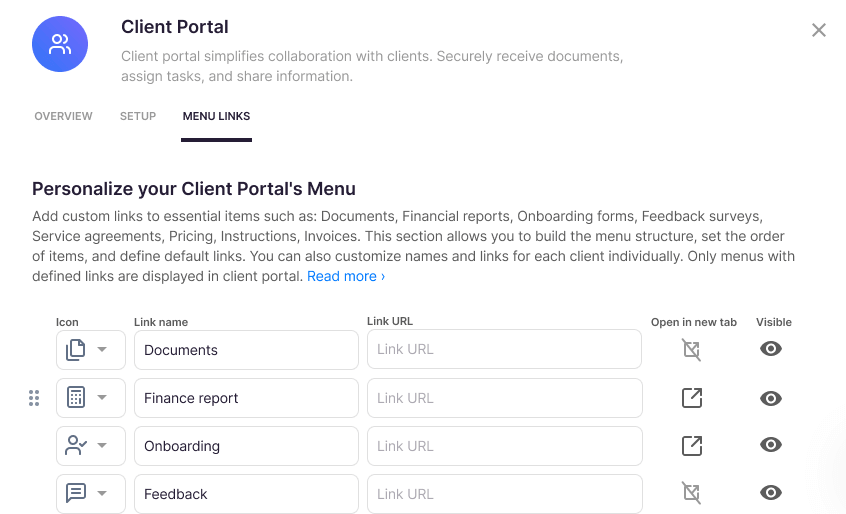
The mobile app ensures clients can respond to requests anytime, potentially reducing the eternal chase for information.
Billing and invoicing separate the comprehensive from the basic
How each platform handles billing reveals their target market and completeness.
Jetpack Workflow provides time tracking with the ability to export billable time to QuickBooks Online for invoicing.
This maintains their focus on workflow management while allowing integration with existing billing solutions. While this approach offers flexibility in choosing billing systems, it does mean managing multiple platforms and potential manual data transfer.
Karbon added billing and payments functionality in January 2024, integrating it with their workflow and time tracking.
The feature supports various billing methods including time and materials, fixed fees, and recurring billing. Powered by Stripe, it handles payment collection with options for credit cards and ACH. While functional and growing more robust, the billing setup and confirmation process takes considerable time compared to automated alternatives.
Uku’s automated billing is positioned as their primary competitive advantage.
The system supports complex price lists based on quantity, time, material, and ranges with different rates for different periods. Sophisticated rounding rules based on entry, team, client, or month allow firms to properly bill for interruptions. For instance, a one-minute unplanned call can be automatically billed as 15 minutes.
Everything is automated through ‘contracts’ where rules are set up once, then time tracking automatically calculates billable amounts in real-time. The system reduces invoice preparation from days to approximately 30 minutes, even for 100+ clients. Integration with accounting software like Xero and QuickBooks ensures seamless financial management.
The real cost of “practice management” software
Pricing structures reveal each platform’s market positioning and value proposition.
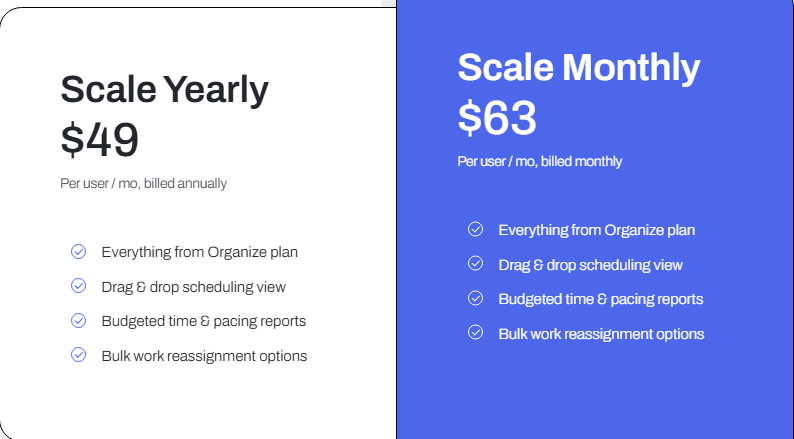
Jetpack Workflow keeps it simple with transparent, affordable pricing:
- Starter: From $40/user/month (annual) or $49/user/month (monthly)
- Includes unlimited projects and clients
- Core features included in base price
- Additional implementation packages available separately
Source: Jetpack Workflow
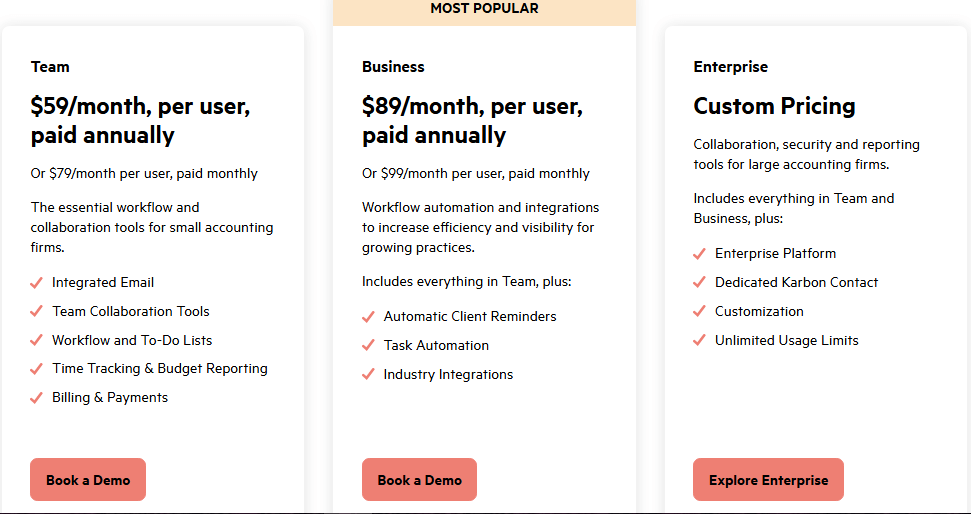
Karbon’s pricing reflects its premium positioning:
- Team: From $59/user/month (annual) or $79/user/month (monthly)
- Business: From $89/user/month (annual) or $99/user/month (monthly)
- Enterprise: Custom pricing
- Some advanced features like Email Insights require add-on fees on lower tiers
- Requires annual commitment for best pricing
Source: Karbon
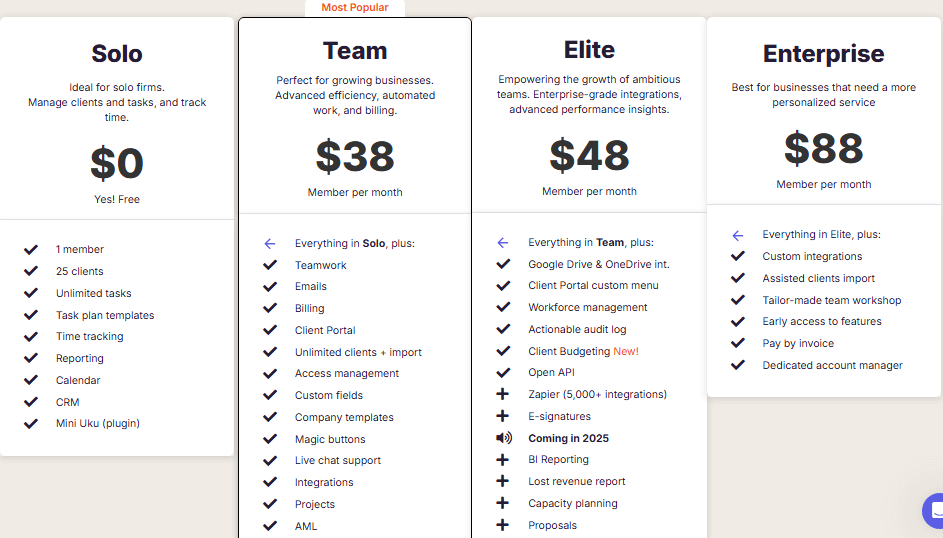
Uku offers flexible and competitive pricing:
- Solo: Free forever for individual practitioners
- Team: From $38/user/month
- Elite: $48/user/month (includes Client Budgeting, Document Management, E-signatures)
- Enterprise: $88/user/month
- 23% discount for annual billing
- 14-day free trial with 90 minutes of onboarding support
- Available in multiple currencies (€, $, £)
- Monthly billing options available
Source: Uku
Beyond price, consider the flexibility: Uku and Jetpack Workflow offer monthly billing options, allowing firms to test the system without large upfront annual commitments that Karbon requires for best pricing.
Time tracking and profitability insights drive firm growth
Understanding where time goes and which clients are profitable is crucial for firm success.
Jetpack Workflow offers functional time tracking with timers and manual entry options, plus basic reporting through timesheet reports.
The data can sync with QuickBooks Online for billing purposes. While adequate for basic needs, firms requiring deep profitability analysis may find it limited.
Karbon provides comprehensive time tracking with automatic timers and manual entry options.
The data feeds into their Practice Intelligence platform, offering insights into utilization, realization, and profitability. The platform includes dashboards for time, budget, and realization metrics. Access to these advanced features may vary by pricing tier.
Uku offers flexible time tracking with multiple capture methods including a stopwatch, manual entry, and bulk time allocation across multiple tasks.
The “Mini Uku” browser plugin enables time tracking from any website. The platform’s BI Reporting provides comprehensive views with deep filters, saved report templates, and three levels of depth: summary, tasks, and time.
A standout feature is the business analytics reports that track both sales prices and actual cost prices. If an employee costs €30/hour but bills at €45/hour, managers can see if they’re profitable. When employees work eight hours but only six are billable, the system provides insights into whether the issue is employee efficiency, client difficulty, or pricing structure. Many firms discover they’ve been underbilling by ~20% when they see these insights.
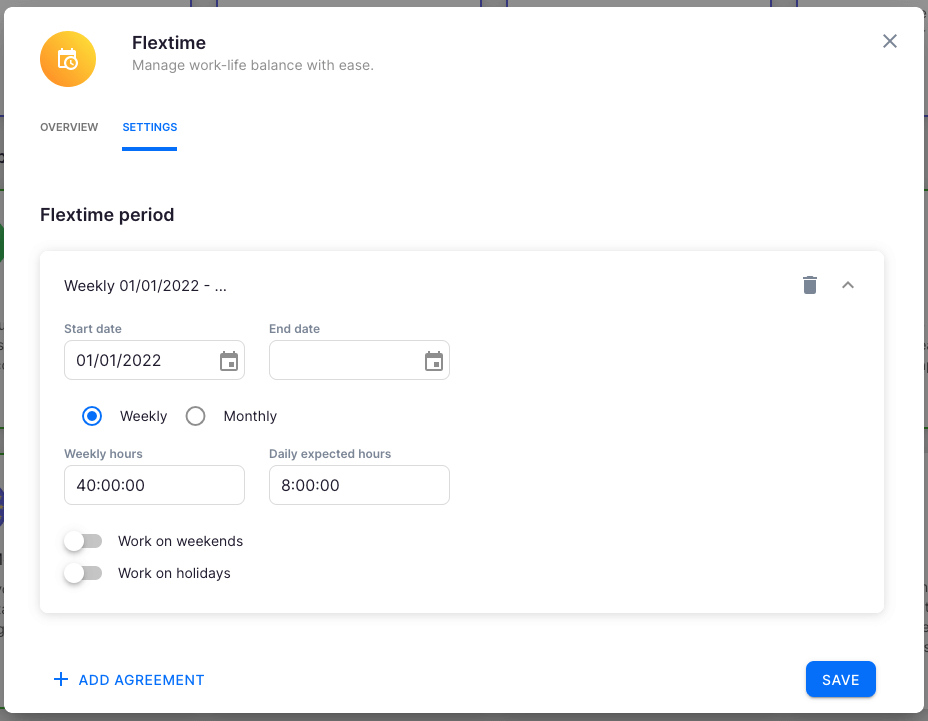
The flextime management feature also helps manage work-life balance by tracking working hours and overtime.
Source: Uku
The learning curve dramatically affects your ROI
The time to value is crucial when implementing new software.
Jetpack Workflow delivers on its promise of simplicity.
User reviews frequently mention being operational within days or even hours, with the intuitive interface requiring minimal training. The extensive template library means you don’t start from scratch. The straightforward nature means most teams can adopt it quickly, though firms may eventually need additional tools as they grow.
Karbon has a notable learning curve that reflects its comprehensive nature.
The platform requires substantial upfront configuration and training, with their guided implementation packages ranging from 4 to 8 weeks. Many firms opt for paid implementation support. However, Karbon does offer a free trial (no credit card required) so you can explore the platform before committing. While powerful once mastered, the time investment for full adoption can be significant.
Uku’s modular approach enables fast and flexible deployment.
Firms can start working on day one, activating only the modules needed and scaling up as they grow. This eliminates the weeks of configuration required by all-in-one platforms. The 14-day free trial includes 90 minutes of complimentary onboarding support to help with setup.
The interface consistently receives praise for being intuitive. Even resistant users aged 50+ who initially complain about tracking time become the biggest champions after a month of use. This balance between immediate usability and advanced features helps firms see value quickly while having room to grow.
Which platform scales with your ambition?
How each platform grows with your firm is crucial for long-term success.
Jetpack Workflow scales well for firms focused on workflow management.
The unlimited clients and projects mean no artificial growth limits. However, as firms mature and need more sophisticated features like advanced client portals, comprehensive reporting, or fully integrated billing, they may need to evaluate whether to add supplementary tools or switch platforms.
Karbon is built for scale, with enterprise features and the infrastructure to support large firms.
The AI-powered Practice Intelligence and comprehensive feature set are designed to become more valuable as your data grows. The platform can handle complex, multi-location firms with sophisticated needs, though smaller firms may find the features and cost more than they require initially.
Uku scales from solo practitioners (with a free plan) to larger firms, designed to grow with your practice.
The modular approach means you can start with just CRM and tasks, then gradually add features like automated billing, client portal, and BI Reporting as your needs evolve. The platform supports 12 languages and multi-currency capabilities (€, $, £), making it suitable for international growth.
With an in-house development team that can create custom software and integrations for clients with 50+ users, including country-specific features, Uku can adapt to unique market requirements. The platform has successfully scaled to support 300 users across 13 countries using separate workspaces with consolidated reporting.
Jetpack Workflow vs Karbon vs Uku: Which should you choose?
The choice depends on your firm’s current needs and future ambitions.
Choose Jetpack Workflow if:
- You need straightforward workflow management with basic additional features
- Your budget is tight
- You’re comfortable using QuickBooks for billing and invoicing
- You prefer focused tools over complex suites
- Quick implementation is a priority
Get started with Jetpack Workflow’s 14-day trial
Choose Karbon if:
- You’re a larger firm ready for enterprise-grade features
- Email management is central to your workflow
- You want AI-powered insights and automation
- Budget allows for premium pricing
- You have resources for extensive training and implementation
Explore Karbon’s comprehensive platform with their free trial
Choose Uku if:
- You want to minimize your team’s admin time
- You value ultra-fast onboarding and modular scaling
- You need multilingual or multi-currency support
- You’re transitioning from Excel and want the easiest implementation
- You need flexible monthly pricing rather than annual commitments
- You want to implement software step by step rather than all at once
Start your 14-day free trial of Uku (no credit card required)
The reality is that each platform serves different needs and preferences.
Jetpack Workflow provides focused workflow management with essential features at an accessible price. Karbon offers a comprehensive, enterprise-ready solution for firms needing advanced capabilities but requiring substantial configuration. Uku bridges the gap with a platform that combines extensive features with user-friendly design, modular deployment, and flexible pricing, allowing firms to start working immediately while scaling capabilities as they grow.
In a world where accounting firms face increasing pressure to do more with less, the right practice management software isn’t just about managing tasks, it’s about transforming how you work. Many firms using Uku discover they’ve been leaving ~20% profit on the table through outdated billing agreements. Choose the platform that aligns with your firm’s needs, budget, and growth trajectory.