

You’re here to get more clients without cold calls or chasing referrals – and yep, SEO for accountants can actually make that happen. But this type of marketing isn’t just about tossing a few keywords on your homepage and hoping Google notices. You’ll need a fast, mobile-friendly website. Clear service pages. Location-specific content that sounds human. A business profile that doesn’t look abandoned.
We’re talking real setup work accounting firms go through: fixing technical gaps, building authority, and writing with intent – not just information.
So here’s what we’ll break down:
- How to define an ideal keyword list for your content?
- How do you get local traffic from Google?
- What tech aspects of the website should be considered before starting?
- How to structure your website content for converting leads?
But before we dive into the process, let’s check if we’re on the same page about the definition 👇
What is SEO for accountants?
It’s short for search engine optimization – aka getting your accounting firm to show up on Google when someone types in “tax help near me” or “bookkeeper for small business.” But it’s not just about ranking higher. It’s about getting found by the right people and turning that search into a client call.
Let’s say you run a firm in Austin. With the right SEO services, you can optimize your website for local terms like “LLC tax tips in Texas” and write relevant, helpful content on your blog.
The goal? More visibility, trust, traffic, and even client reviews on Google Business Profile.
This process starts with research – figuring out what your ideal clients actually search for. Then, you’ll need effective strategies tailored for SEO for accounting firms: service, location pages, FAQs, and backlinks that build authority.
When everything is done right, search engine optimization becomes a lead engine and much more 👇
6 benefits of SEO for accountants
SEO is one of those things that works for almost every industry – if you want to sell online, it’s kind of a no-brainer. For accountants, it’s especially powerful because people don’t just Google “accountant” for fun. They search when they’re ready to act.
And when your firm shows up first? You win the client.
Here’s what SEO can actually do for you:
- Get seen by people already looking for accounting help. 75% of users never scroll past the first page of Google results. With strong SEO, your firm appears right when someone searches “tax help in [your city]”.
- Turn your website into a lead machine. A well-optimized website can turn cold visits into booked calls. Pages that match user intent – like “bookkeeping for startups” – keep visitors around longer and convert more often.
- Build trust before they even contact you. Online reviews aren’t just nice to have – they influence every decision. 87% of people read reviews before choosing a local business. A solid SEO strategy helps you collect and showcase those reviews.
- Let your content do the selling (even while you sleep). Great content answers questions before people ask them. Blogs, service breakdowns, FAQs – they all work 24/7 to move quality leads down the funnel.
- Attract better-fit clients with keyword research. Not all clients are your ideal clients. With keyword research, you can tailor your messaging and pages to the people you want to work with – whether that’s freelancers, small businesses, or high-net-worth individuals.
- Compete with bigger firms without spending big. SEO levels the playing field. Even if you’re a solo accountant, search engine visibility lets you show up next to national brands – and often outrank them locally if your SEO is dialed in.
Impressed? Let’s dive into the best ideas on how to bring you new clients from Google 👇
Top 9 strategies on how to do SEO for accountants
Here we’ve gathered the best SEO strategies for your firm, tested by industry experts and our team. From optimizing your website to creating high-value content, these tactics are proven to help accountants like you grow their business website visibility, rank higher on Google, and target the right keywords every time.
Do your firm’s competitor research to gain SEO insights
Whether you’ve been in the Google SEO game for a while or you’re just figuring it out, one thing never changes: you start with competitor research. Whether your accounting firm site has been around for 20 years or you just launched a month ago – first, you’ve got to figure out whose website is already winning on Google search engine and why.
Now, there are two ways to do this. You can do it manually, or you can use proper SEO tools like Ahrefs, Google Search Console, or SEMrush services. (If you’re serious about ranking, investing in a tool is kind of non-negotiable.)
While these tools are excellent, many agencies build custom dashboards for deeper insights. They often use enterprise-level data platforms from providers like HasData to pull structured, real-time Google data via a SERP API.
So here’s where you start:
- Search for something your ideal clients might type in – like “accounting firms” keywords.
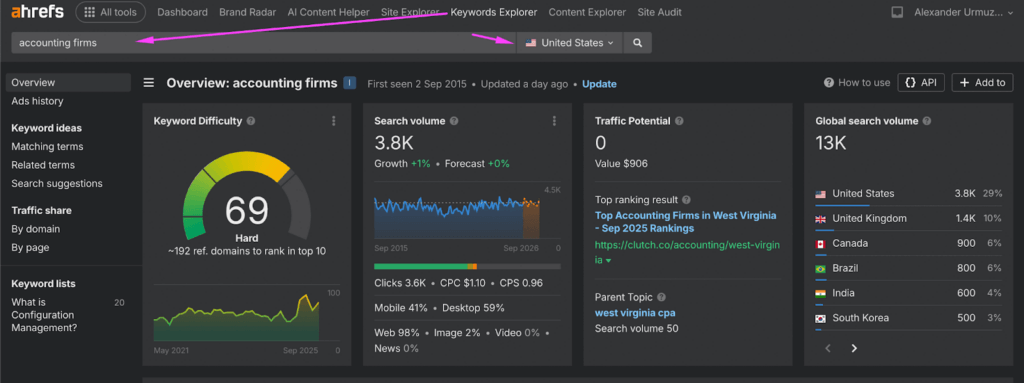
2. Scroll down to the SERP section. This is where you see who’s ranking, along with juicy stats like Domain Rating (DR) and backlinks. Spoiler: not all of them are your direct competitors. It can be just listings – ignore them.
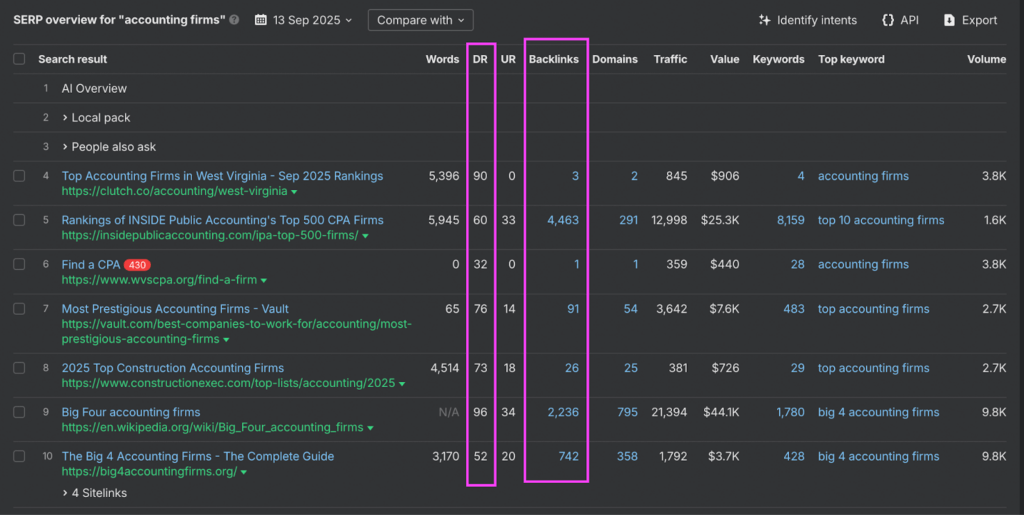
If you see DR 60+ sites with thousands of backlinks? They’re beasts. But if a few are under DR 30 and only have a handful of backlinks? You’ve got a shot.
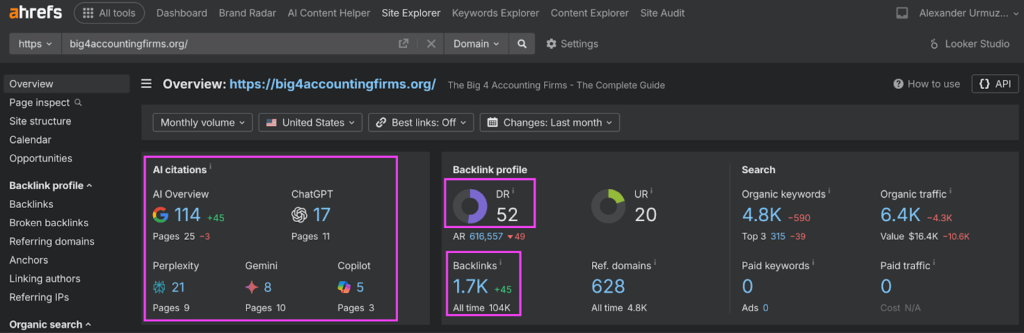
3. Click on a competitor domain you want to analyze. (Document everything from here in a comparison table.) Check how much traffic they have? Backlinks? AI search appearance?
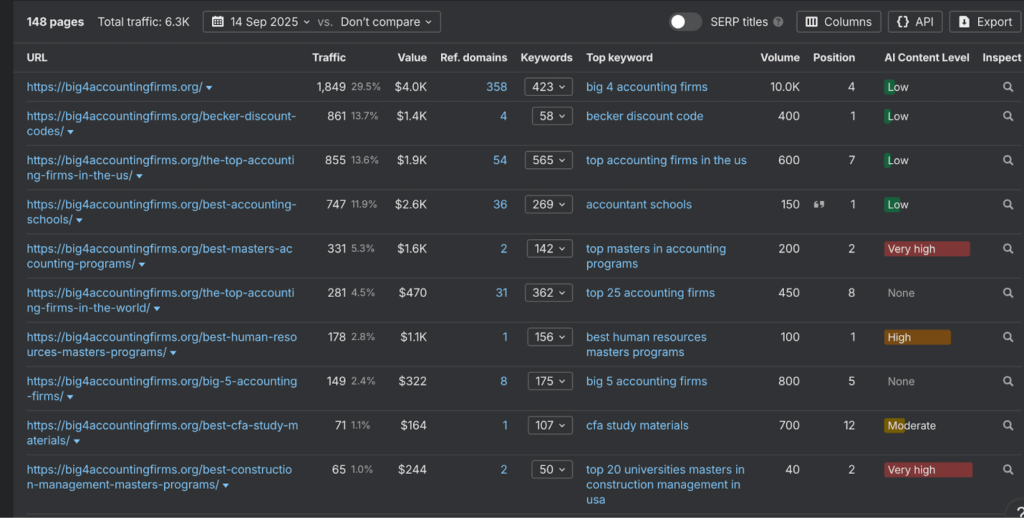
4. Then, scroll to Top Pages – how many pages do they have? 150? That’s doable.
Are they mostly blog posts or landing pages? That tells you what kind of content they’re doubling down on.
5. Go down to Organic Keywords. Here you’ll see which keywords are bringing them the most traffic.
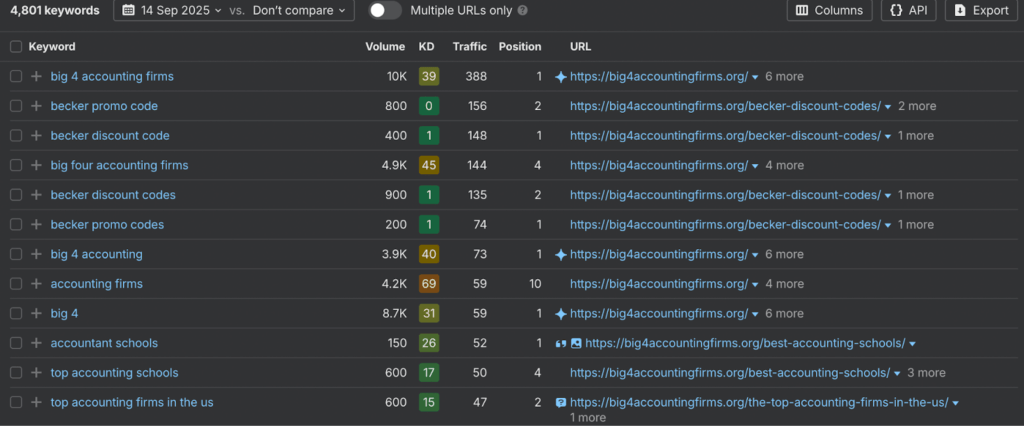
This is gold. These are the topics and search terms that actually bring in real visitors – not just vanity metrics. Export the keywords that the competitor gets traffic from in your table.
6. Go back to Google and check user reviews on the competitor, their profile on websites like Capterra, TrustRadius, etc. How do they engage with users?
Repeat the same steps (starting from the 3rd step) for every competitor. Limit your research to 5-10 websites.
Feed your comparison table to AI with a prompt:

Conduct keyword research to target the right clients
Now that you’ve pulled the most popular keywords from your competitor’s website, let’s put them to work. Let’s focus on what’s already driving organic traffic for others.
- Create a new tab in your Google Spreadsheet and drop in every keyword you collected. Remove duplicates, clean it up, and sort them by search volume. You’ll quickly see which ones show up most – and that’s where the opportunities begin.
- Next, highlight the relevant keywords that actually make sense for your business traffic. If something feels off-brand, skip it.
Pro tip? Mark in red any keyword where the competing domains have a Domain Rating over 40. Unless you’ve got a ton of backlinks (or budget), those terms will be tough to crack with just content alone. - You can also run keyword ideas straight through your SEO tool. Type in something like “accounting service,” check the matching terms and related search suggestions, and export them.
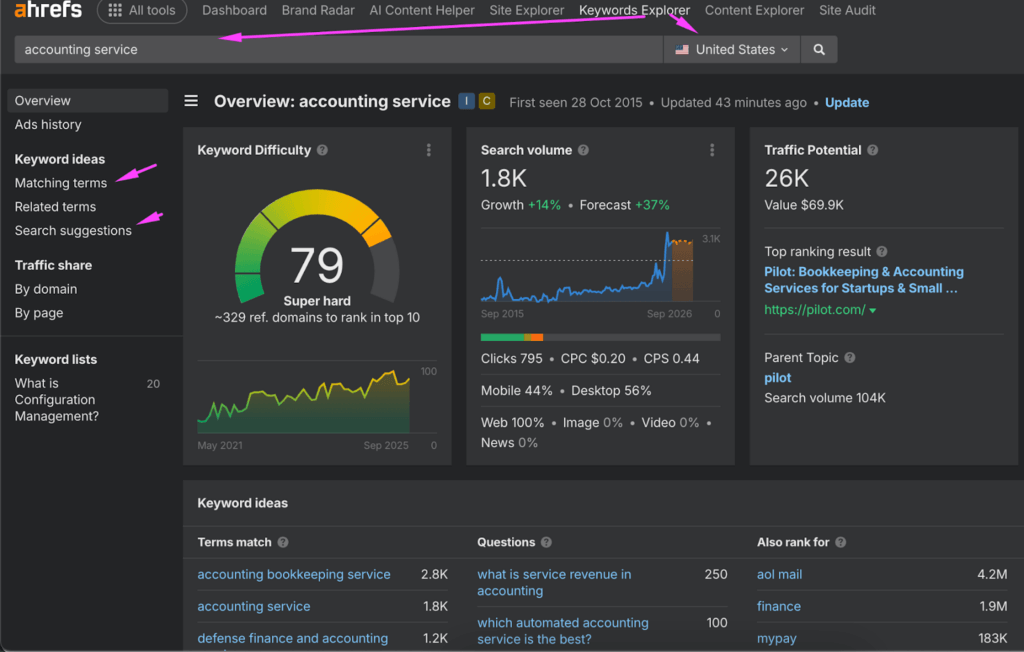
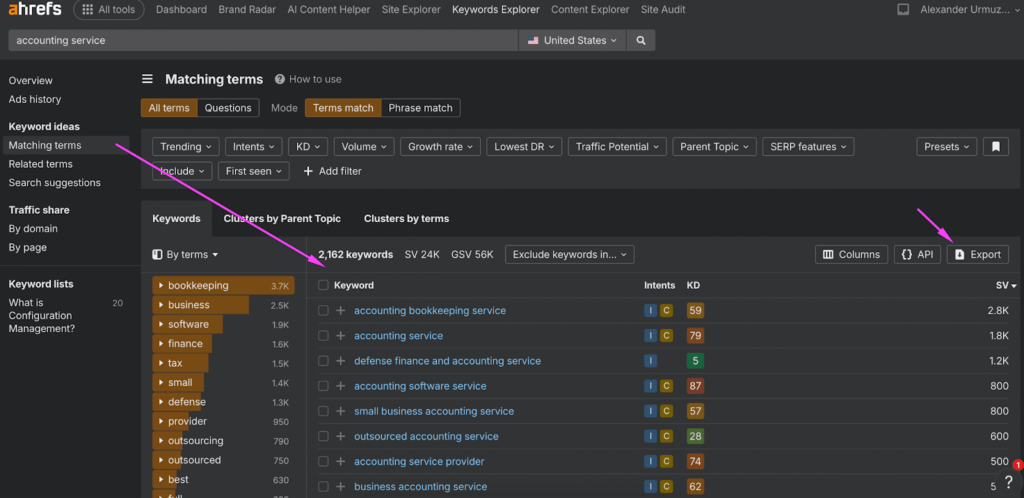
Same deal – clean the list, remove what doesn’t fit, and keep what aligns with your offer.
The success will look like a curated list of keywords that reflect your services, your audience, and your goals. After keyword research, group them and decide what pages to create.
Next, UX 👇
Structure your website navigation for SEO success
Think of your business website like the front desk of your accounting firm. It should guide visitors without them asking where to click.
- Present your services in sections like tax, audit, and bookkeeping. Each of them should get its own page with focused content and one keyword group. Thus, Google understands your structure and improves your ranking in local searches.
- Link related blog posts under each service to boost depth in the topic.
Pro tip: Consider a knowledge base. It can also be an SEO goldmine if given proper attention.
It’s important to keep the clear structure of each page you have. In addition to the menu in the header, blogs as a knowledge base SEO articles should have a table of contents, H2/H3 tags, and an FAQs section.
Use Google Analytics to track their performance, what gets clicks, and tweak based on real insights, while ad and conversion tracking give you a clear picture of what’s turning visitors into customers.
Plan a quality blog content strategy to get consistent traffic
You’ve got your keyword research – now it’s time to build a blog that actually drives traffic. Start by grouping related keywords into topic hubs. For example, it can be a main guide (like small business taxes), then blog posts around it that link back.
That’s how your site builds topic authority.
To keep track of all these blog posts and knowledge base articles, document generation uses Google Spreadsheet, Uku, or any task tracker.

Use content calendar if you prefer more professional approach:
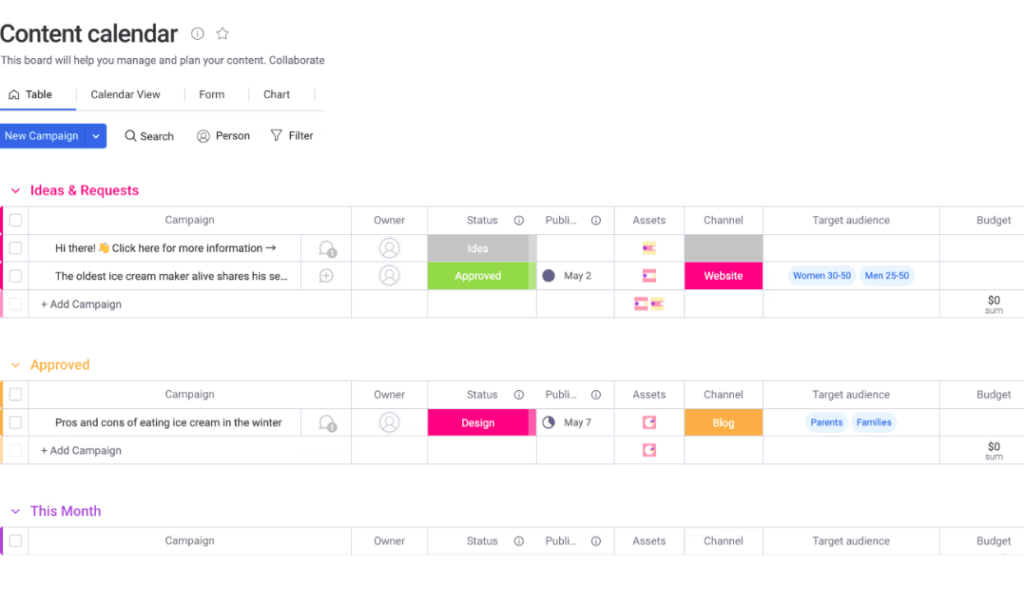
Even if your firm is small, publishing just 1-2 solid pieces a week can move the needle. Make sure each blog connects back to your services, so your website isn’t just helpful – it converts.
Optimize local SEO to attract nearby businesses
If you want local clients, don’t skip this. Start by claiming your Google Business Profile – it’s free and insanely powerful. Add real photos, accurate hours, and services. Then make sure your name, address, and phone number (NAP) are identical across every directory. That builds trust.
Your website should also target local terms like “accountant near me” using smart page SEO on service pages. And don’t forget your content – answer location-based questions your ideal business clients actually ask.
To further strengthen your local SEO strategy, it’s essential to leverage tools that help you manage your Google reviews effectively. With the right system in place, businesses can consistently collect positive reviews, which are crucial for improving local visibility. Platforms like Reviewly AI make this process effortless, allowing businesses to automatically generate, track, and respond to reviews, ensuring a positive online reputation that boosts your SEO rankings.
This combo is key to local visibility – and real SEO success.
Audit the on page technical SEO aspects to improve ranking fast
Start with the basics: check every service page on your business website. Is there a proper meta title? A description that makes someone want to click? Are your headers clean and logical (H1, H2, H3)? Is your main keyword placed naturally in all the right spots – title, URL, intro paragraph?
That’s the foundation. But if you want to play nice with Google searches, you’ll also need a few local SEO essentials:
- Schema markup (to help your pages stand out in search results)
- A clean robots.txt file (so bots crawl the right stuff)
- An updated sitemap (so your pages actually get indexed)
This isn’t about being perfect – it’s about being better than the next accounting firm on the list.
Now, don’t try to eyeball this. Run a tech performance audit using a real SEO tool like Ahrefs, SEMrush, or Screaming Frog. Every legit SEO platform has this feature. It’ll flag missing tags, broken links, duplicate content, slow pages, all of it.
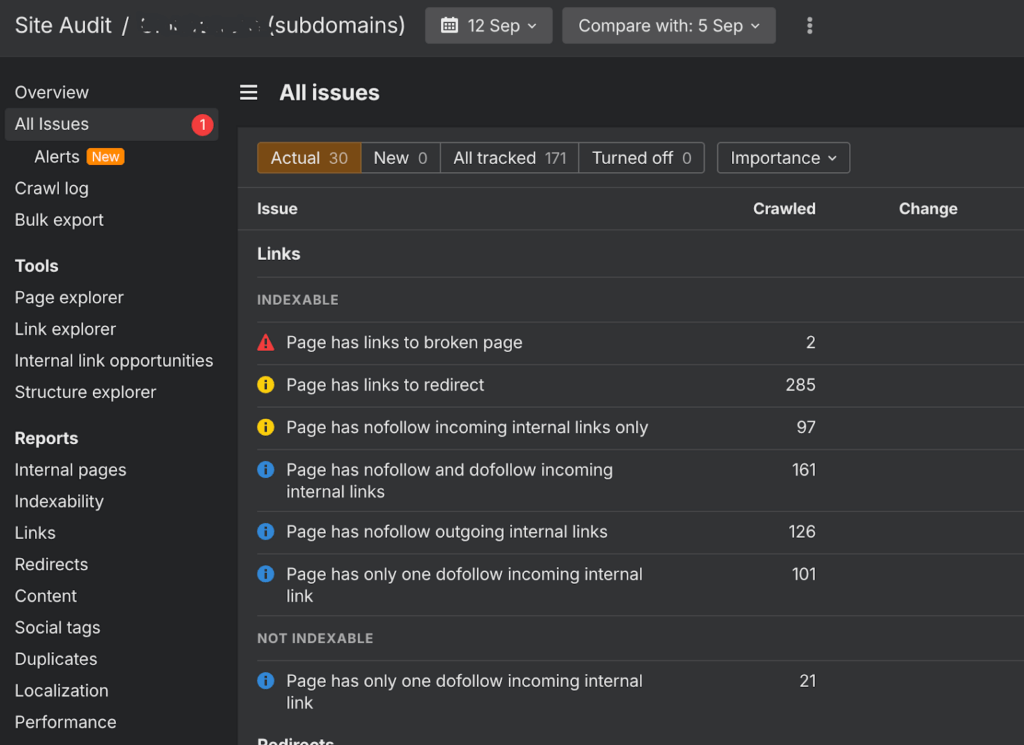
Also, collect technical seo issues from Google Analytics about unindexed pages. Use those insights to clean up your pages so your business looks polished – not only to clients, but to the ranking algorithm.
Add internal links to relevant site pages, double-check for mobile responsiveness quality, and make sure your accounting firm website loads fast.
Get more Google reviews to build trust and visibility
To boost your local SEO strategy, you need to collect Google reviews consistently. These directly impact your visibility in search results and help build trust with new clients before they even contact your firm.
Ask for reviews right after completing your services – send a short message with a direct link to your Google Business Profile. It could be a great idea to utilize the power of email sequence and send automated emails to customers who have just used your services and ask them for reviews.
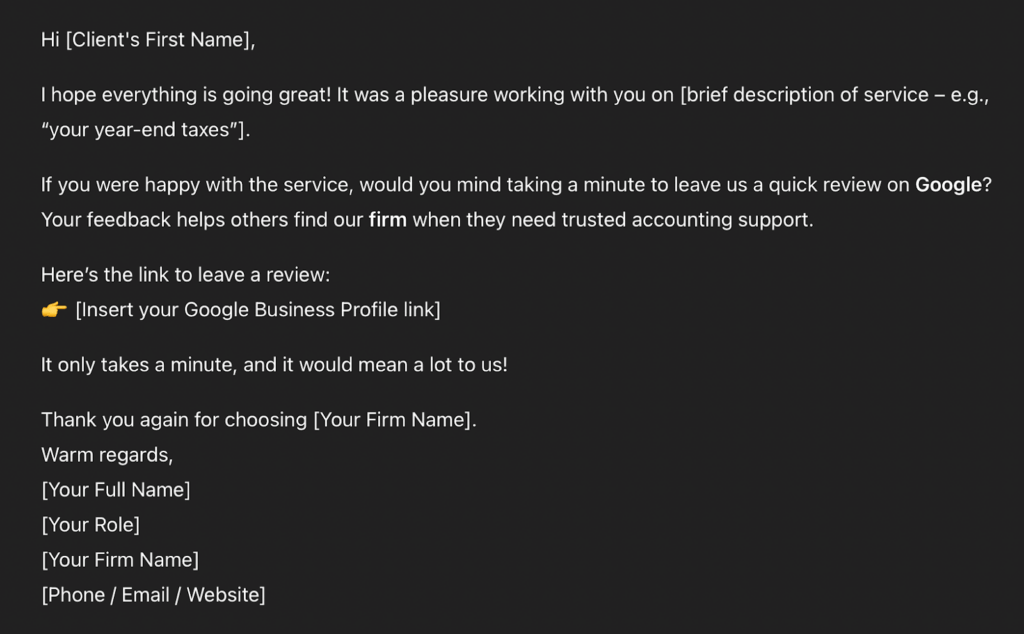
When replying to reviews, use one relevant term from your keyword research. It reinforces your content naturally and strengthens overall seo performance.
Conduct regular SEO audit of site performance to ensure your business’s long-term success
If you’re doing website SEO for accountants, tracking is a must. Use Google Analytics or any set service you use to see which blog posts get visitors from Google and which services get clicks. Track visitors number per week and month for each page. Add info about what positions your keywords take in SERP. You can use a keyword ranking dashboard template to keep this data structured.
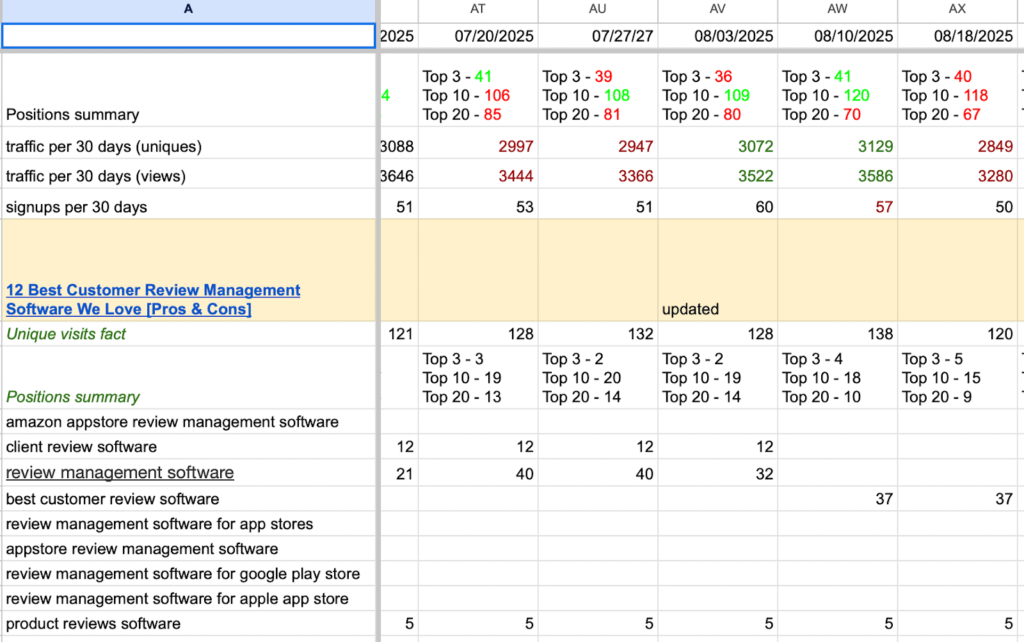
Track keyword movement and landing page traffic to understand what brings in potential clients and when to improve search engine rankings.
Don’t forget to run an SEO audit monthly to catch broken links, slow pages, or weak content.
Use link building to strengthen authority and ranking
If you’re just starting SEO, launch link building the same month you begin writing content. It’s how you compete – because your competitors already have backlinks.
- Earn links from trusted sites in your industry – think directories, professional listings, blogs, and local business partners. Avoid spammy domains, especially ones linking to casinos or low-quality services. A bad link can hurt your ranking and lower your domain trust.
- Analyze your competitors’ backlinks to find where they’re getting traffic. Then reach out for guest posting or link exchange. Guest posts cost from €100 to €1000 but they build PR too.
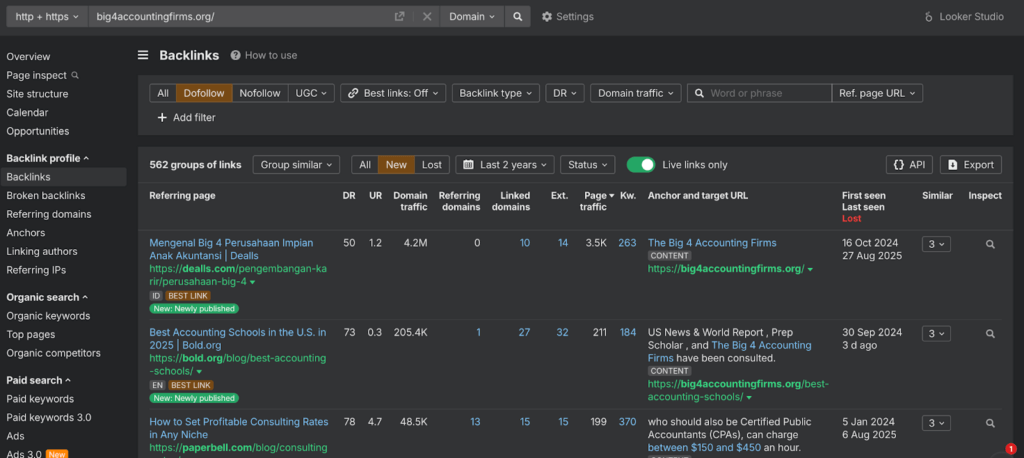
- Link to high-value pages and use the right keyword for each. You already have them sorted in your Google Sheet.
I’d advise delegating this task to a professional service or an expert.
To summarize: Main steps on SEO strategy for your accounting firm
Want your accounting firm to show up when it matters? Start with an effective SEO strategy. Check who’s ranking on Google – then reverse-engineer it.
- Fix your accounting website structure so every service is easy to find. Organize your site by clear categories – tax, bookkeeping, and accounting services.
- Turn your keyword list into a smart blog plan.
- Build links from trustworthy sites – don’t skip that step. It drives traffic and authority. Track everything with Google Analytics. Improve. Repeat.
DIY is possible if you’ve got time. But if you want results faster? Bring in an expert or experienced SEO agency to own your strategies. We recommend Smash Digital.