Best Apps for Accountants, CPAs and Accounting Firms
Discover 150+ apps for accountants in 2026: practice management, tax software, AI tools & more. Compare features, pricing & integrations.


Contents
- Practice Management Software for Accountants & CPA Firms
- Tax Preparation Software for Accountants & CPAs
- Accounting & General Ledger Software for CPA Firms
- AI-Powered Accounting Software for CPAs
- Payroll Software for Accounting Firms
- Engagement Letters & Proposal Software for Accountants
- Tax Workflow & Client Intake Software for CPAs
- Month-End Close Automation for Accounting Firms
- Tax Research Software for CPAs
- Team Communication Tools for Accounting Firms
- AI Meeting Notetakers for Accountants
- Appointment Scheduling Software for Accountants
- Time Tracking Software for Accounting Firms
- Secure File Sharing for Accountants & Clients
- Password Management for Accounting Firms
- Marketing & Email Software for Accounting Firms
- AML & KYC Compliance Software for Accountants
- Wellness & Mental Health for Accounting Professionals
- Additional Tools & Software for Accounting Firms
- How to Choose Your Stack
- FAQ
The most comprehensive directory of apps for accountants, CPAs, bookkeepers, and accounting firms. We’ve researched 150+ tools across 18 categories — practice management, online bookkeeping and general ledger software, tax preparation, AI accounting, and every other app category a modern firm runs on — with honest assessments of strengths, weaknesses, pricing, and real user feedback from G2 and Capterra.
Table of Contents
- Practice Management Software for Accountants
- Tax Preparation Software for CPAs
- Accounting & General Ledger Software
- AI-Powered Accounting Software
- Payroll Software for Accounting Firms
- Engagement Letters & Proposal Software
- Tax Workflow & Client Intake Software
- Month-End Close Automation
- Tax Research Software for CPAs
- Team Communication Tools
- AI Meeting Notetakers for Accountants
- Appointment Scheduling Software
- Time Tracking Software
- Secure File Sharing
- Password Management
- Marketing & Email Software
- AML & KYC Compliance Software
- Wellness & Mental Health
- Additional Tools & Software
- How to Choose Your Stack
- FAQ
Practice Management Software for Accountants & CPA Firms
The global practice management software market is projected to reach $1.45 billion by 2030, growing at 9.9% CAGR. Over 73% of accounting firms have already adopted these solutions, with cloud-based systems commanding 68% market share in 2025. Modern platforms integrate workflow automation, client portals, time tracking, and billing—reducing administrative tasks by over 50%. As AI becomes embedded into core systems (what industry leaders call “ambient AI”), practice management is evolving from simple task tracking to intelligent work orchestration.
1. Uku
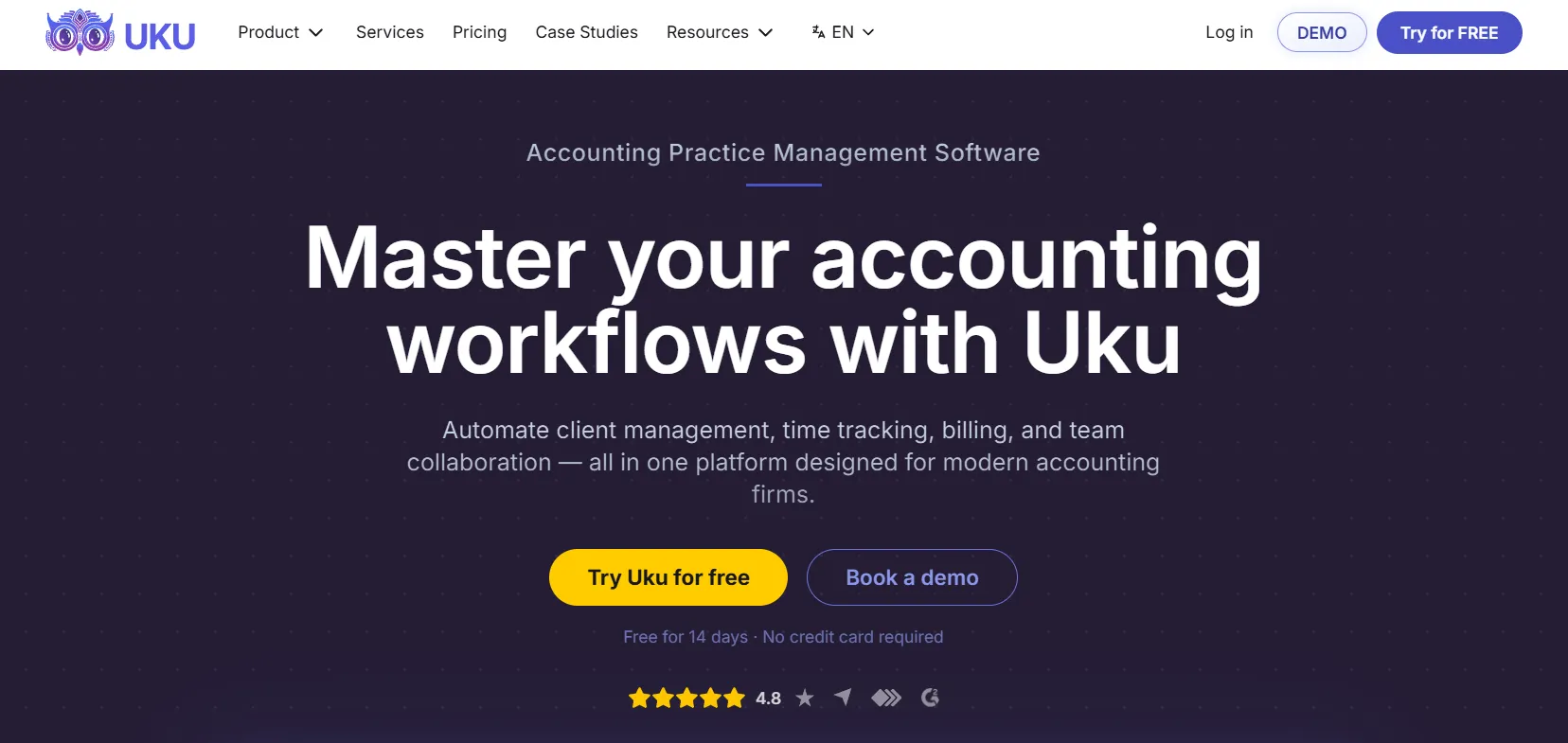
The Unified Practice Management Platform.
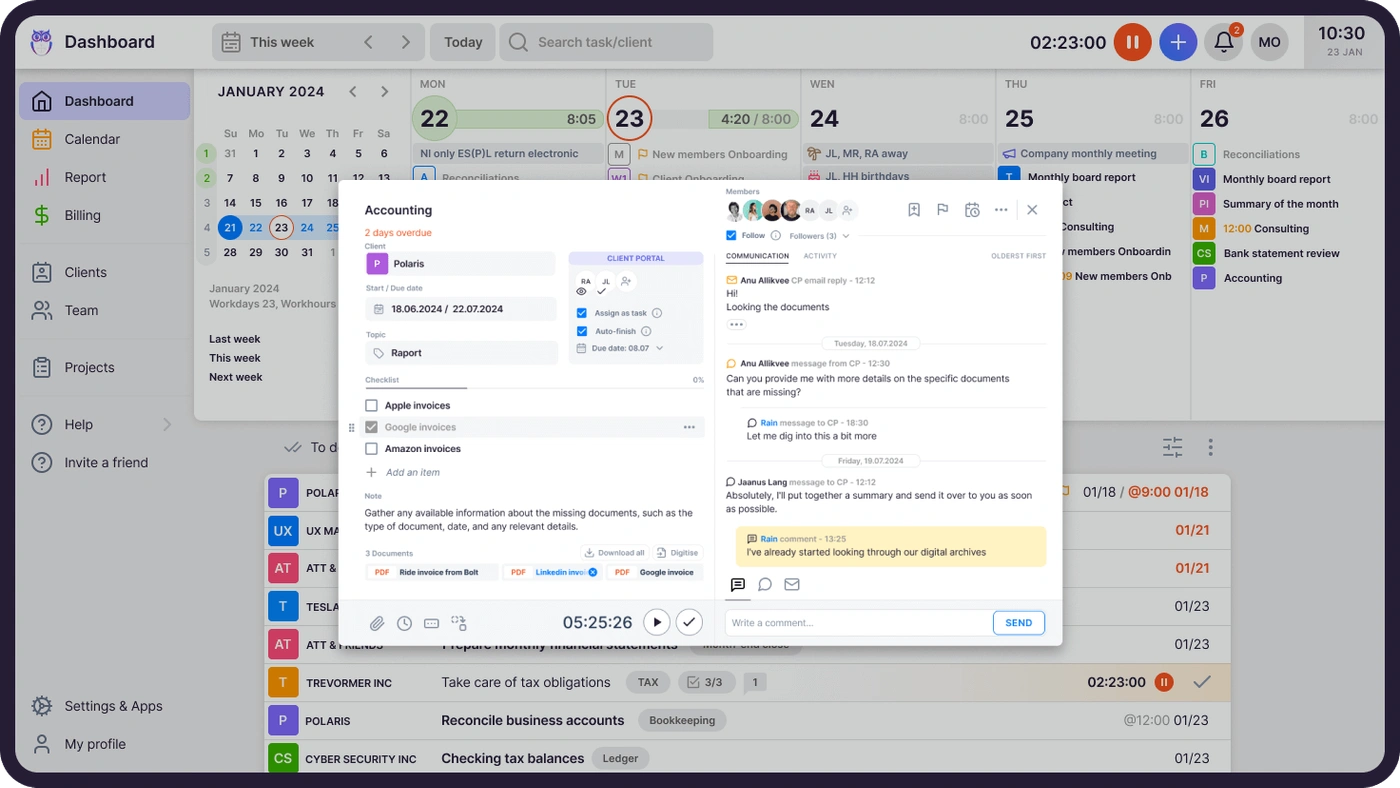
Uku connects client agreements, time tracking, and billing into a single ecosystem, solving the disconnect between doing work and getting paid. By unifying CRM and Task Management, it ensures every billable minute is captured without toggling between disconnected tools.
Real result: Firms report an average 20% revenue increase post-implementation by identifying unbilled work and plugging billing leaks.
Strengths:
- Ecosystem Connectivity: Native integrations with Xero and QuickBooks, plus 1000+ connections via Zapier, allow you to automate data flow between apps without manual entry.
- High Adoption Rate: Accountants actually use it. Rated 4.8/5 for ease of use, Uku’s clean interface ensures teams are productive within days, not months.
- Business Intelligence: Real-time monitoring of client profitability and employee capacity helps you make data-driven decisions on pricing and hiring.
- Client Portal: A friction-free way to collect documents without chasing clients.
Weaknesses: Enforces standardization. Uku is built for scalable firms, requiring agreed-upon workflows. It is less effective for “lone wolf” accountants who resist unified processes.
Pricing: Team plan at $38/user/month, Elite plan at $48/user/month. 14-day free trial available.
Best for: Growth-minded firms (5-50 people) who want to stop revenue leakage and automate their operations.
Links: Website • G2 • Capterra • Start Free Trial

Ready to upgrade your practice management?
Join 1,000+ accounting firms already using Uku to save time and grow their business.
2. Karbon
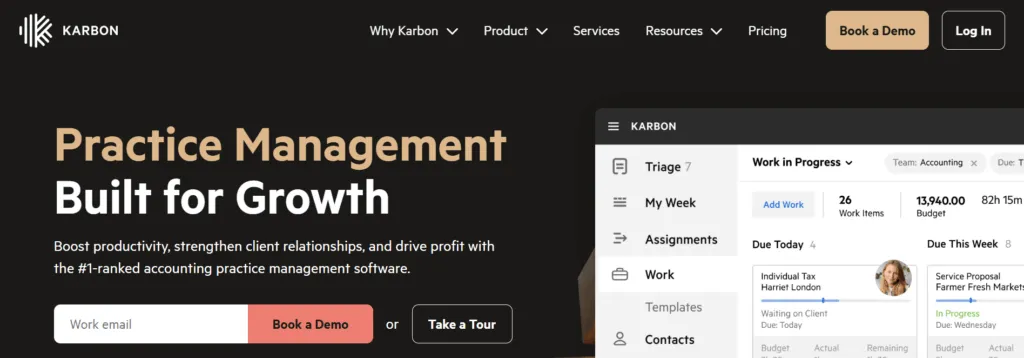
Email-centric workflow management for larger teams.
Karbon is positioned as the market leader in practice management, backed by significant venture capital. The platform transforms email into structured workflows through its Triage feature, offers Practice Intelligence analytics with 10 live dashboards, and AI-driven email prioritization. Serves 30,000+ accounting professionals globally.
Pricing: Team at $59/user/month, Business at $89/user/month. A 10-person firm pays $590-890/month. No free tier—14-day trial only. Extra costs: eSignature credits, advanced reporting.
Integrations: QuickBooks Online, QuickBooks Time, Xero, Xero Practice Manager, Gmail, Microsoft 365, Outlook, Ignition, Zoom, Zapier. View all
Strengths: Strong market presence and brand recognition. Powerful email-to-task automation. Practice Intelligence provides 10 live dashboards. 96% user sentiment on G2 (860+ reviews).
Weaknesses: Implementation complexity is significantly underestimated—firms under 50 users often struggle to complete onboarding even with expert assistance. Marketing promises don’t always match real-world experience. Premium pricing with additional costs for features like eSignatures.
Best for: Large firms (50+ users) with dedicated resources for complex implementation. Smaller teams frequently find the platform overwhelming despite marketing claims of broader suitability.
Links: Website • G2 • Capterra
3. TaxDome
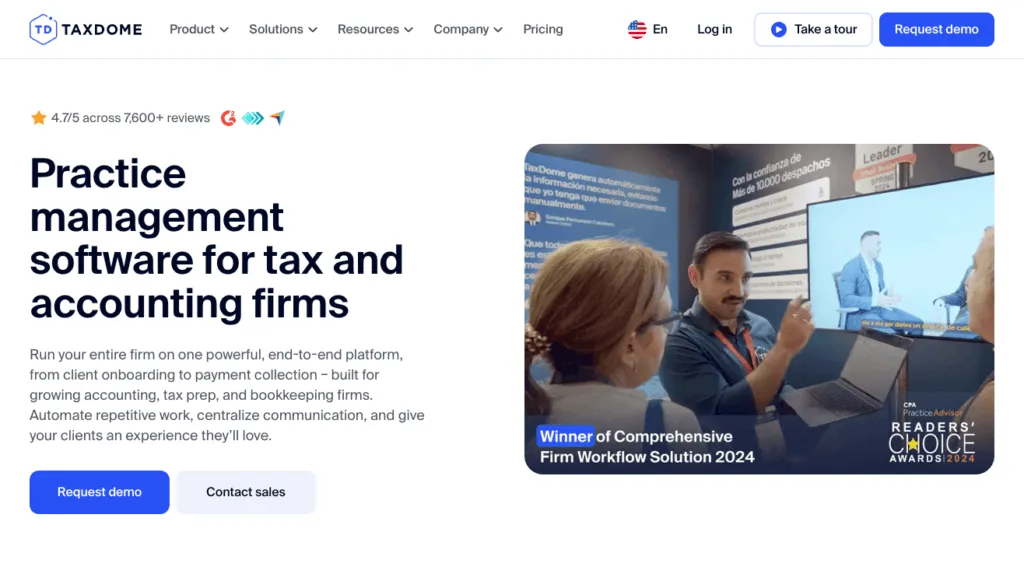
All-in-one practice management with built-in client portal.
TaxDome combines CRM, workflow automation, document management, billing, e-signatures, and client portal into a single platform. Serves 10,000+ firms globally with 3,500+ reviews on G2/Capterra. The platform includes unlimited e-signatures and storage on all plans.
Pricing: Essentials at $800/year, Pro at $1,000/user/year, Business at $1,200/user/year. A 10-person firm on Pro pays $10,000/year upfront. No monthly option—annual commitment only. Multi-year discounts available (3-year saves ~10%).
Integrations: QuickBooks Online, IRS, Lacerte, ProConnect, Drake, UltraTax, CCH Axcess, TaxAct, ProSeries, Calendly, Acuity, Zapier, Google Drive, Dropbox, Gmail, Right Networks. View all
Strengths: True all-in-one eliminates need for multiple subscriptions. Unlimited e-signatures and storage included. Strong client portal with mobile app. Direct IRS integration. 3,500+ reviews with high ratings.
Weaknesses: 6-8 weeks onboarding typical—some firms report longer. Task scheduling requires too many clicks. No QuickBooks Desktop integration—QBO only.
Best for: Mid-size firms (10-50 users) with stable cash flow ready to commit annually and invest 2+ months in implementation. Tax-focused firms benefit most from IRS and tax software integrations.
Links: Website • G2 • Capterra
4. Canopy
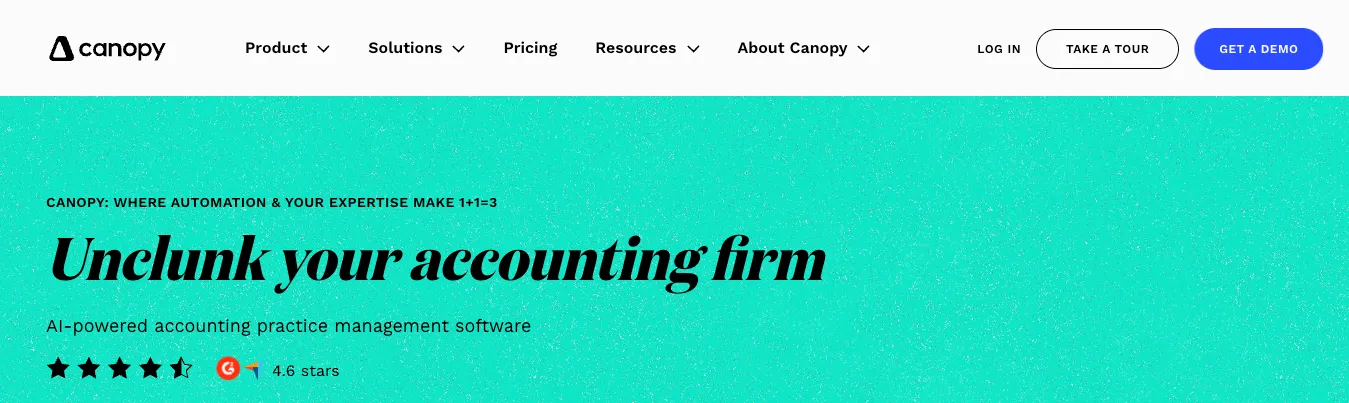
All-in-one practice management with IRS transcript integration.
Canopy pulls 20 years of IRS transcripts directly into the platform—a feature unique in practice management. Every pricing tier now bundles the full platform: document management, workflow, time & billing, and client portal. Specialist tax work (tax resolution, tax workflow automation) is priced separately as consumption-based add-ons. SOC 2 Type II certified.
Pricing: Three flat per-seat tiers on annual billing: Standard $74/user/month, Plus $109/user/month, Premium $149/user/month — full platform included at every tier. Specialist add-ons: Tax Resolution $50/user/month, Tax Workflow Automation from $34/client credit, Close Automation $10/connected client/month. A 10-person firm on Standard pays $740/month before add-ons. (Canopy pricing checked 13 August 2026.)
Integrations: QuickBooks Online, Xero, FreshBooks, Gmail, Outlook, Slack, Salesforce, Zoho, Mailchimp, Google Contacts, Zapier, IRS Transcripts. View all
Strengths: Only platform with direct IRS transcript access (20 years history). Full platform bundled from the entry tier. Unlimited eSignatures included.
Weaknesses: Steep learning curve reported by users. US-focused with limited international features. Occasional bugs and glitches reported. No self-serve free tier — trial requires a sales demo.
Best for: Tax resolution practices and US-based firms (1-20 users) needing IRS transcript access. Firms comfortable budgeting for metered specialist tax add-ons.
Links: Website • G2 • Capterra
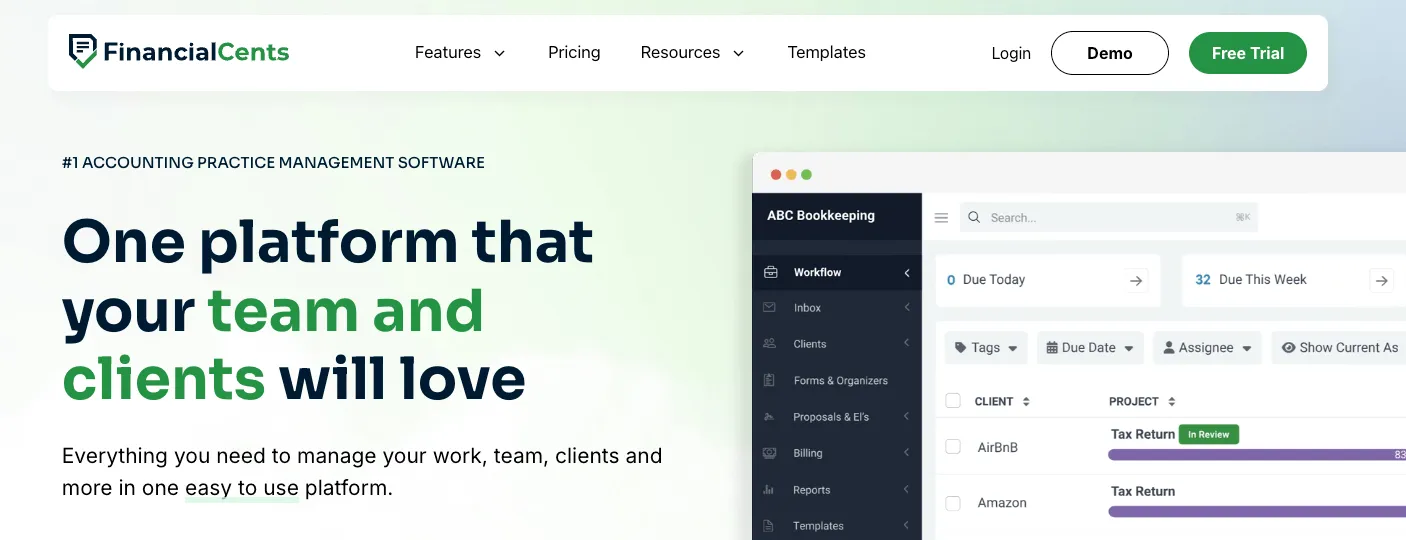
5. Financial Cents
Easy-to-use workflow management for small firms.
Financial Cents won ease-of-use awards from 2023-2025 with 4.9/5 rating. The platform offers 100+ community-shared templates, visual team capacity management, and built-in proposals. Users report being productive within hours of setup.
Pricing: Solo $19/month, Team $49/user/month, Scale $69/user/month (annual billing). Monthly option requires 5-user minimum. A 10-person firm on Team pays $490/month.
Integrations: QuickBooks Online, Gmail, Outlook, SmartVault, Google Drive, OneDrive, Dropbox, Box, ShareFile, Adobe eSign, Ignition, GoProposal, Anchor, Zapier. View all
Strengths: Fastest onboarding in the category—users productive within hours. Strong QuickBooks Online two-way sync. Visual capacity management prevents team overload. 100+ community templates included.
Weaknesses: No native Xero integration—Zapier workaround only. Client emails sent from Financial Cents domain, not your firm’s. US/Canada only. Mobile app significantly weaker than desktop.
Best for: Small firms (1-10 users) using QuickBooks Online who prioritize ease of use over advanced customization. Not for Xero users or firms outside North America.
Links: Website • G2 • Capterra
6. Double (formerly Keeper)
AI-powered bookkeeping automation with month-end close tools.
Double (formerly Keeper) automates bookkeeping workflows with AI bank feeds, error detection, and 2-way sync to QuickBooks Online and Xero. The platform includes file review tools that help complete month-end close up to 3x faster. Unlimited team members on all plans.
Pricing: Per-client pricing: Core $10/client/month, Plus $25/client/month, Scale $50/client/month. A firm with 50 clients on Core pays $500/month. Tax Suite add-on $200/month.
Integrations: QuickBooks Online, Xero, Ping, Abacor, Zapier. View all
Strengths: AI detects miscoded transactions automatically. 2-way sync with QBO and Xero. Month-end close up to 3x faster. Unlimited team members included. Mix-and-match client tiers.
Weaknesses: Per-client pricing gets expensive at scale. Bookkeeping-only—no tax preparation or workflow features. Limited integrations compared to full practice management tools.
Best for: Bookkeeping and CAS practices (any size) wanting AI automation. Not suitable for tax firms or general practice management needs.
Links: Website • G2 • Capterra
7. Jetpack Workflow
Affordable workflow tracking for small accounting firms.
Jetpack Workflow offers 70+ pre-built templates, unlimited projects and clients, and capacity planning for teams. The platform focuses on standardizing recurring work with automated deadlines. 94% user satisfaction rating across review sites.
Pricing: Starter $40/user/month (annual) or $49/user/month (monthly). A 10-person firm pays $400/month annually. Setup packages: Kickstarter $299, Done-For-You $1,299.
Integrations: QuickBooks Online, Gmail, Microsoft Outlook, Google Calendar, Zapier. View all
Strengths: Affordable pricing for small teams. Unlimited projects and clients. 70+ pre-built templates. Free training sessions (3+ users get five 30-min sessions). 30-day money-back guarantee.
Weaknesses: No mobile app. No client portal. Limited integrations compared to competitors. Workflow-only—no billing, document management, or e-signatures.
Best for: Small firms (1-10 users) needing basic workflow tracking at an affordable price. Not for firms wanting all-in-one practice management.
Links: Website • G2 • Capterra
8. Qount
AI-native practice intelligence with eight unified modules.
Qount consolidates practice management, CRM, billing, document management, and client communication into one AI-powered platform. QAI (Qount AI) provides intelligent task prioritization, scope creep detection, and client sentiment analysis. Handles Tax, Accounting, 1099s, and Payroll workflows. Backed by $17M investment in 2025.
Pricing: Essentials $74, Pro $114, Intelligence $139/user/month (annual). 10-person firm: $740-1,390/month. One-time onboarding fee. No free trial.
Integrations: QuickBooks Online, Xero, Gmail, Outlook, HubSpot, Salesforce, CPACharge, Zenwork Tax1099. View all
Strengths: True all-in-one eliminates multiple subscriptions. AI task prioritization and sentiment analysis. Unified communication (email, SMS, portal). Users report 8-hour billing reduced to 10 minutes.
Weaknesses: No free trial. Ease of use rated 30%, steep learning curve. Premium pricing. Newer platform with smaller user base. Limited third-party integrations vs Karbon/TaxDome.
Best for: Mid-size firms (10-50 users) consolidating multiple subscriptions into one AI platform. Not for firms wanting proven stability or free trial.
Links: Website • Pricing • Capterra
9. Client Hub
Bookkeeping-focused practice management with deep QuickBooks integration.
Client Hub combines practice management, client portal, and bookkeeping workflows with month-end close automation. AI-powered features include workflow creation, email drafting, and cross-document search. Mobile apps for team and clients.
Pricing: Practice Manager $59/user/month (annual), PLUS $79/user/month. 10-person firm: $590-790/month. Unlimited clients and storage. Free trial available.
Integrations: QuickBooks Online, Xero, Microsoft 365, Google Workspace, Anchor, Zapier. View all
Strengths: Month-end close with transaction recategorization and anomaly detection. Automated client task reminders. 5.0/5 on G2. Per-user pricing—firms report 40% savings when switching.
Weaknesses: Bookkeeping-focused—no tax software integrations. Recurring jobs can create duplicate sequences. Reporting less robust than larger platforms. Full QBO features require PLUS tier.
Best for: Bookkeeping firms (5-30 users) wanting QBO integration and month-end automation. Not for tax-focused practices.
Links: Website • G2 • Capterra
10. Firm360
All-in-one practice management with strong tax software integrations.
Firm360 combines project management, document management, time tracking, billing, and client portal in one platform, built by a practicing CPA who wanted to replace five disconnected systems. US-based support team. See our full Firm360 review and pricing breakdown.
Pricing: Basic $49, Standard $79, Premium $99/user/month, billed annually. Standard and Premium carry a 3-user minimum, so the realistic entry point is $2,844/year. A 10-person firm on Standard pays roughly $9,480/year. Custom pricing for 20+ users. No free plan or self-serve trial: the entry point is a demo request.
Integrations: QuickBooks Online, UltraTax CS, Intuit Lacerte, CCH Axcess, Microsoft 365 (Word, Excel), Gmail, Stripe, Adobe (PDF and e-signature), Zapier (Premium only). Drake and ProConnect are not natively supported, though the announced AutoPrep integration routes data to both through Juno. View all
Strengths: Capterra 4.7/5 across 159 reviews, with Customer Service rated 4.8 and Ease of Use 4.6. US-based support is the most consistently praised aspect. Automated A/R collections from the Standard tier. An early AI mover: a Claude Connector shipped in limited beta in June 2026 for plain-language queries on live firm data, and AutoPrep, announced July 2026 with Juno, automates tax-prep data entry into major tax software.
Weaknesses: No free plan or self-serve trial, annual billing only, and the $49 Basic tier excludes project management, advanced reporting, custom fields, and every integration, so most firms start at $79 with a 3-user minimum. No public API or developer portal. E-signature costs extra on Basic. US-market focus means limited multilingual support. AutoPrep requires the $99 Premium tier plus a separate Juno subscription.
Best for: US tax and accounting firms (5-20 users) wanting deep tax software integration and strong support, and willing to commit annually without trialling first.
Links: Website • G2 • Capterra
11. Accelo
Professional services automation (PSA) platform beyond accounting.
Accelo integrates CRM, sales, project management, retainer tracking, time tracking, and invoicing in one platform. Designed for professional services firms broadly, not accounting-specific. Connects entire client journey from quote to cash with automated billing and retainer management.
Pricing: Professional ~$50, Business ~$70, Advanced ~$90/user/month. Minimum 3-7 users depending on plan. Contact for exact pricing. Free trial available, no credit card required.
Integrations: QuickBooks Online, Xero, Microsoft 365, Google Workspace, Salesforce, HubSpot CRM, Zapier, Stripe, PayPal, Ignition, Gusto, Jira. View all
Strengths: Comprehensive PSA covering entire client lifecycle. Strong Microsoft 365 integration with auto-sync. Powerful retainer and recurring work management. Extensive integrations (25+). Regular feature updates and responsive support.
Weaknesses: Steep learning curve—interface can feel cluttered for new users. Not accounting-specific, may be overkill. Ease of use 4.2/5 (below category average). Minimum user requirements. Pricing not transparent.
Best for: Multi-service professional firms (10-50 users) needing full PSA beyond accounting. Not ideal for pure accounting/tax practices or small teams under 5.
Links: Website • G2 • Capterra
12. Aero Workflow
Flat-rate workflow management with 160+ bookkeeping checklists.
Aero Workflow focuses on task scheduling with built-in procedures, client credentials storage, and time tracking. Each task contains step-by-step instructions, screenshots, and links. Includes 160+ ready-to-use bookkeeping checklists. Founded 2011.
Pricing: Startup (1-5 users) $135/month, Growth (6-25 users) $250/month, Scaling (26-50 users) $365/month. Flat rate, no per-user fees. Premium library +$40/month.
Integrations: QuickBooks Online, QuickBooks Time, Zapier, open API for custom integrations. View all
Strengths: Flat pricing regardless of user count within tier. 160+ ready-made bookkeeping checklists. Free onboarding, training, and certification for all users. Time tracking syncs to QBO for billing.
Weaknesses: Dated interface. Steep learning curve—requires watching training videos. Not complete practice management—lacks client communication and email integration. Limited for teams 3+.
Best for: Small bookkeeping firms (1-10 users) wanting flat pricing and detailed task procedures. Not for firms needing modern UI or full practice management.
13. ATOM Software
Tax office management for solo practitioners with client portal.
ATOM (Automated Tax Office Manager) helps tax preparers manage daily activities, client communication, and document exchange. Includes client portal with appointment scheduling, payments, and tax return status tracking. PIN-based e-signatures and centralized messaging.
Pricing: Starting at $149/month flat rate. Reasonable pricing for included functionality.
Integrations: Limited integrations. Basic email and SMS capabilities built-in. View features
Strengths: Client portal with payments, appointments, and status tracking. Flat pricing. Automated task reminders. Good for solo tax preparers managing client activities.
Weaknesses: Dated interface (described as “mid-90s design”). No pipeline or workflow manager. Built for single preparers—doesn’t scale for teams. Messaging not threaded. Clients find portal hard to navigate.
Best for: Solo tax preparers wanting basic client portal and task management. Not suitable for multi-staff firms or those needing modern UX.
14. BQE Core
Professional services platform primarily for architects and engineers.
BQE Core integrates project management, time tracking, billing, accounting, CRM, and HR. Built for architecture, engineering, and consulting firms with complex billing needs (retainers, progress billing). Cloud, on-premise, or hybrid deployment.
Pricing: Modular pricing starting ~$20/user/month. Pay per feature needed. 15-day free trial. Core Plus and Enterprise tiers available.
Integrations: QuickBooks Online, QuickBooks Desktop. View all
Strengths: 24/7/365 live support. 86% user satisfaction. Highly customizable billing. Mobile app for expenses. Scalable from startup to enterprise.
Weaknesses: Designed for AEC firms, not accounting practices. Steep learning curve. Mobile app lags desktop. Modular pricing adds up quickly.
Best for: Architecture/engineering firms (10-100+ users). Not purpose-built for accounting/tax practices.
Links: Website • G2 • Capterra
15. CCH Axcess Practice Management
Enterprise practice management within Wolters Kluwer ecosystem.
CCH Axcess Practice integrates time/billing, project management, and analytics within the CCH Axcess cloud suite. Best for firms already using CCH tax products. Open APIs for custom integrations.
Pricing: Contact for quote. Historically ~$255/user/year. Enterprise pricing varies by firm size.
Integrations: CCH Axcess Tax, CCH ProSystem fx, Microsoft Power BI, mobile app. View all
Strengths: Deep CCH ecosystem integration. 150+ customizable reports. Cloud-based with mobile time entry. Data visualization with Power BI.
Weaknesses: Pricing not transparent. Best value only for existing CCH users. Annual price increases reported without new features.
Best for: Mid-to-large firms (20+ users) already invested in CCH Axcess ecosystem. Not ideal for non-CCH shops.
16. CCH iFirm
Cloud practice management for international markets (UK, AU, CA, Asia).
CCH iFirm offers workflow automation, compliance tracking, client portals, and document management. Cloud-native with real-time access. Part of Wolters Kluwer ecosystem. Used by 24,000+ firms globally.
Pricing: Contact for personalized quote. 14-day free trial. Described as “pricey for small businesses.”
Integrations: CCH tax products, various regional compliance tools. View all
Strengths: Strong in UK/AU/CA markets. Local customer support teams. Integrated compliance and research. Onboarding and training included.
Weaknesses: Pricing not transparent. Best for Wolters Kluwer ecosystem users. Limited US market presence.
Best for: Small-to-mid firms in UK, Australia, Canada, or Asia using CCH products. Limited appeal for US-only practices.
Links: Website • G2 • Capterra
17. Elephant
Affordable all-in-one for small US accounting firms.
Elephant (ElephantCPA) provides client management, task management, time tracking, billing, e-signatures, messaging, and document management. Built by CPAs for CPAs. Cloud-based with no credit card required for trial.
Pricing: Starting at $49.95/user/month. Save 10% with annual billing. Free trial available.
Integrations: Stripe, Twilio. Limited third-party integrations. View all
Strengths: Simple flat per-user pricing. Built by CPAs. Includes e-signatures and payment processing. Good for solo/small firms.
Weaknesses: Limited integrations (only Stripe, Twilio). US-focused. Fewer advanced features than larger platforms.
Best for: Small US accounting firms (1-10 users) wanting affordable, simple practice management. Not for firms needing extensive integrations.
Links: Website • G2 • Capterra
18. IRIS Practice Management
UK-focused practice management with compliance features.
IRIS offers multiple products: IRIS Elements (cloud), IRIS Star (enterprise), and IRIS Accountancy Suite. Handles compliance for AML, FRS, GDPR, and MTD. Used by 24,000+ firms. Integrates with HMRC and Companies House.
Pricing: Contact for quote. 30-day free trial for IRIS Elements. No free version.
Integrations: Xero, QuickBooks, FreeAgent, KashFlow, HMRC, Companies House. View all
Strengths: Strong UK compliance features. Multiple deployment options. Modular approach. API available.
Weaknesses: Pricing not transparent. Gets expensive with more users. Primarily UK-focused.
Best for: UK accounting firms needing compliance automation and HMRC/Companies House integration. Limited appeal outside UK.
Links: Website • G2 • Capterra
19. Mango Practice Management
Affordable all-in-one with tax software integrations.
Mango provides project management, time/billing, document management, engagement letters, e-signatures, client portal, and integrated email. Built by accountants. Up and running in half a day.
Pricing: Starting at $35/user/month. Free trial, no credit card required. Implementation and training included free.
Integrations: Drake Tax, UltraTax CS, Lacerte, ProSeries, Intuit ProConnect, Gmail, Outlook, Mailchimp. View all
Strengths: Affordable pricing. Tax software integrations. Fast implementation. Free training. KBA e-signatures included.
Weaknesses: Less robust than enterprise solutions. Limited advanced reporting. Smaller user community.
Best for: Small-to-mid US tax/accounting firms (1-25 users) wanting affordable all-in-one with tax software integration.
Links: Website • G2 • Capterra
20. OfficeTools
Established practice management with Thomson Reuters backing.
OfficeTools (by CARET/Abacus) offers client management, project tracking, time tracking, billing, document management, and client portal. Cloud or on-premise deployment. Native cybersecurity features.
Pricing: Starting ~$10-100/user/month range. Free trial available. Price increases reported after Abacus acquisition.
Integrations: QuickBooks Online, Lacerte Tax, PayNow (Abacus). View all
Strengths: 82% user satisfaction. Comprehensive feature set. Bi-directional sync with accounting/tax apps. Mobile app included.
Weaknesses: Outdated UI reported. Significant price increases post-acquisition. Portal email issues noted.
Best for: Small-to-mid US accounting firms (5-25 users) wanting established solution. Consider pricing trajectory before committing.
Links: Website • G2 • Capterra
21. Pascal Workflow
Free tier available with patented Pay Lock feature.
Pascal Workflow offers CRM, client portals, proposals, e-signatures, document management, and automated billing. Unique Pay Lock feature requires payment before clients can view documents.
Pricing: Free tier for up to 5 users (250 contacts). Paid plans from $55/user/month. No free trial for paid tiers.
Integrations: Gmail, Outlook, Exchange, Google Drive, iCloud, Xero, QuickBooks. View all
Strengths: Generous free tier. Patented Pay Lock for collections. Complete tax delivery solution. 365-day email lookback imports past documents.
Weaknesses: No reporting features. Limited compared to full practice management platforms.
Best for: Solo practitioners and small firms (1-5 users) wanting free workflow tool. Upgrade for larger teams.
22. Practice CS
Enterprise solution within Thomson Reuters CS Suite.
Practice CS offers time/billing, project management, document management, and 150+ customizable reports. Part of CS Professional Suite alongside UltraTax CS, Accounting CS. SaaS, Virtual Office, or on-premise deployment.
Pricing: Contact for quote. Enterprise pricing. Annual fee increases (~5%) reported without proportional new features.
Integrations: UltraTax CS, Accounting CS, Fixed Assets CS, Planner CS, Microsoft Outlook. View all
Strengths: Deep CS Suite integration. 150+ reports. Multi-level security. Outlook sync. Established platform.
Weaknesses: Best value only for CS Suite users. Requires dedicated admin. Annual price increases.
Best for: Larger firms (50+ users) heavily invested in Thomson Reuters CS Suite. Not for small firms or non-TR shops.
23. PracticePro 365
Microsoft Dynamics 365-based practice management.
PracticePro 365 is built on Microsoft Dynamics 365 and Power Platform. Nine core modules including CRM, billing, project management, and real-time dashboards. SOC 2 Type 1 certified.
Pricing: Starting ~$10-100/user/month range. Contact for custom quote. Subscription model.
Integrations: Microsoft 365, Teams, Outlook, SharePoint, Power BI (native). View all
Strengths: Native Microsoft integration. Replaces 3-5 tools with one platform. SOC 2 certified. Real-time Power BI dashboards.
Weaknesses: Limited reviews (80% satisfaction from 3 reviews). Best for Microsoft-centric firms. Learning curve for non-Microsoft users.
Best for: Firms (10-50 users) already invested in Microsoft 365 wanting unified Dynamics-based solution.
24. Senta
Affordable UK practice management with unlimited e-signing.
Senta offers CRM, task management, document portal, workflows, automated reminders, and Companies House integration. All client accounts free. UK-focused with compliance features.
Pricing: £32/month first user (£25.60 annual), reduced rates for additional users. 30-day free trial. No hidden costs or per-module fees.
Integrations: FreeAgent, QuickBooks, Xero, GoProposal, Companies House, Zapier (1000+ apps). View all
Strengths: Simple transparent pricing. Unlimited e-signing included. Companies House integration. Automated client reminders.
Weaknesses: No inbox sync—email management is manual. UI not the most modern. No mobile app. Missing native invoicing.
Best for: Small UK firms (1-10 users) wanting affordable solution with compliance features. Not for firms needing email integration.
25. TaxFlow
Simple, affordable tax workflow tracking.
TaxFlow focuses specifically on tax workflow—tracking returns (1040s, 1120s, 1065s), deadlines, extensions, and entity associations. Customizable workflows without practice management bloat.
Pricing: $20/user/month (annual) or $25/user/month (monthly). All features included. Free trial, no credit card required.
Integrations: Limited. No API. Designed as one component of firm tech stack. View features
Strengths: Simple and affordable. Focused on tax workflow only. Customizable workflows. Tracks all entity types.
Weaknesses: Not full practice management. No API. Must supplement with other tools for complete solution.
Best for: Small tax practices (1-10 users) wanting simple workflow tracking without full PM overhead.
26. TPS Software (TPS Cloud Axis)
Canadian-focused practice management with 25+ years history.
TPS Cloud Axis offers time/billing, WIP, AR, workflow, scheduling, and client portal. 10,000+ accountants use TPS. Multi-office database support. Power BI analytics included.
Pricing: Starting at $15/user/month. Three tiers: Entrepreneur, Pro, Ultimate. Free trial. No onboarding fee.
Integrations: QuickBooks Online, Microsoft 365 Outlook (bi-directional). View all
Strengths: Very affordable starting price. 25+ years serving Canadian market. Multi-office support. Responsive customer service.
Weaknesses: No API. Primarily Canadian-focused. Learning curve reported. Occasional glitches.
Best for: Canadian accounting firms (1-50 users) wanting affordable, established solution. Strong for multi-office firms.
27. XCM Solutions
Enterprise workflow automation, now CCH Axcess Workflow.
XCM (now part of Wolters Kluwer as CCH Axcess Workflow) provides 360-degree visibility into tasks, projects, and metrics. Automated tracking across Tax, Audit, CAS, HR, and Operations departments.
Pricing: Per-user pricing. Contact Wolters Kluwer for quote. Enterprise-focused.
Integrations: CCH Axcess suite, various tax and accounting platforms. View all
Strengths: 360-degree real-time visibility. Custom “My View” dashboards. Automated task creation. Claims 500% ROI.
Weaknesses: Enterprise pricing. Part of Wolters Kluwer ecosystem—best for existing CCH users.
Best for: Large firms (50+ users) needing enterprise workflow automation, especially CCH Axcess users.
28. Xero Practice Manager
Free for Xero partners at Silver+ status.
Xero Practice Manager (XPM) offers job management, time tracking, invoicing, and workflow customization. Includes Xero Workpapers at no extra cost. Mobile app available. Part of Xero ecosystem.
Pricing: $149/month for up to 10 users (Bronze partners). FREE for Silver/Gold/Platinum partners. 14-day trial.
Integrations: Xero, Xero HQ, Xero Workpapers, 30+ third-party apps. View all
Strengths: Free for established Xero partners. Highly configurable. Mobile app. Includes Workpapers. 4.4/5 on G2.
Weaknesses: Must reach Silver partner status for free access. Best value only within Xero ecosystem.
Best for: Xero-focused firms (3+ staff, 200+ clients) at Silver partner level or above. Not for non-Xero shops.
29. Zoho Practice
Free for small teams within Zoho Finance ecosystem.
Zoho Practice offers client management, task management, workpapers, workflow automation, and client portal. WhatsApp integration for client communication. Preparing firms for MTD ITSA 2026.
Pricing: Free for up to 5 users. $5/user/month for additional users. Standard and Premium tiers for partners. 14-day trial.
Integrations: Zoho Books, Zoho Expense, Zoho Payroll, Zoho Billing, WhatsApp. View all
Strengths: Very affordable/free for small teams. WhatsApp integration. MTD ITSA ready. Part of Zoho ecosystem.
Weaknesses: Best value within Zoho ecosystem. Limited outside Zoho Finance suite.
Best for: Small firms (1-10 users) already using Zoho products. Great for UK firms preparing for MTD ITSA.
30. Acounta
AI-powered practice management with workflow automation.
Acounta offers workflow automation, CRM, document management, task management, billing, time tracking, and AI-powered features. Cloud-based with 30-day free trial.
Pricing: $99/user/month standard. Introductory: first user $65/month, additional users $45/month. Annual: $540/user/year (20% discount).
Integrations: QuickBooks, Google Workspace, Microsoft Outlook, Stripe. View all
Strengths: AI-powered automation. Comprehensive feature set. Introductory pricing available. 30-day free trial.
Weaknesses: Higher standard pricing ($99/user). English only. Newer platform with smaller user base.
Best for: Firms wanting AI automation willing to pay premium pricing. Take advantage of introductory rates.
31. Levvy
Practice management designed for firms with outsourced teams.
Levvy offers work management, workflow automation, time tracking, capacity management, team collaboration, and Smart Assist AI. Designed for accounting firms with distributed/outsourced teams.
Pricing: Starter (1-50 users) $79/user/month, Whole Firm (51-100 users) $99/user/month, Enterprise 101+ custom pricing.
Integrations: QuickBooks Online, Xero, Gmail, Outlook, Slack, Zapier. View all
Strengths: Built for outsourced teams. Smart Assist AI for quick answers. Prebuilt workflow templates. Automated time tracking and billing.
Weaknesses: Premium pricing. Newer platform. Best for firms with outsourcing model.
Best for: Mid-to-large firms (20-100 users) with outsourced or distributed teams needing capacity management.
Tax Preparation Software for Accountants & CPAs
The tax preparation services market reached $34.9 billion in 2025 and is projected to hit $46 billion by 2029. According to a 2024 Journal of Accountancy survey, CPAs most commonly use UltraTax CS (22.6%), Lacerte, and Drake Tax. Nearly 90% of accounting firms raised tax prep rates in 2025, with hourly billing declining as firms shift to fixed-fee and value-based pricing. The competitive landscape is intensifying as electronic filing and AI-powered tools disrupt traditional prep workflows.
1. UltraTax CS
Enterprise tax compliance software from Thomson Reuters.
UltraTax CS is premium tax preparation software used by 22.6% of CPAs according to a 2024 Journal of Accountancy survey—the highest market share among professional tax software. The platform supports individual, business, fiduciary, and multi-state returns with extensive e-filing capabilities and integration with other Thomson Reuters products like Practice CS and Accounting CS.
Pricing: Starting around $2,500/year for limited plans. Unlimited filing options range from $7,000-$25,000/year depending on users and modules. Pay-per-return plans available at $25-$50 per return.
Integrations: Practice CS, Accounting CS, Onvio, GoFileRoom, FileCabinet CS, SmartVault, SurePrep. QuickBooks via third-party hosting. View all
Strengths: Comprehensive form coverage across federal, state, and local jurisdictions. Strong diagnostics and error-checking. Seamless integration with Thomson Reuters ecosystem. Handles complex multi-state returns efficiently.
Weaknesses: Steep learning curve—requires training for new users. Inconsistent customer support with complaints about response times. Premium pricing strains smaller firm budgets. QuickBooks integration requires manual imports or third-party tools.
Best for: Mid-size to large firms (10+ users) already invested in the Thomson Reuters ecosystem handling complex multi-state returns.
Links: Website • G2 • Capterra
2. Intuit Lacerte
Professional desktop tax software for complex returns.
Lacerte is Intuit’s flagship professional tax software designed for large tax and accounting firms handling complex returns. The platform features over 5,700 tax forms and 25,000+ built-in diagnostics. According to a 2024 CPA survey, Lacerte scored highest for overall rating, e-filing ease, and handling multistate business returns—with 73% of CPAs praising its usability.
Pricing: Multiple packages available: Lacerte 200 (limited returns), Lacerte Unlimited, and Pay-as-you-go options. Tax Planner and Analyzer included free with Unlimited. New customers eligible for 40% off hosting for first 4 months.
Integrations: QuickBooks Desktop, QuickBooks Online Accountant, SmartVault, Microsoft Office 365, Adobe Acrobat. Rightworks hosting for third-party apps. View all
Strengths: Excellent state integration and K-1 export/import. Over 25,000 diagnostics catch errors before filing. Automatic updates eliminate manual patching. Strong QuickBooks integration. Highly rated for multistate business returns.
Weaknesses: Expensive with annual price increases. Customer support can be slow—30-45 minute wait times reported during peak periods. All significant workflow improvements sold separately as add-ons. Cannot e-file past years if subscription lapses.
Best for: Large tax and accounting firms with multiple preparers handling complex individual and business returns.
Links: Website • G2 • Capterra
3. Drake Tax
Value-focused tax software with unlimited state filing.
Drake Tax serves over 50,000 tax professionals filing approximately 26 million returns annually. The software includes all state returns without additional modules, free prior-year software with current-year purchase, and the GruntWorx feature for automated data entry. Drake offers U.S.-based phone support included in the price.
Pricing: Pay-Per-Return at $345. Unlimited Package at $1,825. Power Bundle (tax + accounting) at $1,975. All packages include unlimited state filing.
Integrations: Drake Accounting, QuickBooks, SmartVault, TaxDome, GruntWorx, StanfordTax, Soraban, SecureFilePro, TicTie Calculate. View all
Strengths: Competitive pricing—often 1/2 to 1/3 the cost of alternatives. All states included at no extra charge. Free prior-year software. GruntWorx automated data entry. Reliable performance handling high volumes. Free U.S.-based phone support.
Weaknesses: Not beginner-friendly—requires tax knowledge to avoid errors. Windows-only (no Mac support). Built-in CRM lacks robustness. Some users report dated interface. Inconsistent support quality with occasional conflicting advice.
Best for: Cost-conscious small to mid-size firms (1-20 users) with Windows environments who value unlimited state filing.
Links: Website • G2 • Capterra
4. Intuit ProConnect Tax Online
Cloud-based professional tax software with QuickBooks integration.
ProConnect Tax Online is Intuit’s cloud-based solution offering seamless QuickBooks Online integration. The software is free to use—you only pay when e-filing or printing. Features include 5,700+ forms, 25,000 error-spotting diagnostics, and Intuit Link client portal for document collection.
Pricing: Pay-per-return: Individual returns from $25.87, Business returns from $28.67. User Access license required at $105/user/year (or $1,049 flat fee for 10+ users). 25% discount available for new customers Nov 2025-Feb 2026.
Integrations: QuickBooks Online, QuickBooks Online Accountant, Intuit Tax Advisor, SmartVault, Intuit Link. View all
Strengths: True cloud-based—work from anywhere with no local installation. Seamless QuickBooks Online data import. Free Intuit Link client portal included. No upfront software cost—pay only for filed returns.
Weaknesses: Per-return fees accumulate for high-volume filers. User Access license adds $105/user/year cost as of 2025. Struggles with highly complex returns. Occasional bugs reported affecting user experience.
Best for: Small practices (under 50 returns) wanting cloud flexibility and tight QuickBooks Online integration without upfront software costs.
Links: Website • G2 • Capterra
5. CCH Axcess Tax
Cloud-native tax compliance from Wolters Kluwer.
CCH Axcess Tax is trusted by 94 of Accounting Today’s Top 100 Firms. The cloud-based platform offers comprehensive federal, state, and local form coverage with real-time integration to CCH AnswerConnect for tax research. Features include cryptocurrency reporting through CoinTracker and Ledgible integrations.
Pricing: 100 returns with 5 states at $2,299. 100 returns with unlimited states at $2,759. Unlimited returns at $9,999. Additional states $49.95 each. CCH Axcess Tax Essentials available for firms with 4 or fewer tax professionals.
Integrations: CCH Axcess Suite modules, CCH AnswerConnect, Microsoft Power BI, Ignition, third-party apps via CCH Marketplace API. View all
Strengths: Native cloud architecture with anywhere access. Real-time CCH AnswerConnect tax research integration. Crypto reporting capability. Trusted by top accounting firms. Strong integration across CCH Axcess ecosystem.
Weaknesses: Periodic lags and occasional outages during peak filing periods. Cost-prohibitive for firms with fewer than 100 clients. Limited user reviews available (5.3/10 on TrustRadius based on ~15 reviews).
Best for: Mid-size to large firms (5+ professionals) already using CCH Axcess ecosystem seeking cloud-native tax preparation.
Links: Website • G2 • Capterra
6. ATX
Professional tax software with comprehensive form library.
ATX by Wolters Kluwer provides over 6,000 federal, state, local, and specialty tax forms. According to a Journal of Accountancy survey, approximately 70% of respondents rated ATX highly for user-friendliness—higher than Drake, Lacerte, and other competitors. The software is designed for CPAs and small to mid-size firms.
Pricing: Pay-Per-Return at $869 (includes 6 individual returns). ATX 1040, MAX, Total Tax Office, and Advantage packages available at various price points. Contact vendor for specific package pricing.
Integrations: CCH AnswerConnect, CCH iFirm, ATX Payroll, Microsoft Office 365. Limited third-party options. View all
Strengths: High user-friendliness ratings. Flat fee regardless of e-file volume on unlimited plans. Comprehensive form library. All needed forms available without add-on purchases. 15+ years of user loyalty reported.
Weaknesses: Customer service complaints—long hold times and slow problem resolution. Memory requirements increasing (16 GB RAM recommended for 2025). Windows only—requires upgrade to Windows 11 for future compatibility.
Best for: Part-time tax preparers and small firms valuing user-friendly interface and flat-fee pricing.
Links: Website • G2 • Capterra
7. Intuit ProSeries Tax
Desktop tax software for small practices.
ProSeries is Intuit’s desktop-based tax solution known for reliability and affordability among solo practitioners and small firms. The software syncs with QuickBooks Desktop for automated data import and handles multiple states efficiently. Rated 4/5 stars with a score of 77/100 by ITQlick.
Pricing: Pay-Per-Return (Professional) at $419/year. Basic 20 at $599/year. Basic 50 at $969/year. Basic Unlimited at $1,519/year. 1040 Complete (Professional) at $2,199/year. All packages include unlimited e-filing.
Integrations: QuickBooks Desktop, SmartVault, Fixed Asset Manager, eFileCabinet. Rightworks hosting for third-party apps. View all
Strengths: Reliable and affordable for small firms. Good error checking and multi-state handling. QuickBooks Desktop integration. Desktop trial available for evaluation.
Weaknesses: Unused returns don’t credit to following year. Customer support dwindling as prices increase. Manual processes and costs less competitive for high-volume filers. Best suited for under 100 returns.
Best for: Solo practitioners and small firms (under 100 returns) preferring desktop software with QuickBooks Desktop integration.
Links: Website • G2 • Capterra
8. ProSystem fx Tax
Enterprise tax software for large firms.
CCH ProSystem fx Tax is considered the #2 professional tax software on the market for features, handling complex forms and calculations for large firms. The platform supports multi-user concurrent work on single returns, allowing specialists to address specific responsibilities simultaneously. User satisfaction rating of 83% based on 192 reviews.
Pricing: Contact Wolters Kluwer for custom pricing. Generally described as the most expensive professional tax software on the market.
Integrations: CCH ProSystem fx Suite (Engagement, Document, Scan, Fixed Assets, Practice Management), CCH AnswerConnect, QuickBooks. View all
Strengths: Robust handling of complex returns and calculations. Multi-user concurrent editing on single returns. Detailed help documentation. Handles all federal and state return types. Extensive electronic filing services.
Weaknesses: Steep learning curve—not intuitive. Most expensive option on the market. Lack of useful customer support reported. Platforms not modernized in years. Known issues sometimes remain unfixed.
Best for: Large firms with dedicated training resources handling highly complex multi-tiered consolidated returns.
Links: Website • G2 • Capterra
9. TaxAct Professional
Affordable tax software for high-volume preparers.
TaxAct Professional has served tax preparers since 2004, offering cloud and desktop versions at competitive pricing. Rated 4.8/5 on Capterra for ease of use, value, and support. The software is considered a top choice for high-volume preparers handling returns with medium to low complexity.
Pricing: Pay-per-return: Individual at $150 + $25 filing fee, Business at $249 + $40 filing fee. Unlimited plans and bundles available for low-volume preparers (40 or fewer returns). 30-day money-back guarantee.
Integrations: TaxDome, DocuSign, Drake Pay/Launchpay, Koinly (crypto reporting), Microsoft Office. View all
Strengths: Significantly less expensive than Lacerte and competitors. User-friendly and accurate calculations. Cloud version enables remote work. Excellent customer service. Over 12 years of user loyalty reported.
Weaknesses: Depreciation schedule doesn’t auto print. Difficult to convert PDF returns to new clients. Lacks some specialized return types (though common limitation). Basic feature set compared to premium alternatives.
Best for: High-volume preparers handling medium to low complexity returns who prioritize value over advanced features.
Links: Website • G2 • Capterra
10. TaxSlayer Pro
Cloud and desktop tax software with mobile app.
TaxSlayer Pro offers both web and desktop solutions with unlimited federal and state e-filing included in all packages. Features include the TaxesToGo mobile app, integrated bank products, and comprehensive training resources. The premium package includes a full corporate business suite for forms 706, 709, 990, 1041, 1065, 1120, 1120-S, and 5500.
Pricing: Starting at $1,495 for web version. All packages include unlimited federal and state e-filing, all state and local taxes, and top-rated technical support.
Integrations: TaxDome, TaxesToGo mobile app, Twilio, QuickBooks Online. No public API available. View all
Strengths: Affordable for solo practitioners. Reliable customer service. Fast return preparation. Includes client database upload capability. Mobile app for on-the-go access.
Weaknesses: Some users report high error rates affecting business operations. Support quality reportedly declined over years for some users. Less established than major competitors.
Best for: Solo practitioners and small practices wanting affordable cloud/desktop flexibility with mobile access.
Links: Website • G2 • Capterra
11. CrossLink
Professional tax software since 1989.
CrossLink has provided professional tax software solutions since 1989, offering both online and desktop versions. Features include Point-and-Shoot Error Correction for real-time diagnostics, Zapier integration for workflow automation, and remote signing capability. Rated 4/5 and considered a top choice for high-volume preparers.
Pricing: Desktop Unlimited originally $1,795 (sale pricing around $695 through some resellers). Pay-per-return options available. Recent pricing includes $10 per tax filed plus software cost through some service bureaus.
Integrations: Zapier, PayJunction, TaxPass mobile app, ERO-Go mobile app. View all
Strengths: Reliable year-over-year performance. Strong diagnostics with Point-and-Shoot Error Correction. Zapier integration for CRM and automation. Remote signing capability. Multi-user support.
Weaknesses: Lacks browser-based flexibility. Limited banking and support options. Pricing varies significantly by purchase channel. Desktop version requires Windows 10 or 11.
Best for: High-volume tax preparers needing reliable desktop software with strong diagnostics and workflow automation.
Links: Website • G2 • Capterra
12. GoSystem Tax RS
Enterprise cloud tax software from Thomson Reuters.
GoSystem Tax RS is utilized by the top 100 CPA firms and corporate tax departments. The cloud-native platform supports concurrent multi-user editing on single returns, enabling specialists to work simultaneously. Rated 3.9/5 on G2 based on 32 reviews, with 4.2/5 for product capabilities on Gartner Peer Insights.
Pricing: Contact Thomson Reuters for custom pricing. Pricing typically customized based on firm size and needs.
Integrations: CS Professional Suite (Accounting CS, Practice CS, Workpapers CS, GoFileRoom, FileCabinet CS), SurePrep, NetClient CS Portal, QuickBooks, Checkpoint. View all
Strengths: Scalable for firms of any size. Concurrent multi-user editing on single returns. Full federal, state, and local tax program coverage. Cloud-native architecture. Integrates with GoFileRoom and SafeSend.
Weaknesses: Some users report slow performance and confusing interface. No public pricing available. Service and support rated 3.5/5 on Gartner—lower than product capabilities.
Best for: Large firms and corporate tax departments handling bulk tax returns requiring concurrent multi-user collaboration.
Links: Website • G2 • Capterra
Accounting & General Ledger Software for CPA Firms
The general ledger software market is expected to grow from $53.6 billion in 2025 to $134 billion by 2034, driven by demand for real-time financial visibility and automated compliance. Cloud adoption leads the market as organizations prioritize accessibility and scalability over traditional on-premise installations. AI and machine learning are transforming these platforms—automating journal entries, detecting anomalies, and enabling natural-language queries on financial data. Major players include SAP, Oracle, Microsoft, QuickBooks, Xero, NetSuite, and Sage.
Accounting software for accountants splits into two layers that are easy to confuse. One layer is the general ledger software your clients’ books actually live in—QuickBooks Online, Xero, and the other platforms in this section. The other is the practice management layer your firm runs on to manage those clients, covered separately above. Most firms need both, and the two rarely overlap.
Online Bookkeeping Software for Accounting Firms
Online bookkeeping software is cloud-based accounting software that lets a firm work in a client’s books from anywhere, with the client’s bank feeds, invoices, and reports updating in real time instead of sitting in a file on someone’s desktop. QuickBooks Online and Xero (both reviewed below) are the default choice for most US and international firms—QuickBooks for its 750+ app ecosystem and accountant portal, Xero for unlimited users on every plan and multi-currency support. Wave and Zoho Books cover free and budget-conscious clients. That mix of tools is what most firms mean by bookkeeping software for accountants: cloud ledgers you work in on behalf of clients, not software you sell to clients directly. For firms doing high volumes of write-up and month-end bookkeeping, AI-native tools further down this page—Digits, Puzzle, Kick, and Double—automate 60-95% of the categorization and reconciliation work, cutting close time without adding headcount. If you’re choosing the software layer that runs your firm rather than your clients’ books, see our breakdown of practice management software for bookkeepers, and if you’re just getting started, our guide on how to start a bookkeeping business covers picking a stack from scratch.
1. QuickBooks Online
Market-leading cloud accounting for small businesses.
QuickBooks Online dominates small business accounting with over 7 million subscribers globally. The platform offers tiered plans from Simple Start to Advanced, with built-in AI automation, bank feeds, and extensive third-party integrations. QuickBooks Online Accountant provides a free portal for managing all client books with 30% ProAdvisor discounts.
Pricing: Simple Start at $30/month, Essentials at $60/month, Plus at $90/month, Advanced at $200/month. Prices increased 21% in August 2025. 30-day free trial available.
Integrations: Shopify, Square, Amazon, Stripe, PayPal, Bill.com, Gusto, Mailchimp, Zapier. 750+ apps in App Store. View all
Strengths: Industry standard with massive ecosystem of integrations. Easy client switching in accountant portal. Strong reporting and customization options. Constant feature updates and AI automation improvements.
Weaknesses: Annual price hikes frustrate users ($10+ yearly increases reported). Menu locations constantly changing with updates. Lag and loading issues with large transaction sets. Premium pricing compared to alternatives.
Best for: Small businesses (1-25 employees) and accounting firms wanting the industry-standard platform with maximum third-party integrations.
Links: Website • G2 • Capterra
2. Xero
Cloud accounting with unlimited users on all plans.
Xero serves over 4 million subscribers with cloud-based accounting featuring bank connections from 21,000+ global institutions. Unlike QuickBooks, Xero includes unlimited users on all plans. The platform offers 1,000+ integrations and uses plain-language terminology (“invoices owed” instead of “accounts receivable”).
Pricing: Early at $20/month (limited to 20 invoices/5 bills), Growing at $47/month, Established at $80/month. 30-day free trial. New customers get 90% off for first 3 months.
Integrations: Hubdoc, Stripe, Square, Shopify, Amazon, PayPal, Gusto, Zapier. 1,000+ apps in App Store. View all
Strengths: Unlimited users on all plans—major cost advantage for teams. Clean interface avoiding accounting jargon. Automatic bank feeds and transaction matching. Strong for growing international businesses with multi-currency support.
Weaknesses: No phone support—only email and chat available. Steep learning curve despite simple appearance. Early plan severely limited (20 invoices/month cap). No built-in payroll—requires Gusto or other add-on. Reports lack customization flexibility.
Best for: Growing businesses with multiple team members who need unlimited user access and international multi-currency capabilities.
Links: Website • G2 • Capterra
3. Sage Intacct
Cloud ERP for mid-market finance teams.
Sage Intacct is an AI-driven cloud accounting platform designed for mid-sized businesses with advanced reporting and multi-entity requirements. User satisfaction rating of 86% based on 2,342 reviews. The platform integrates with Salesforce, Expensify, Bill.com, and other enterprise tools. Popular in professional services, nonprofit, retail, and healthcare industries.
Pricing: Starts at $12,000/year for one user. Average customers spend $25,000-$35,000/year. Add-on modules add $3,000-$10,000/year each. Implementation typically costs 1-1.5x first-year subscription.
Integrations: Ramp, MineralTree, Tipalti, Versapay, Paylocity, Salesforce. 350+ marketplace partners. View all
Strengths: 65% of users praise intuitive interface. 94% report excellent scalability and performance. 94% value third-party integrations. Strong multi-entity consolidation and dimensional reporting.
Weaknesses: Subscription pricing exceeds small business budgets. Requires separate payroll integration. 64% of users report slow customer support response times. Feature-rich interface can overwhelm beginners.
Best for: SMBs with 15-250 employees and $5M-$250M annual revenue needing multi-entity consolidation and advanced financial reporting.
Links: Website • G2 • Capterra
4. NetSuite
Enterprise ERP from Oracle for scaling businesses.
Oracle NetSuite is the leading cloud ERP for businesses outgrowing entry-level accounting. The platform offers comprehensive financial management, inventory, CRM, and e-commerce in one system. Used by over 37,000 organizations globally. Modular pricing allows paying only for needed features.
Pricing: Base license at ~$999/month (billed annually). User licenses at $129/user/month (increased from $99 in 2025). Add-on modules $300-$1,500+/month each. Starter, Emerging, and Mid-Market editions available.
Integrations: Celigo, Shopify, Amazon, Salesforce, Avalara, ADP. SuiteApp marketplace with hundreds of certified apps. View all
Strengths: Comprehensive all-in-one ERP with accounting, inventory, CRM. Strong automation and reporting accuracy. Scalable from startup to enterprise. Real-time visibility across all business functions.
Weaknesses: Expensive with hidden fees and costly add-ons. Complex setup requiring proper onboarding and training. Frequent price increases after contracts (up to 28% if declining Advanced Customer Support). No free tier available.
Best for: Growing businesses ($5M+ revenue) that have outgrown QuickBooks/Xero and need unified ERP with inventory, CRM, and advanced financials.
Links: Website • G2 • Capterra
5. FreshBooks
Invoice-first accounting for freelancers and service businesses.
FreshBooks serves over 30 million users with accounting focused on invoicing, time tracking, and expense management. The platform excels at simple, intuitive workflows for freelancers and service-based businesses. Recognized in 2025 Capterra Shortlist for Accounting Software.
Pricing: Lite at $19/month (5 clients), Plus at $33/month (50 clients), Premium at $60/month (unlimited clients). Select plan with custom pricing. Team members +$11/user/month. 30-day free trial.
Integrations: G Suite, Stripe, Square, Squarespace, Bench, Shopify, Gusto, Zapier. 100+ apps. View all
Strengths: Exceptional ease of use—particularly strong invoicing. Built-in time tracking and project management. 24/7 chatbot support plus live chat. Low learning curve for non-accountants.
Weaknesses: Client limits on lower tiers frustrating for growth. No bank reconciliation in Lite plan. Not GAAP/IFRS compliant. Extra users at $11/month adds up quickly. No forecasting or budgeting tools.
Best for: Freelancers and service-based businesses (under 10 employees) prioritizing simple invoicing and time tracking over complex accounting.
Links: Website • G2 • Capterra
6. Zoho Books
Affordable cloud accounting in the Zoho ecosystem.
Zoho Books offers cloud accounting with a genuinely useful free plan (under $50K revenue) and strong automation. Rated 4.4/5 stars. The platform integrates seamlessly with Zoho CRM, Inventory, and Projects. Most small businesses pay $15-$60/month.
Pricing: Free plan (under $50K revenue, 1,000 invoices/year). Standard at $15/month, Professional at $40/month, Premium at $60/month, Elite at $120/month. Save 20-25% paying annually.
Integrations: Zoho CRM, Zoho Inventory, Zoho Projects, Amazon, Etsy, Shopify, Square, Stripe, Zapier. View all
Strengths: Free plan genuinely useful for micro-businesses. Excellent value—Elite plan 30-40% cheaper than comparable competitors. Strong Zoho ecosystem integration. Automation capabilities reduce manual work.
Weaknesses: Best value requires commitment to Zoho ecosystem. Less known than QuickBooks/Xero means fewer accountants familiar with it. Support quality varies. Advanced features require higher tiers.
Best for: Small to midsize businesses (1-200 employees) already using or open to Zoho ecosystem wanting excellent value.
Links: Website • G2 • Capterra
7. Wave
Free accounting software for micro-businesses.
Wave provides genuinely free accounting and invoicing for small businesses, serving over 2 million businesses globally since 2010. Acquired by H&R Block in 2019. The free tier includes unlimited invoicing, expense tracking, and double-entry accounting with financial reports.
Pricing: Free plan includes accounting and invoicing. Pro plan at $16/month adds bank transaction automation and receipt scanning. Payroll at $40/month base + $6/employee.
Integrations: PayPal, Shopify, Etsy, Google Sheets, Zapier, Make. Limited native integrations. View all
Strengths: Truly free accounting—not a limited trial. Unlimited users at no cost. Modern, clean interface. Unlimited professional invoices. Solid for basic bookkeeping needs.
Weaknesses: No third-party integrations. Free users cannot contact human support. Auto-categorization causes issues—duplicates transactions and bank feed delays reported. Account freezes reported by some users. Limited features compared to paid alternatives.
Best for: Freelancers and micro-businesses (under $100K revenue, fewer than 10 employees) with basic accounting needs and limited budget.
Links: Website • G2 • Capterra
8. Campfire
AI-native ERP for startups outgrowing QuickBooks.
Campfire is a modern accounting platform founded in 2023, positioned as a “modern NetSuite” for startups and mid-size tech companies. Raised $108M total funding including $35M Series A led by Accel (2025). Targets companies migrating from QuickBooks, Xero, or frustrated with NetSuite/Sage.
Pricing: Contact for custom pricing. No public pricing tiers available.
Integrations: Ramp, Brex, Rho, Stripe, Salesforce, HubSpot, Snowflake, Looker. 100+ API endpoints. View all
Strengths: Modern LLM-powered alternative to legacy ERPs. Built for startups scaling beyond QuickBooks. Strong investor backing (Accel, Y Combinator). Core accounting plus revenue automation.
Weaknesses: New company (founded 2023)—limited track record. No public pricing transparency. Fewer reviews and user testimonials available compared to established players.
Best for: Venture-funded startups and mid-size tech companies outgrowing QuickBooks/Xero or frustrated with NetSuite complexity.
Links: Website
9. Puzzle
AI accounting software built for startups.
Puzzle offers AI-powered accounting specifically designed for startups, automating 85-95% of repetitive bookkeeping tasks with up to 95% categorization accuracy. Features include real-time financial dashboards showing burn rate, runway, ARR/MRR, and investor-ready reporting. Popular among founders switching from QuickBooks/Pilot.
Pricing: Free tier for companies under $5K monthly expenses. Paid plans starting at $43/month. Custom pricing for larger organizations.
Integrations: Brex, Ramp, Mercury, Stripe, Gusto, Rippling, Deel, BILL, Plaid, Runway. View all
Strengths: AI automates 85-95% of bookkeeping tasks. Clean, simple interface praised by founders. Real-time runway and burn rate visibility. Painless setup with responsive onboarding. Investor-ready dashboards.
Weaknesses: Still requires CPA review for tax filings and audits. Newer platform with less track record than established tools. Best suited for startup use cases—may lack features for complex businesses.
Best for: Early-stage startups wanting automated bookkeeping with runway/burn rate visibility without full-time bookkeeper costs.
Links: Website • G2 • Capterra
10. QuickBooks Enterprise
Advanced desktop accounting for larger businesses.
QuickBooks Enterprise is the only remaining QuickBooks Desktop product available for new purchases (after September 2025). Supports 1-30 simultaneous users with advanced inventory, custom user permissions, and industry-specific editions for manufacturing, contractors, retail, and nonprofits. User satisfaction rating of 90% based on 21,750 reviews.
Pricing: Gold starting at ~$1,740/year, Platinum and Diamond tiers available. Significant price increases in 2025 (some users report 47-75% increases over 3 years). Cloud hosting adds $30-60/user/month.
Integrations: Bill.com, PayPal, Square, Amazon, Tipalti, SOS Inventory, Zapier. 750+ apps via QuickBooks ecosystem. View all
Strengths: Handles complex accounting for manufacturing, construction, retail. Advanced inventory management and reporting. 160+ customizable reports. Supports up to 30 users. Desktop reliability without cloud dependency.
Weaknesses: Steep price increases (2024: $1,325 → 2025: $2,230 reported). Windows only. Less automation than cloud competitors. Intuit discontinuing other Desktop products—Enterprise is only remaining option.
Best for: Businesses (10-100 employees) in manufacturing, construction, or retail needing advanced inventory and preferring desktop software.
Links: Website • G2 • Capterra
11. Rillet
AI-native ERP automating 93% of accounting tasks.
Rillet is an AI-native ERP built by accountants, automating approximately 93% of accounting processes. Raised over $100M in 2025 (Series A from Sequoia, Series B from Andreessen Horowitz and ICONIQ). Features plug-and-play connectors for Stripe, Salesforce, Ramp, Brex, Rippling, and more.
Pricing: Three tiers: Starter, Scale, and Enterprise. Specific pricing not publicly available—contact for quote.
Integrations: Salesforce, HubSpot, Stripe, Ramp, Brex, Rippling, Gusto, ADP, Tipalti, Avalara, Anrok. View all
Strengths: Automates 93% of accounting processes. Real-time financials with automatic bank feeds. White-glove implementation with chart of accounts design support. Users praise “fast, intuitive, and beautifully modern” interface. Slack-based support.
Weaknesses: No public pricing—requires sales contact. Newer company—less established than legacy ERPs. May be overkill for simple accounting needs.
Best for: Venture-funded startups and mid-market companies seeking modern ERP replacement for NetSuite, Sage Intacct, or QuickBooks.
12. SoftLedger
Multi-entity accounting with real-time consolidation.
SoftLedger provides multi-entity accounting designed for organizations managing multiple subsidiaries, entities, or business units. Features real-time consolidation, multi-currency management, and a powerful API. Most clients operational within 30-45 days of implementation.
Pricing: Standard at $750/month, Enterprise at $975/month, Enterprise with Digital Asset at $1,375/month. All plans include unlimited entities.
Integrations: Expensify, Plaid, Stripe, Ramp, BILL, Budgeto, QuickBooks Online. Open API for custom integrations. View all
Strengths: Unlimited entities included in all plans—no per-entity fees. Real-time multi-entity consolidation. Strong API for integrations. Users praise simplicity for family offices and holding companies. Responsive support team.
Weaknesses: AP and AR reports described as “bare.” Opening/closing accounting periods requires manual work for each module. Less feature-rich than enterprise ERPs like NetSuite.
Best for: Family offices, holding companies, and multi-entity organizations needing consolidated reporting across many subsidiaries.
Links: Website • G2 • Capterra
13. Odoo
Open-source modular ERP with free accounting app.
Odoo is an open-source ERP offering modular apps from accounting to inventory, CRM, and project management. The accounting app is free as a standalone; fees apply when adding modules. 88% of reviewers rate it as good value, with 100% positive feedback on integrations. Used by businesses wanting customizable, scalable solutions.
Pricing: One App Free (accounting only with unlimited users). Standard at $24.90/user/month (all apps), Custom at $37.40/user/month (all apps + customization). Save with annual billing.
Integrations: QuickBooks connector, TaxJar, Stripe, PayPal, Shopify, Amazon. Odoo Apps Store with thousands of modules. View all
Strengths: Free accounting app if only one module needed. Open-source enables deep customization. Massive app ecosystem (accounting, inventory, CRM, HR, etc.). Scalable from startup to enterprise. Strong community and documentation.
Weaknesses: Requires technical expertise for customization. Quality depends on implementation partner. Setup can be complex for non-technical users. Support complaints regarding responsiveness.
Best for: Small to mid-size businesses (1-200 employees) in retail, manufacturing, or services wanting customizable, modular ERP with open-source flexibility.
Links: Website • G2 • Capterra
14. E-conomic – Accounting Software for Danish Accountants
E-conomic is the preferred accounting software in Scandinavia. It is highly regarded for its powerful features, which cater specifically to the needs of Danish accounting firms.
E-conomic enhances accounting workflows by:
- Automating essential tasks like invoicing, VAT reporting, and receipt uploads to reduce manual data entry.
- Simplifying client management through streamlined and automated workflows, allowing accountants to focus on strategic activities.
- Offering extensive app integration, facilitating a more cohesive operation and all-in-one solution.
Accounting Reporting Software
Accounting reporting software is the layer that turns the general ledger into decisions—dashboards, dimensional breakdowns, and exports finance teams actually read. Among the tools above, Sage Intacct is built around multi-entity consolidation and dimensional reporting for mid-market finance teams, NetSuite gives real-time visibility across financials, inventory, and CRM in one system, and CCH Axcess Tax exports directly to Microsoft Power BI for custom dashboards. That’s reporting on the client’s books. If what you actually need is reporting on your own firm—hours worked, overdue tasks, client profitability—that’s a practice management concern, not a general ledger one; see Uku’s reporting for an example built specifically for accounting firms.
AI-Powered Accounting Software for CPAs
By 2026, AI will shift from optional add-on to native layer inside core accounting systems. 95% of accountants have already adopted some automation, with 98% reporting improved accuracy and efficiency. The fundamental shift: AI is moving from generative support (helping spot anomalies) to agentic support (doing the checking, identification, and reconciliation autonomously). This transforms accountants from Preparers to Reviewers. Firms integrating AI report 5-7 hours saved weekly per professional, though the industry demands algorithmic transparency—”black box” AI won’t fly in accounting.
1. Digits
Next-generation accounting platforms using artificial intelligence to automate transaction categorization, reconciliation, and anomaly detection. Trained on billions of dollars in transaction data, these AI-native tools reduce manual bookkeeping work by 60-80% while improving accuracy. Ideal for CAS-focused firms looking to scale client capacity without proportionally scaling headcount.
Digits represents a new generation of accounting software built from the ground up with AI. The platform delivers real-time financials, 24/7 AI reconciliation handling up to 1M transactions/year, and auto-populated vendor/customer directories.
Pricing: Essentials at $65/month (coming soon), AI Accounting at $100/month, Full-Service at $350+/month with dedicated accountants. Professional tier has custom pricing.
Integrations: Gusto, Mercury, Ramp, BILL, Stripe, Arc. Plaid for 12,000+ bank connections. View all
Strengths: Users describe it as “10x better than any other accounting software.” Dimensional accounting for department, location, and project tracking. W-9 and 1099 tracking built-in. Integrations with Gusto, Mercury, Ramp, BILL, Stripe, and Arc.
Weaknesses: Newer platform with less proven track record. Full-service tier required for dedicated accountant support.
Best for: SMBs (10-500 employees) wanting AI-first accounting.
Links: Website • G2 • Capterra
2. Kick
95% auto-categorization for entrepreneurs.
Kick automates bookkeeping with AI that auto-categorizes approximately 95% of transactions, handles reconciliation, and generates reports automatically.
Pricing: Free under $25k annual expenses. Basic/Plus for $25k-250k (30-day trial then annual). Enterprise for $250k+ (custom pricing via sales call).
Integrations: Stripe, PayPal, Ramp, Mercury, Gusto. Plaid for bank connections. US only. View all
Strengths: Built specifically for entrepreneurs. 95% auto-categorization. Multi-entity at no extra fees. Stripe, PayPal, Mercury integrations.
Weaknesses: 1.8 stars on Trustpilot (early-stage product). US-only. Limited to basic bookkeeping needs.
Best for: US-based entrepreneurs with straightforward books wanting minimal manual work.
Links: Website
3. Synder
Synder automates the transfer of financial data, reducing manual work and errors. By integrating with popular payment platforms and accounting software (e.g., Stripe, PayPal, Square, QuickBooks, and Xero), Synder synchronizes invoices and transactions in real-time. This allows accountants to spend less time on repetitive tasks and focus more on strategic client advising, ultimately improving overall efficiency and accuracy.
Payroll Software for Accounting Firms
Payroll software commands 29.45% of the accounting software market, expanding at 10.91% CAGR through 2030. The HR payroll market alone is valued at $35 billion and growing to $66 billion by 2029. Despite available technology, 51% of organizations still use spreadsheets for payroll processing—creating opportunity for firms offering modern solutions. In 2025, 77% of organizations use AI in payroll processing, and 94% of business leaders want payroll integrated across all HR systems. Data security remains the top improvement priority globally.
1. Gusto
#1 rated payroll on G2 for small businesses.
Gusto serves over 400,000 businesses with payroll, benefits, and HR tools. Ranked #1 in customer satisfaction on G2 Fall 2025. The platform handles payroll tax filing, health benefits administration, and offers a dedicated Gusto Pro plan for accountants managing client payroll with month-long free trials.
Pricing: Simple at $49/month + $6/employee. Plus at $80/month + $12/employee. Premium at $180/month + $22/employee. Contractor-only at $6/contractor/month. Prices increased March 2025.
Integrations: QuickBooks, Xero, Slack, Google Workspace, Zoom, Microsoft 365, Zapier. 180+ apps. View all
Strengths: #1 G2 rating for customer satisfaction. Easy to use interface. Includes multiple pay runs and tax filing at no extra cost. Health benefits administration. Early paydays and spending account features praised by users.
Weaknesses: Some users report inconsistent customer service. Limited PTO administration options. Cannot administer benefits that aren’t 100% employer-funded. Some tax document errors requiring outside accountant fixes reported.
Best for: Small businesses (1-100 employees) wanting all-in-one payroll with benefits administration and strong user experience. If training tools are also on your list, see the Gusto LMS pricing breakdown.
Links: Website • G2 • Capterra
2. Rippling
Unified HR, payroll, and IT management platform.
Rippling combines HR, payroll, benefits, and IT device management in one platform. Highest-rated HR platform on Software Advice 2025 with 4.9/5 from 3,300+ reviews. The platform automates 95% of payroll admin and automatically provisions employee laptops, email, and software access when hiring.
Pricing: Core platform starts at $8/employee/month. Payroll module at $35/month per user. Most businesses pay $25-$50/employee/month with full modules. Quote-based pricing—no public price list.
Integrations: QuickBooks Online, Xero, NetSuite, Sage Intacct, Slack, Zoom, Okta. 650+ apps. View all
Strengths: Automates 95% of payroll administration. 600+ software integrations. Unified HR + IT management (auto-provisions devices and software). Handles federal, state, and local taxes with penalty reimbursement for Rippling errors. 60% of users rate pricing positively.
Weaknesses: No pricing transparency—requires sales contact. No free trial available. Implementation takes 2-4 weeks (6-8 for complex migrations). More expensive than payroll-only solutions for very small teams.
Best for: Tech-forward growing businesses (50-1,000 employees) needing unified HR, payroll, and IT management in one platform.
Links: Website • G2 • Capterra
3. OnPay
Transparent pricing with 30+ years payroll experience.
OnPay evolved from a traditional payroll service with over 30 years of processing experience. Named best payroll service for small businesses by Business News Daily. The platform offers as many or more features than Gusto, ADP, and Paychex while charging less than all three for comparable services.
Pricing: Single plan: $40/month + $6/person. Includes W-2s, 1099s, year-end filings, unlimited pay runs, multi-state tax filing, and HR tools. No setup fees, contracts, or cancellation fees. Free one-month trial.
Integrations: QuickBooks Online, QuickBooks Desktop, Xero, QuickBooks Time, Deputy, When I Work. View all
Strengths: Transparent pricing with no hidden fees. Unlimited payroll runs included. Multi-state tax filing at no extra cost. Free setup and dedicated onboarding support. Guaranteed on-time, accurate tax filing. HR tools included at no extra cost.
Weaknesses: Single plan lacks scalability for complex growing businesses. Mobile admin app has fewer functions than desktop. Less brand recognition than major competitors.
Best for: Small to midsize businesses (up to 500 employees) wanting straightforward pricing with comprehensive features and no hidden costs.
Links: Website • G2 • Capterra
4. ADP RUN
Enterprise payroll giant for small businesses.
ADP serves over 900,000 small business clients with RUN Powered by ADP, designed for 1-49 employees. User satisfaction rating of 90% based on 2,835 reviews. Four plan tiers (Essential, Enhanced, Complete, HR Pro) offer increasing features from basic payroll to full HR suite.
Pricing: Essential starts around $79/month + $4/employee (reported user pricing). Implementation fees around $2,000 reported. Custom quotes based on business size, location, and services. Annual contracts typically required.
Integrations: When I Work, Ease, 401(k) providers, HSA providers. ADP Marketplace for more apps. View all
Strengths: 24/7 customer support on all plans. 88% of users praise intuitive interface including mobile app. Strong automation and reporting. Established reputation with 900K+ clients. Comprehensive compliance coverage.
Weaknesses: Complex, non-transparent pricing with potential hidden fees. Annual contracts with early termination fees. Per-payroll-cycle charges costly for weekly pay schedules. Pricier than simpler alternatives for basic needs.
Best for: Small businesses (10-49 employees) wanting single-vendor solution with strong automation, willing to pay premium for established provider.
Links: Website • G2 • Capterra
5. Justworks
PEO with access to large-group benefits.
Justworks offers Professional Employer Organization (PEO) services, providing access to Fortune 500-level benefits at small business prices. Rated 4.6/5 on G2 from 576 reviews. The platform handles payroll, compliance, HR, and benefits through a co-employment model.
Pricing: Payroll-only at $50/month + $8/employee. PEO Basic at $79/employee/month. PEO Plus at $109/employee/month (adds health insurance). EOR (international) at $599/employee/month. Time tracking add-on at $8/employee.
Integrations: QuickBooks Online, Xero, NetSuite, Sage Intacct, Greenhouse, 15Five, Carta, Brex, Ramp. View all
Strengths: Access to large-group health insurance rates. Clear pricing with no hidden fees or setup costs. 24/7 support through multiple channels. Intuitive, easy-to-implement platform. Compliance expertise included.
Weaknesses: PEO model means less control—reps are service people, not payroll/tax experts. Limited reporting and onboarding functionality vs. full HRIS. Higher cost than simple payroll tools ($59-$599/employee).
Best for: U.S.-based small to mid-size businesses (5-500 employees) wanting PEO benefits access and compliance support without enterprise complexity.
Links: Website • G2 • Capterra
6. Patriot Payroll
Budget-friendly payroll for very small businesses.
Patriot Payroll serves U.S. businesses with 1-500 employees at highly competitive pricing. Rated 4.8/5 overall with 5 stars on Trustpilot from 3,177 reviews. Over 70% of reviewers come from companies with 2-10 employees, confirming its small business focus.
Pricing: Basic Payroll at $17/month + $4/employee (self-service tax filing). Full Service at $37/month + $5/employee (includes tax filing). No setup fees, contracts, or cancellation fees. 30-day free trial, then 50% off for 3 months.
Integrations: Patriot Accounting, QuickBooks Online, QuickBooks Desktop, Patriot Time & Attendance. Limited third-party options. View all
Strengths: Most affordable option—$17/month base vs. $50+ competitors. US-based customer support praised as responsive and knowledgeable. No contracts or cancellation fees. Unlimited payroll runs included. Direct deposit for employees and contractors.
Weaknesses: Tax filing only in Full Service plan. Multi-state filing costs extra ($12/additional state). Lacks functionality of full-service platforms like QuickBooks. US-only—no international payroll.
Best for: Very small U.S. businesses (1-10 employees) in a single state wanting the most affordable payroll with solid basic features.
Links: Website • G2 • Capterra
7. QuickBooks Payroll
Seamless integration with QuickBooks accounting.
QuickBooks Payroll offers the tightest integration with QuickBooks Online, automatically transferring payroll data to your books. High marks from 500+ reviews for ease of use, setup, and QuickBooks integration. Three tiers offer increasing features from basic payroll to tax penalty protection.
Pricing: Core at $50/month + $6.50/employee. Premium at $85/month + $9/employee. Elite at $130/month + $11/employee. Prices increased July/August 2025. Plus subscription has risen 64% since 2020.
Integrations: QuickBooks Online, QuickBooks Time, QuickBooks ecosystem apps. Native integration with QBO. View all
Strengths: Seamless QuickBooks Online integration—automatic data transfer. Simple setup with customizable reports. All plans include multi-state payroll and federal/state tax filing. Next-day direct deposit on all plans.
Weaknesses: Base plan lacks automated local tax filing. Multi-state filing only in Elite without extra fees. Steady price increases (64-83% over 5 years). Same-day direct deposit only on higher tiers. Some glitches with updates reported.
Best for: QuickBooks Online users wanting seamless payroll-accounting integration without managing separate systems.
Links: Website • G2 • Capterra
8. Paychex Flex
50+ years serving 740,000 companies.
Paychex has over 50 years in business serving approximately 740,000 companies. Paychex Flex offers three tiers (Essentials, Select, Pro) with scalable payroll, HR, and compliance tools. Integrates with nearly 300 third-party vendors for customized business platforms.
Pricing: Essentials starts at $39/month + $5/employee. Select and Pro tiers offer additional HR tools at higher prices. PEO services average ~$140/employee/month. Custom quotes required—no public price list for all tiers.
Integrations: QuickBooks, Xero, Fidelity, Empower, Principal Financial, Charles Schwab. Paychex Marketplace. View all
Strengths: 24/7 support and strong compliance coverage. 300+ third-party integrations. Scalable from small business to enterprise. Mobile access with intuitive dashboards. 50+ years of industry experience.
Weaknesses: No public pricing for most services. Onboarding can feel lengthy. System complex initially. Customer support reviews mixed. Advertised prices don’t include per-employee charges and add-ons.
Best for: Growing businesses wanting scalable payroll with extensive integration options and established provider reputation.
Links: Website • G2 • Capterra
9. SurePayroll
Budget payroll from Paychex for simple needs.
SurePayroll, a Paychex company since 2010, has over two decades of small business payroll experience. Rated 4/5 with 95% of G2 reviewers recommending it. Offers both full-service and DIY payroll options with no contracts—cancel anytime with no penalty.
Pricing: No Tax Filing at $20/month + $4/employee (DIY taxes). Full Service at $39/month + $7/employee (tax filing included). Year-end services at $45 + $4/employee. Multi-state filing at $10/state/month. Free for first 6 months for new customers.
Integrations: QuickBooks, Xero, Zoho Books, Sage 50, AccountEdge, stratustime, Homebase. View all
Strengths: Affordable entry point with free 6-month trial for new customers. No contracts—cancel anytime. Unlimited pay runs and direct deposits. DIY option for businesses preferring to handle taxes. Backed by Paychex infrastructure.
Weaknesses: Recent price increases (Full Service from $29.99 to $39). Multi-state and accounting integrations cost extra ($10/month each). Less comprehensive than parent company Paychex. Basic features compared to full-service competitors.
Best for: Startups, household employers, and very small businesses with simple payroll needs wanting budget-friendly option with Paychex backing.
Links: Website • G2 • Capterra
Engagement Letters & Proposal Software for Accountants
Proposal and engagement letter software helps accounting firms close deals faster and get paid upfront. Platforms like GoProposal, Ignition, and Canopy automate the journey from pricing to payment collection. Key capabilities include branded proposals, e-signatures, automated engagement letters that update with regulatory changes, and integrated payment processing. Canopy reports that firms using tiered pricing packages see 20-30% increases in average revenue per client. The best tools let clients review, sign, and pay from any device in one seamless workflow.
1. Ignition
Professional proposal and engagement letter platforms that streamline client acquisition and onboarding. Create branded proposals, collect e-signatures on engagement letters, and automate payment collection—all in one workflow. These tools help accounting firms close deals faster while ensuring compliance with professional standards and getting paid upfront before work begins.
Ignition automates the entire engagement process from professional proposals through automated billing and payment collection with AutoCollect.
Pricing: Solo at $39-49/month, Pro at $229-279/month, Pro+ at $399-499/month.
Integrations: Xero, QuickBooks Online, Karbon, Xero Practice Manager, Gusto, Financial Cents, Slack, Zapier. View all
Strengths: Automated invoicing and billing. AutoCollect ensures payment collection. AI Price Insights help with pricing. Xero, QuickBooks, and Karbon integrations.
Weaknesses: Premium pricing for smaller firms. Learning curve for advanced features.
Best for: Firms wanting automated payment collection and professional proposals.
Links: Website • G2 • Capterra
2. Anchor
AR automation with no monthly fees.
Anchor takes a unique approach—no monthly subscription, just $5 flat fee per transaction with pre-approved payment collection.
Pricing: Free to use. $5 flat fee per transaction.
Integrations: QuickBooks Online, Xero, Karbon, Zapier. View all
Strengths: No monthly fees. Pre-approved payments ensure collection. Automatic invoicing. QuickBooks reconciliation.
Weaknesses: Transaction fees add up for high volume. Newer platform.
Best for: Firms wanting transaction-based pricing without subscriptions.
3. Cone
Affordable proposal-to-payment for smaller firms.
Cone offers professional proposals, engagement letters, and integrated payments at accessible pricing for smaller practices.
Pricing: Basic at $9/user/month, Growth at $12/user/month.
Integrations: QuickBooks Online, Xero, Stripe, Google Drive, SharePoint, OneDrive, Zapier. View all
Strengths: Flexible proposal editor. E-signatures included. Integrated payments. SOC-2 compliant. CRM/pipeline on Growth tier.
Weaknesses: Less established than competitors. Fewer integrations.
Best for: Smaller firms wanting affordable engagement tools.
4. Aiwyn
Complete practice automation with $127M backing.
Aiwyn provides end-to-end practice automation including engagement, billing, payments, and collections backed by significant venture funding.
Pricing: Custom pricing—contact for quote.
Integrations: Practice management systems, CRM systems. Built for enterprise accounting firms. View all
Strengths: Complete automation suite. Well-funded for continued development. Handles billing and collections.
Weaknesses: Custom pricing (potentially expensive). Enterprise focus.
Best for: Larger firms wanting comprehensive automation.
Links: Website
5. Knuula
Engagement platform for accounting firms.
Knuula offers engagement letters, proposals, and billing tools designed for accounting practices.
Pricing: Contact for pricing.
Integrations: QuickFee (payments). Limited third-party integrations. View all
Strengths: Built for accountants. Engagement letter focus.
Weaknesses: Limited public information. Smaller market presence.
Best for: Firms wanting dedicated engagement tools.
Links: Website
6. GoProposal by Sage
Pricing wizard with menu-based approach.
GoProposal (now part of Sage) helps firms price services using a guided wizard and menu-based proposal system.
Pricing: Starting at $75/month for one user.
Integrations: Xero, QuickBooks, Karbon, Senta, AccountancyManager, GoCardless, Zapier. View all
Strengths: Pricing Wizard guides service pricing. Professional templates. AppsMap visualization. VIP onboarding included.
Weaknesses: Sage acquisition may affect direction. Learning curve for pricing wizard.
Best for: Firms wanting structured pricing methodology.
7. AccountGroove
Engagement and proposal management.
AccountGroove provides engagement letters and proposal tools for accounting professionals.
Pricing: Contact for pricing.
Integrations: QuickBooks, Stripe, Xero (via Zapier), Zapier. View all
Strengths: Engagement letter templates. Proposal management.
Weaknesses: Limited public information. Smaller market presence.
Best for: Firms needing focused engagement tools.
Links: Website
Tax Workflow & Client Intake Software for CPAs
Tax workflow automation is transforming the “first mile” of tax season—intake, document collection, and data extraction. Modern platforms like TaxDome, Karbon, and SmartVault integrate AI to extract data from source documents and pre-populate returns, while automated reminders eliminate client follow-up chaos. Drake Software launched its Workflow suite in 2025 specifically for this need. Firms report saving 2+ hours daily by eliminating manual administrative work and client chasing. The goal: an intake process that doesn’t burn out staff while saving significant time and money.
1. StanfordTax
Specialized workflow tools that automate the tax season intake process—from sending organizers and collecting documents to tracking return status and managing review workflows. Many use AI to extract data from source documents and pre-populate tax forms. Essential for high-volume tax practices looking to eliminate email chaos and manual data entry during busy season.
StanfordTax generates personalized questionnaires from prior-year data and processes 30+ document types (W-2s, 1099s, K-1s) into bookmarked PDF workpapers automatically.
Pricing: Contact for pricing—dedicated pricing page available at app.stanfordtax.com/pricing.
Integrations: CCH Axcess, ProSystem fx, UltraTax, Lacerte, ProSeries, Drake, ProConnect. View all
Strengths: 75%+ questionnaire completion rate vs 25% for PDF organizers. AI-categorized workpapers. Auto-imports thousands of clients in under 10 minutes. Integrates with CCH Axcess, UltraTax, Lacerte, ProSeries, Drake, ProConnect. Supports 1040, 1120, 1120S, 1065. SOC 2 compliant.
Weaknesses: Contact required for pricing.
Best for: Firms wanting to dramatically improve client questionnaire completion.
2. Soraban
Y Combinator-backed intake automation.
Soraban automates intake, document collection, data entry into tax software, and return delivery with a modern, intuitive experience.
Pricing: Basic at $49/month, Advanced at $99/month.
Integrations: Drake, SmartVault, TaxWise, Google Drive, OneDrive, Karbon, Canopy. Zapier/Make.com support. View all
Strengths: Auto-bookmarked workpapers and lead sheets. Direct integrations with UltraTax, Lacerte, Drake. White-labeled client experience. No passwords/logins for clients. SOC 2 Type II compliant. Y Combinator backed.
Weaknesses: Focused on 1040s primarily. Pricing higher than some competitors.
Best for: CPA firms wanting to scale 1040 processing without additional hires.
3. Truss
4.9/5 rated intake with optional outsourcing.
Truss offers secure document collection with AI workflow automation plus TrussPrep—optional 72-hour US-based return preparation outsourcing.
Pricing: Contact for demo—users note initial price seems high but includes e-signatures and onboarding.
Integrations: UltraTax, CCH Axcess, Lacerte, Drake, ProSeries, ProSystem fx, ATX, GoSystem Tax RS. View all
Strengths: 4.9/5 on both G2 and Capterra. Zero-login client links. AI checklists for document requests. TrussPrep outsourcing option with 72-hour turnaround. Supports 1040, 1120-S, 1120, 1065, 1041, 990, 706, 709. Integrates with UltraTax, Axcess, Lacerte, Drake, ProSeries, GoSystem, ATX.
Weaknesses: Contact required for pricing. Best for firms with 300+ returns.
Best for: Firms processing 300+ returns wanting optional outsourcing.
Links: Website • G2 • Capterra
4. Liscio
Secure client communication with AI automation.
Liscio provides encrypted messaging, unlimited file sharing (5GB per file), and Smart Tax Automation for organizing tax documents.
Pricing: Approximately $50-75/user/month plus add-ons.
Integrations: Adobe Sign, Gmail, Outlook, QuickBooks, Karbon, SmartVault. View all
Strengths: Secure messaging with 256-bit encryption. Unlimited file sharing up to 5GB per file. E-signatures included. Smart Tax Automation. Mobile apps for iOS and Android.
Weaknesses: Add-on pricing can increase costs. Learning curve for some features.
Best for: Firms prioritizing secure client communication.
5. SafeSend
Per-return tax automation for top firms.
SafeSend covers document gathering through return delivery with AI-powered features, used by 50%+ of the Top 300 accounting firms.
Pricing: $13-17 per return (approximately $15/delivery).
Integrations: CCH Axcess, ProSystem fx, UltraTax CS, GoSystem Tax RS, Lacerte. View all
Strengths: AI document collection (Next Gen Gather). Engagement letters. Tax return assembly. E-signatures. 300+ features. Used by 50%+ of Top 300 firms.
Weaknesses: Per-return pricing adds up for high volume.
Best for: High-volume firms wanting per-return pricing with comprehensive features.
6. SurePrep
Best-in-class document scanning.
SurePrep’s 1040SCAN uses AI that recognizes 4-7x more documents than competitors, with digital workpaper management and TaxCaddy integration.
Pricing: Contact for pricing. BKR members get 20% off.
Integrations: CCH Axcess Tax, ProSystem fx, GoSystem Tax RS, Lacerte, UltraTax CS, TaxCaddy. View all
Strengths: AI recognizes 4-7x more documents than competitors. Digital workpaper management. Auto-verification. Thomson Reuters integration.
Weaknesses: Contact required for pricing. Best with Thomson Reuters products.
Best for: Firms wanting industry-leading document scanning.
7. TaxCaddy
Client portal with automatic document retrieval.
TaxCaddy automatically retrieves tax documents from financial institutions (1099s, W-2s) and provides a modern client portal experience.
Pricing: Contact for firm pricing. Free for clients.
Integrations: CCH Axcess Tax, GoSystem Tax RS, Lacerte, UltraTax CS, SurePrep 1040SCAN. View all
Strengths: Auto-retrieval of 1099s and W-2s from institutions. Mobile apps. E-signatures. Payment processing. Real-time analytics. SOC 2 compliant.
Weaknesses: Retrieval depends on institution availability. Contact required for pricing.
Best for: Firms wanting automated document retrieval from financial institutions.
8. Filed
AI-driven tax workflow.
Filed uses AI to automate tax workflow processes from intake through delivery.
Pricing: Contact for pricing.
Integrations: CCH Axcess, UltraTax, Lacerte, Drake, ProSeries, Canopy. View all
Strengths: AI-driven automation. Modern interface.
Weaknesses: Limited public information. Newer platform.
Best for: Firms wanting AI-first tax workflow.
Links: Website
9. Black Ore
Document automation for tax firms.
Black Ore provides document automation capabilities for tax workflow.
Pricing: Contact for pricing.
Integrations: CCH Axcess Tax, Drake Tax, Lacerte, ProSystem fx, UltraTax. View all
Strengths: Document automation focus.
Weaknesses: Limited public information.
Best for: Firms needing document automation.
Links: Website
10. Juno
AI tax prep that handles the data entry before review.
Juno extracts data from source documents across 100+ types (W-2s, 1099s, K-1s, Schedules C and E, balance sheets, P&Ls), builds review-ready workpapers, flags source-to-return mismatches, and pushes verified data into tax software. Founded by a CPA who sold his own firm to build it, and backed by a $12M seed round in April 2026.
Pricing: Per-return and volume-based, set through a slider on their pricing page rather than fixed tiers. Users scale at 2 per 100 returns per year, with custom pricing above 3,500 returns. Free trial: 7 days and 5 preparations, no credit card.
Integrations: Practice management: Karbon, TaxDome, Canopy, Firm360, Qount, Financial Cents. Documents: SmartVault, Box. Tax software: Drake, Lacerte, ProConnect, CCH Axcess, UltraTax. View all
Strengths: Four modules at one price (Preparer, Binder, Reviewer, Advisor). Broad platform reach means most firms can adopt it without switching practice management systems. Claims roughly 95% of tax-prep data entry automated.
Weaknesses: US tax only, so no value outside the US system. Per-return cost sits on top of whatever practice management platform the firm already pays for. Some platform integrations require the partner’s top tier, such as Firm360’s AutoPrep needing Premium at $99/user/month.
Best for: US tax firms with meaningful return volume that already run a supported practice management platform and want to cut prep data entry.
Links: Website
11. HubSync
Client communication hub.
HubSync centralizes client communication for accounting practices.
Pricing: Contact for pricing.
Integrations: Thomson Reuters GoRS/OIT, Microsoft 365, IRIS. Open API framework. View all
Strengths: Communication centralization.
Weaknesses: Limited public information.
Best for: Firms wanting centralized client communication.
Links: Website
12. GruntWorx
Automated document processing.
GruntWorx automates tax document processing with data extraction and organization.
Pricing: Contact for pricing.
Integrations: Drake, GoSystem Tax RS, CCH ProSystem fx, CCH Axcess, UltraTax CS, Lacerte, ProSeries. View all
Strengths: Established document processing. Integration with major tax software.
Weaknesses: Older platform. Interface dated.
Best for: Firms wanting established document processing.
Links: Website
Month-End Close Automation for Accounting Firms
According to 2025 research, 50% of teams require six or more days for month-end close—that’s 140+ hours of repetitive work. 48% cite lack of automation as the biggest hindrance. The financial close software market is projected to reach $4.15 billion by 2033 as firms adopt AI-driven solutions. Modern platforms use machine learning to automate journal entries, detect anomalies, and perform intercompany eliminations. One firm cut month-end close from 10 days to 3 by switching to an integrated system. 70% of companies report substantial ROI after automating their close process.
1. Double (formerly Keeper)
Close automation software that streamlines the month-end and year-end close process for client accounting services. These platforms provide standardized checklists, automated bank reconciliations, variance analysis, and audit-ready documentation. Help your team close books faster while maintaining consistency and quality across all client engagements.
Double uses AI to automate transaction categorization, reconciliation, and month-end close checklists with deep integration into QuickBooks and Xero.
Pricing: Contact for pricing—typically $100-200/client/month.
Integrations: QuickBooks Online, Xero (two-way sync), Zapier, Gmail, Slack. 75+ platforms. View all
Strengths: AI-powered transaction categorization. Automated reconciliation. Month-end close checklists built for CAS workflow. Deep QuickBooks Online and Xero integration.
Weaknesses: Pricing not transparent. Best suited for CAS-focused firms.
Best for: CAS and bookkeeping practices wanting AI automation for monthly close.
Links: Website
2. Xenett
100+ automated error checks for faster review.
Xenett auto-detects 100+ types of errors and streamlines the close process, claiming 70% reduced review time and 3x faster book closing.
Pricing: Custom pricing with discounts for firms with fewer than 10 clients. Free onboarding included.
Integrations: QuickBooks Online, Xero (two-way sync). XenettGO Chrome extension. View all
Strengths: 100+ automated error checks. 70% reduced review time. 3x faster book closing. Two-way QuickBooks sync. Centralized reconciliation.
Weaknesses: Custom pricing requires contact. Best with higher client volumes.
Best for: Firms wanting AI-powered review automation.
3. XBert
AI audit alerts with workflow.
XBert combines 80+ AI audit alerts with workflow automation, duplicate detection, and team performance reporting.
Pricing: Starting at $99/month or $7/file/month.
Integrations: Xero, MYOB, QuickBooks. 80+ AI audit algorithms. View all
Strengths: 80+ AI audit alerts. Duplicate detection. Workflow templates. Team performance reports. White-labeled dashboards. Xero and QuickBooks integration.
Weaknesses: Feature depth can be overwhelming. Best with Xero or QuickBooks.
Best for: Firms wanting combined workflow and AI audit tools.
4. Numeric
AI close for sophisticated clients.
Numeric provides AI-powered close automation including AI journal entries, anomaly detection, and auto-drafted flux explanations. Used by OpenAI, Plaid, and Brex.
Pricing: Free trial available. Tiered pricing—raised $51M Series B.
Integrations: Sage Intacct, NetSuite, QuickBooks, Xero, bank feeds. View all
Strengths: AI journal entries. Anomaly detection. Auto-drafted flux explanations. Smart Subledgers. 90%+ cash matching rate. Used by OpenAI, Plaid, Brex.
Weaknesses: Best for sophisticated clients. Tech company focus.
Best for: Tech companies and firms with sophisticated clients.
5. Truewind
AI accountant cutting close time in half.
Truewind offers AI-powered transaction categorization, automated reconciliations, anomaly detection, and AI accountant chat.
Pricing: Starting at $249/month.
Integrations: QuickBooks Online, Xero, NetSuite, Sage Intacct, Bill.com, Stripe. 100+ apps. View all
Strengths: AI transaction categorization. Automated reconciliations. Anomaly detection. AI accountant chat. 100+ integrations. Claims to cut close time in half.
Weaknesses: Premium pricing. Newer platform.
Best for: Startups and firms wanting AI automation.
Links: Website
6. Uncat
Helps accountants find and resolve uncategorized transactions in client books with client follow-up tools and batch categorization.
Integrations: QuickBooks Online, QuickBooks Desktop, Xero, Hubdoc, Dext, Expensify, AutoEntry, Karbon, Financial Cents. View all
Links: Website
Tax Research Software for CPAs
AI is revolutionizing tax research, with platforms like Blue J (the 10-year pioneer), CPA Pilot, and TaxGPT transforming how practitioners access IRS guidance, court cases, and regulations. Blue J specializes in legal precedent analysis and case outcome prediction. CPA Pilot offers affordable AI assistance starting at $19/month, integrating with Drake, Lacerte, UltraTax, and ProConnect. Studies show firms using AI tax research save 5-7 hours weekly per professional. The key consideration: demanding algorithmic transparency so AI recommendations can be traced, explained, and justified.
1. Blue J
Professional tax research platforms providing access to IRS guidance, court cases, regulations, and expert analysis. Modern tools use AI to search across primary sources and predict case outcomes. Essential for complex tax planning, audit defense, and staying current with constantly changing tax law.
Blue J represents a breakthrough in tax research, predicting court outcomes with 90% accuracy and helping tax professionals find relevant case law 100x faster using factor-based search rather than keywords.
Pricing: Enterprise pricing—contact for demo.
Integrations: QuickBooks Online, QuickBooks Desktop, Xero, Hubdoc, Dext, Expensify. View all
Integrations: QuickBooks Online, QuickBooks Desktop, Xero, Hubdoc, Dext, Expensify, AutoEntry, Karbon, Financial Cents. View all
Strengths: 90% accuracy predicting court outcomes. Factor-based search (not just keywords) for intuitive research. Automated memo and email drafting. Curated database updated daily. Folios for annotated topic collections. Built on GPT-4.1 with RAG architecture. Saves 2.7 hours per user weekly. Used by 250+ firms and 7,000+ practitioners.
Weaknesses: Enterprise pricing requires contact. Learning curve for factor-based approach.
Best for: Tax professionals, CPAs, and attorneys needing research speed and accuracy.
Links: Website • G2 • Capterra
Team Communication Tools for Accounting Firms
Accounting firms choosing between Slack and Microsoft Teams should consider their existing tech stack. Slack offers 2,600+ app integrations including QuickBooks and Xero, while Teams provides native Microsoft 365 document collaboration and compliance certifications (HIPAA, SOC 2, GDPR) critical for regulated industries. Teams is included in Microsoft 365 Business Basic at $6/user/month; Slack Pro costs $8.75/user/month. On G2, Slack scores 4.5/5 vs Teams’ 4.3/5. Bottom line: Teams for Microsoft shops needing compliance, Slack for flexibility and broader integrations.
1. Slack
Internal communication platforms that keep your accounting team connected and organized. From instant messaging to video calls, these tools integrate with practice management and document systems to centralize client discussions. Replace scattered email threads with searchable channels organized by client, project, or team.
Slack provides channel-based messaging that helps accounting firms organize conversations by client, engagement, or topic with powerful integrations connecting to QBO, Xero, and practice management tools.
Pricing: Free tier available (90-day message history). Pro at $7.25/user/month, Business+ at $15/user/month, Enterprise at $45/user/month.
Integrations: QuickBooks, Xero, FreshBooks, Sage, NetSuite, Toggl, Asana, Trello, Google Drive, Dropbox, Zoom, Salesforce. 2600+ apps. View all
Strengths: Channel-based organization by client or engagement. Reduces client response time by 43% per studies. 2,400+ app integrations. Powerful search and threading.
Weaknesses: Free plan only retains 90 days of messages. Notification overload during busy periods. Can distract from deep work.
Best for: Firms wanting modern team communication with strong integrations.
Links: Website • G2 • Capterra
2. Microsoft Teams
Best for Microsoft 365 environments.
Microsoft Teams integrates deeply with Excel, Outlook, SharePoint, and the Microsoft 365 ecosystem with enterprise-grade security and comprehensive video meetings.
Pricing: Teams Essentials at $4/user/month, Microsoft 365 Business Basic at $6/user/month, Business Standard at $12.50/user/month.
Integrations: Microsoft 365, SharePoint, Power BI, Dynamics 365, Xero, Sage, FreshBooks, FloQast, Gravity Software, Zapier. 600+ apps. View all
Strengths: Seamless Microsoft 365 integration. Enterprise-grade security. Comprehensive video meetings. File sharing via SharePoint.
Weaknesses: Complex interface with steep learning curve. Resource-heavy. Requires constant connectivity for best experience.
Best for: Firms already invested in Microsoft 365.
Links: Website • G2 • Capterra
3. Missive
Purpose-built for client email collaboration.
Missive enables shared inboxes for each client where teams can collaborate directly within any email thread, eliminating forwarding bottlenecks.
Pricing: Free tier (3 users, 15-day history). Starter at $14/user/month, Productive at $24/user/month, Business at $36/user/month.
Integrations: Stripe, Shopify, HubSpot, Pipedrive, Todoist, Trello, ClickUp, Asana, Salesforce, WhatsApp, GitHub, Zapier. View all
Strengths: Shared inboxes per client. Team collaboration within any email thread. Eliminates email forwarding bottlenecks. Internal chat within email threads.
Weaknesses: Only 20-25 native integrations. Basic task management compared to dedicated tools.
Best for: Firms where email is the primary client touchpoint.
Links: Website • G2 • Capterra
AI Meeting Notetakers for Accountants
The U.S. transcription market was valued at $30.4 billion in 2024, growing at 5.3% CAGR. AI meeting tools like Otter.ai, Fireflies.ai, and Read.ai deliver up to 95% transcription accuracy, saving users 4+ hours weekly. For accounting firms, these tools create auditable, time-stamped logs of client conversations—a regulatory necessity in finance. Leading platforms are SOC 2 certified and GDPR-compliant, with enterprise options meeting HIPAA and FINRA requirements. Key features: automated summaries, action item extraction, and searchable archives across all client discussions.
1. Vinyl
AI-powered meeting assistants that automatically record, transcribe, and summarize client calls and internal meetings. Create searchable archives of client discussions, extract action items, and generate meeting notes without manual effort. Particularly valuable for advisory engagements where documentation of recommendations is essential.
Vinyl auto-joins Zoom, Teams, and Meet calls, providing accounting-trained AI summaries with action item extraction and integrations with Karbon, FYI, and Xero Practice Manager.
Pricing: Pay-per-meeting model with no hidden fees. Free trial available (no credit card).
Strengths: Accounting-trained AI summaries—better results than generic tools. Auto-joins virtual meetings. In-person meeting recording on MacBook. Vinyl AI Chat queries across all meetings. White-label capability. Integrations with Karbon, FYI, Xero Practice Manager. Used by 400+ firms.
Weaknesses: Focused specifically on accounting (narrower than general tools).
Best for: Accounting firms wanting meeting notes that understand accounting context.
Links: Website
2. Ping
Client Intelligence brain for accountants.
Ping captures meeting notes, manages client information, drafts follow-up emails in your tone, and surfaces cross-sell opportunities through a “Client Intelligence” brain built from emails and meetings.
Pricing: Free 14-day trial (no credit card). Core tier for solo/small teams (unlimited AI outputs). Enterprise for custom solutions. Startup package for firms under 1 year. 20% off annual billing.
Integrations: Zoom, Google Meet, Microsoft Teams, Gmail, Outlook, accounting practice management tools. View all
Strengths: Client Intelligence builds AI brain per client. Email drafting in your tone. Prep notes before meetings. Cross-sell opportunity detection. SOC-compliant data storage. Karbon integration.
Weaknesses: Not yet listed on major review platforms.
Best for: Advisory-focused accountants wanting AI to identify opportunities.
Links: Website
3. Abacor
Built by ex-Big 4 accountants.
Abacor was created by former Deloitte, PwC, and Crowe staff who understood accountant meeting needs. It transcribes meetings, generates notes/action items/follow-ups, and syncs with practice management tools.
Pricing: Subscription-based via Stripe. Contact hello@abacor.com for pricing.
Integrations: Karbon, Zoom, Google Meet, Microsoft Teams, practice management systems. View all
Strengths: Built by ex-Big 4 accountants who understand the profession. Reduces 30-40 min follow-up to under 5 minutes. In-person meeting capture. Practice management integrations. Easy transcript editing.
Weaknesses: Not yet listed on review platforms—recently launched from stealth (October 2025).
Best for: Firms wanting meeting tools designed by accountants.
Links: Website
4. NotebookLM
Google’s AI research assistant.
NotebookLM (powered by Gemini 2.0) analyzes uploaded documents including PDFs, Docs, YouTube, websites, and audio, providing summaries, Q&A, and even podcast-style “Audio Overview” discussions.
Pricing: Free tier includes 100 notebooks, 50 sources each, 50 queries/day, 3 audio overviews/day. Plus at $19.99/month (via Google One AI Premium) offers 500 notebooks, 300 sources, 500 queries/day. Enterprise at $9/license/month.
Integrations: Google Drive, Google Docs, Google Slides, Gemini, YouTube, PDF files, websites. View all
Strengths: Multi-source support (PDFs, Docs, YouTube, websites, audio). Audio Overview creates podcast-style discussions. Study guides, flashcards, quizzes. Privacy-focused—data not used for training.
Weaknesses: Not specifically built for accounting. General-purpose tool.
Best for: Accountants wanting AI research assistance across document types.
Links: Website
Appointment Scheduling Software for Accountants
Online scheduling eliminates the email back-and-forth that drains accountant productivity, especially during tax season. Tools like Calendly, Taxaroo (built specifically for tax professionals), and YouCanBookMe let clients self-book into available time slots with automatic calendar sync and reminders. Features to look for: timezone handling for remote clients, integration with video conferencing, and payment collection for paid consultations. Most platforms offer free tiers with unlimited bookings, making adoption risk-free for firms of any size.
1. Calendly
Calendly eliminates scheduling back-and-forth with easy booking links, 100+ integrations, and reliable calendar sync.
Pricing: Free tier available. Standard at $10/seat/month, Teams at $16/seat/month, Enterprise starting at $15,000/year.
Integrations: Stripe, PayPal, Zoom, Google Meet, Salesforce, HubSpot, Zapier, Google Calendar, Outlook. 700+ apps. View all
Strengths: Easiest setup with minimal learning curve. 100+ integrations (Salesforce, Zoom, HubSpot). Reliable Google/Outlook/iCloud sync. Professional booking experience.
Weaknesses: Essential features behind paywalls. Apple/iCloud Calendar sync issues reported. Round-robin only on Teams+.
Best for: Firms wanting the most widely recognized scheduling tool.
Links: Website • G2 • Capterra
2. Acuity Scheduling
Best for payment collection during booking.
Acuity (now part of Squarespace) excels at collecting payments during scheduling with native Stripe, PayPal, and Square integration plus intake forms.
Pricing: Emerging at $16/month, Growing at $27/month, Powerhouse at $49/month.
Integrations: QuickBooks, FreshBooks, Zoom, Google Meet, Stripe, Square, PayPal, Zapier, Constant Contact. View all
Strengths: Native Stripe/PayPal/Square payment integration. Multi-staff calendar management. QuickBooks integration. Intake forms during booking. Appointment packages and gift certificates.
Weaknesses: Data export limitations on large datasets. Email-only customer support.
Best for: Firms wanting to collect consultation fees during booking.
Links: Website • G2 • Capterra
3. Cal.com
Open-source and privacy-focused.
Cal.com offers true free-forever scheduling with unlimited bookings, HIPAA/SOC 2/GDPR compliance, and self-hosting option for privacy-conscious firms.
Pricing: Free for individuals (unlimited bookings). Teams at $15/user/month, Organizations at $99/user/month.
Integrations: Zoom, Google Meet, Stripe, HubSpot, Zoho CRM, Google Calendar, Zapier, Make. Open source. View all
Strengths: True free-forever with unlimited features. HIPAA, SOC 2, GDPR compliant. Self-hosting option. Open-source transparency.
Weaknesses: Support response times up to 5+ days reported. Complex for non-technical users.
Best for: Privacy-conscious firms wanting open-source scheduling.
Time Tracking Software for Accounting Firms
Businesses tracking time effectively see up to 61% revenue increases. For accounting firms, precise billable hour tracking across multiple clients and projects is essential for profitability analysis. Modern solutions range from dedicated tools (Harvest, Clockify, Toggl) to integrated practice management platforms with built-in tracking. AI-powered options now provide automatic time capture and productivity insights. Key requirements: flexible billing options (hourly, fixed, retainer), multi-currency support, and integration with QuickBooks Online or Xero for seamless invoicing.
1. Toggl Track
Time tracking solutions that capture billable hours across clients and projects. From manual timers to AI-powered automatic tracking, these tools ensure accurate invoicing and provide insights into team productivity and project profitability. Many practice management platforms include built-in time tracking, eliminating the need for separate software.
Toggl Track offers one-click time tracking with flexible billable rates at workspace, project, and task levels plus visual reporting.
Pricing: Free tier for up to 5 users. Starter at $9/user/month, Premium at $18/user/month.
Integrations: QuickBooks, Xero, FreshBooks, Asana, Trello, Jira, Slack, Google Calendar, Zapier, Make. 100+ apps. View all
Strengths: Flexible billable rates (workspace, project, task level). One-click timer and manual entry. Visual reports and dashboards. QuickBooks and Xero integration. Browser extensions and mobile apps.
Weaknesses: Limited native invoicing. Lacks approval workflows for larger teams.
Best for: Teams wanting flexible, simple time tracking with good reporting.
Links: Website • G2 • Capterra
2. Harvest
Best for full billing workflow.
Harvest combines time tracking with native invoicing and payment collection through Stripe and PayPal, plus detailed profitability reporting.
Pricing: Free for 1 user and 2 projects. Pro at $11/seat/month.
Integrations: QuickBooks, Xero, Stripe, PayPal, Asana, Trello, Jira, Slack, Google Calendar, Zapier. 50+ apps. View all
Strengths: Native invoicing with Stripe/PayPal. Seamless QuickBooks integration. Detailed profitability reporting. Team scheduling view. Budget vs actual tracking.
Weaknesses: No automatic time tracking. Manual entry can be buggy. Limited free tier.
Best for: Firms wanting time tracking with integrated invoicing.
Links: Website • G2 • Capterra
3. Clockify
Most generous free tier.
Clockify is the only major time tracking tool offering unlimited FREE users, making it ideal for budget-conscious firms or those with large teams.
Pricing: Free tier with unlimited users. Basic at $3.99/user/month, Standard at $5.49/user/month, Pro at $7.99/user/month.
Integrations: QuickBooks, Jira, Asana, Trello, ClickUp, GitHub, GitLab, Google Calendar, Outlook, Zapier. 80+ apps. View all
Strengths: Only tool with unlimited FREE users. Flexible hourly rate structure. QuickBooks sync. Kiosk mode for shared devices. Reports and exports.
Weaknesses: Limited visualization options on free tier. Advanced features require paid plans. Interface less polished than competitors.
Best for: Firms wanting free time tracking for unlimited team members.
Links: Website • G2 • Capterra
Secure File Sharing for Accountants & Clients
Secure document portals have replaced email attachments as the standard for exchanging sensitive financial data. Platforms like SmartVault, ShareFile, and TaxDome offer bank-level encryption, IRS-compliant audit trails, and SOC 2 Type 2 certification. ShareFile’s AI-powered request lists collect client documents 3.5x faster than traditional methods. Key features: version control, granular access permissions, e-signatures, and automatic backups for regulatory compliance. One firm using Moxo reduced email volume by 90% while improving client experience with branded, mobile-optimized portals.
1. Google Drive
Secure document sharing platforms for exchanging sensitive financial documents with clients. These tools provide encrypted storage, client portals, e-signatures, and audit trails that meet professional security standards. Replace risky email attachments with secure links and organized client folders.
Google Drive offers real-time collaboration on Docs, Sheets, and Slides with seamless Gmail and Calendar integration—and most clients already have Google accounts.
Pricing: Business Starter (30GB) at $7/user/month, Business Standard (2TB) at $14/user/month, Business Plus (5TB) at $22/user/month.
Integrations: Google Workspace, Slack, Trello, DocuSign, Asana, Salesforce, Zapier. 5000+ apps via Marketplace. View all
Strengths: Most clients already have Google accounts. Real-time collaboration on Docs/Sheets. Seamless Gmail and Calendar integration. Strong search capabilities.
Weaknesses: No password protection for shared links. Limited audit trails for compliance. Google can scan files.
Best for: Firms prioritizing ease of client collaboration.
Links: Website • G2 • Capterra
2. Dropbox Business
Cross-platform reliability.
Dropbox offers reliable sync across all devices and operating systems with strong version history and 700+ million users globally ensuring client familiarity.
Pricing: Standard (5TB) at $12.50/user/month, Advanced (15TB+) at $20/user/month.
Integrations: Google Workspace, Microsoft 365, Slack, Zoom, Salesforce, Adobe, Trello, Asana, Jira. View all
Strengths: 700+ million users globally (high client familiarity). Reliable cross-platform sync. Strong version history and file recovery. Works with Google and Microsoft Office.
Weaknesses: No zero-knowledge encryption (Dropbox holds keys). Limited subfolder permissions. Storage limits tightened in 2025.
Best for: Firms wanting reliable sync with high client recognition.
Links: Website • G2 • Capterra
3. Box
Enterprise-grade security and compliance.
Box provides HIPAA, FINRA, FedRAMP, and GDPR compliance with password-protected folders and advanced workflow/governance tools for regulated industries.
Pricing: Business Starter at $5/user/month, Business at $15/user/month, Business Plus at $25/user/month, Enterprise at $35/user/month.
Integrations: Microsoft 365, Google Workspace, Salesforce, Slack, Adobe, Okta, DocuSign. 1500+ apps. View all
Strengths: HIPAA, FINRA, FedRAMP, GDPR compliant. Password-protected documents and folders. Box Sign for e-signatures. Advanced workflow and governance tools.
Weaknesses: Performance and sync issues with large files. 5GB file upload limit even on business plans. Higher cost than competitors.
Best for: Firms requiring enterprise security and compliance certifications.
Links: Website • G2 • Capterra
Password Management for Accounting Firms
The password management market will reach $27 billion by 2035, growing at 22% CAGR. For accounting firms with access to sensitive client financial systems, this isn’t optional—81% of hacking-related breaches involve stolen or weak credentials. The average employee manages 191 passwords across accounts. Enterprise solutions like 1Password, Keeper, and Bitwarden offer administrative controls, secure sharing, and audit trails for compliance. NIST guidelines recommend 15+ character passwords; for high-value accounts, hardware security keys like YubiKey provide the strongest protection against phishing.
1. 1Password
Enterprise password managers that secure and organize credentials across your firm. With access to sensitive client financial systems, accounting firms are high-value targets—making strong password hygiene essential. These tools enable secure password sharing, enforce complexity policies, and provide audit trails for compliance.
1Password offers an intuitive interface that teams actually enjoy using, with family accounts included for business users and strong security features.
Pricing: Teams Starter at $19.95/month flat (up to 10 users), Business at $7.99/user/month.
Integrations: Okta, Azure AD, Duo, Splunk, Slack, GitHub, AWS, Kubernetes, Zapier. 350+ apps. View all
Strengths: Intuitive interface praised in reviews (166 user mentions). Triple authentication security. Family accounts included for team members. Watchtower security dashboard.
Weaknesses: Higher price point than competitors. Autofill issues reported occasionally.
Best for: Firms prioritizing user experience and team adoption.
Links: Website • G2 • Capterra
2. Bitwarden
Best value with open-source transparency.
Bitwarden offers enterprise-grade password management at fraction of competitor pricing with full open-source transparency.
Pricing: Teams at $4/user/month, Enterprise at $6/user/month.
Integrations: Okta, Azure AD, Google Workspace, OneLogin, JumpCloud, Duo, SCIM providers. View all
Strengths: Significantly lower cost than alternatives. Open-source transparency. #1 on G2 Enterprise Grid for 11 consecutive quarters. Self-hosting option.
Weaknesses: Basic UI and navigation. Steeper learning curve. Less polished than 1Password.
Best for: Firms wanting enterprise features at budget pricing.
Links: Website • G2 • Capterra
3. Proton Pass
Privacy-first and most affordable.
Proton Pass offers end-to-end encryption and privacy-first design from the makers of ProtonMail at the lowest price point.
Pricing: Pass Essentials at $1.99/user/month, Pass Professional at $4.49/user/month, Proton Business Suite at $12.99/user/month.
Integrations: Proton Mail, Proton Drive, Proton VPN, Proton Calendar. Browser extensions for all major browsers. View all
Strengths: Lowest starting price. End-to-end encryption with Swiss privacy laws. Unlimited email aliases (hide-my-email). Part of Proton ecosystem.
Weaknesses: Fewer enterprise features than established competitors. Newer platform with less track record.
Best for: Privacy-conscious firms wanting affordable password management.
4. NordPass
NordPass is a reliable tool designed to help you securely manage all your passwords and sensitive information in one place. With NordPass, you can save, organize, and access your passwords effortlessly while benefiting from advanced security features like zero-knowledge encryption, ensuring only you can unlock and view your data.
Additionally, NordPass offers features like an emergency access option, password health checker, and data breach scanner, giving you peace of mind that your accounts are secure and up to date. If you’re considering NordPass, check out Cybernews’ NordPass review to explore its strengths, pricing, and how it compares to other password managers.
5. Psono
Psono is a reliable, open-source password manager designed for both individuals and teams who prioritize privacy and want complete control over their data. With Psono, you can securely store and organize your passwords, credentials, and sensitive files, all protected by robust end-to-end encryption.
It also offers features like team sharing, syncing across multiple devices, and self-hosting options, providing flexibility to manage and safeguard your digital life. Whether using it for personal needs or enterprise-level security, Psono ensures your data remains safe and easily accessible.
Marketing & Email Software for Accounting Firms
Firms using CRM see 41% increases in sales revenue, with average returns of $30.48 for every dollar spent. HubSpot and ConvertKit lead for accounting firms by combining CRM tools like Pipedrive, email marketing, and automation in one platform—with a genuinely useful free tier. Email marketing costs range from free (250-1,000 contacts) to $3,600+/month for large practices. Key capabilities: tax deadline automation, client segmentation by service type, compliance-friendly templates, and behavioral triggers. The goal: staying top-of-mind with clients through educational content on tax changes and financial planning.
1. Mailchimp
Email marketing and CRM platforms designed to help accounting firms nurture leads and stay top-of-mind with clients. Send newsletters, automate drip campaigns for prospects, and track engagement. Build relationships with educational content about tax changes, financial planning tips, and service announcements.
Mailchimp (now part of Intuit) offers 300+ integrations including QuickBooks, 100+ professional templates, and sophisticated automation for client communication.
Pricing: Free tier (250 contacts). Essentials at $13/month, Standard at $20/month.
Integrations: QuickBooks, Xero, Salesforce, Shopify, WooCommerce, WordPress, Zapier, Canva. 300+ apps. View all
Strengths: 300+ integrations including QuickBooks. 100+ professional email templates. Automation and customer journeys. QuickBooks ProAdvisor discount available.
Weaknesses: Pricing escalates quickly with list growth. Free plan limited to 250 contacts. Interface has become complex.
Best for: Accounting firms wanting professional email marketing.
Links: Website • G2 • Capterra
2. Kit (ConvertKit)
Best for content-creating accountants.
Kit (formerly ConvertKit) offers an incredibly generous free tier (10,000 subscribers) with strong automation for accountants building audiences through content.
Pricing: Newsletter (Free) up to 10,000 subscribers. Creator at $39/month, Creator Pro at $79/month.
Integrations: Shopify, WooCommerce, WordPress, Calendly, Teachable, Zapier, Squarespace. 90+ apps. View all
Strengths: Generous free tier (10,000 subscribers). Strong automation and email sequences. 99.8%+ deliverability rate. Built for creators.
Weaknesses: Built for creators, not businesses. Only 3 basic email design templates. Limited design flexibility.
Best for: Accountants building personal brands through content.
Links: Website • G2 • Capterra
3. MeetEdgar
Social media automation for busy season. During busy season, social media automation ensures your firm stays visible online without pulling anyone away from client work — posts go out on schedule while your team stays focused on filings and deadlines.
MeetEdgar automatically recycles and republishes evergreen content, perfect for maintaining social presence during tax season when you can’t post manually.
Pricing: Eddie at $24.91/month, Edgar at $41.58/month (annual billing).
Integrations: Facebook, Instagram, LinkedIn, X (Twitter), Pinterest, Google Business, Canva, Shopify, Zapier, Bitly. View all
Strengths: Automatically recycles evergreen content. Set it and forget it during busy season. Content categorization by topic. Supports LinkedIn, Facebook, Twitter, Instagram, Pinterest.
Weaknesses: Limited analytics compared to competitors. No TikTok support. Narrower feature set.
Best for: Firms wanting automated social media during busy periods.
Links: Website • G2 • Capterra
AML & KYC Compliance Software for Accountants
In 2025, AML compliance is an ongoing operational imperative, not a one-time hurdle. The EU’s new Anti-Money Laundering Authority (AMLA) becomes operational mid-2025, while the US Corporate Transparency Act requires beneficial ownership reporting. For accountants, this means identity verification, PEP/sanctions screening, and suspicious activity reporting. Modern platforms use adaptive machine learning to identify threats like mule accounts and crypto exchange abuse. Key features: automated checks across 200+ countries, audit-ready reports, and automatic Enhanced Due Diligence triggers for flagged identities.
1. Ondato
Anti-money laundering and know-your-customer platforms that help accounting firms meet regulatory obligations. Automate client identity verification, risk assessment, and ongoing monitoring. Essential for firms providing services that fall under AML regulations, including certain advisory and financial services.
Ondato delivers 99.8% verification accuracy with 99.74% automation rate and 30-50 second onboarding times across 192 countries.
For AI-powered AML compliance, also consider AML Ranger – an intelligent assistant for faster, smarter adverse media, sanctions, and PEP screening.
Pricing: Growth at €259/month + €0.95/verification, Expansion at €569/month + €0.85/verification, Enterprise custom.
Integrations: REST API, iOS SDK, Android SDK, webhooks, TransactionLink. 10,000+ document types. View all
Strengths: 99.8% identity verification accuracy. 99.74% automation rate. 30-50 second onboarding. Responsive support rated 4.8/5. 192 countries supported.
Weaknesses: Screenings not automated by default (must turn on manually). May be expensive for smaller firms.
Best for: Firms needing high-accuracy, high-automation identity verification.
Links: Website • G2 • Capterra
2. Sumsub
Best for startups and low volume.
Sumsub offers excellent API documentation and no minimum check requirements, making it ideal for firms just starting with AML compliance.
Pricing: Basic at $149/month + $1.35/verification, Compliance at $299/month, Beyond custom.
Integrations: Okta, Chainalysis, Elliptic, Twilio, Salesforce. SDKs for iOS, Android, React Native, Flutter. View all
Strengths: Excellent API and documentation. 200+ jurisdictions. No minimum check requirements. 14-day free trial with 50 free checks. Web SDK deployable in under an afternoon.
Weaknesses: Up to 10% false positive rate reported. Support delays during high-demand periods.
Best for: Startups and firms with lower verification volumes.
Links: Website • G2 • Capterra
3. Onfido (Entrust IDV)
Enterprise-grade with deepfake detection.
Onfido (acquired by Entrust in 2024) provides leading AI with deepfake detection, 52 compliance certifications, and 2,500+ document types supported.
Pricing: Custom quotes—minimum approximately $10,000/year reported.
Integrations: Salesforce, Scrive, REST API. SDKs for iOS, Android, Web, React Native, Flutter. View all
Strengths: Leading AI with deepfake detection. 52 compliance certifications. 2,500+ document types across 195 countries. EU/UK data residency guarantees.
Weaknesses: Opaque, customized pricing. Complex deployment process. Support gaps reported on entry tiers.
Best for: Enterprise firms needing comprehensive compliance and AI fraud detection.
Links: Website • G2 • Capterra
Wellness & Mental Health for Accounting Professionals
A study of 204 accounting professionals found 99% experienced burnout, with 53% scoring at or above average on the MBI burnout scale. Replacing a burned-out employee costs approximately 200% of their annual salary. Leading firms now partner with mental health platforms and wellness apps like Spotify for focus playlists, Lyra, Spring Health, and Headspace for real-time employee wellness monitoring. Accounting Today’s 2025 Best Firms for Young Accountants prioritize work-life balance through flexible work, mental health ambassadors, and wellness activities. The ROI is clear: reduced healthcare costs, lower absenteeism, and improved productivity.
Many successful business leaders, including Steve Jobs, Bill Gates, and Arianna Huffington, credit meditation with helping them achieve success.
A study by BetterUp found that cultivating friendships in the workplace leads to 36% greater life satisfaction, 27% more job satisfaction, and 34% improvement in reaching goals.
1. Calm
Mental health and wellness platforms addressing the unique stressors of accounting work—especially during busy season. Provide your team with meditation, stress management, and mental health resources. Major firms like Deloitte and Accenture invest in employee wellness to reduce burnout and improve retention.
Pricing: Teams plans for 100 or fewer employees. Enterprise custom—approximately $64/employee/year reported.
Integrations: Zoom, Microsoft Teams, Apple Health, Google Fit, Fitbit, SFTP for enterprise. View all
Strengths: #1 app for sleep and meditation. Used by major firms including Accenture and Deloitte. Sleep Stories and clinical programs. Organization-level usage analytics.
Weaknesses: Content navigation challenges reported. Pre-recorded content only—no live support.
Best for: Firms wanting the most recognized wellness app.
2. Headspace
Science-backed mindfulness.
Headspace offers 68+ peer-reviewed publications supporting its efficacy, with studies showing 32% stress reduction after 30 days.
Pricing: Custom pricing—approximately $7.50-12.99/employee/month reported.
Integrations: Microsoft Teams, Alexa, Google Assistant, Virgin Pulse, Apple Health. View all
Strengths: 68+ peer-reviewed publications. 32% stress reduction after 30 days (UCSF study). Used by Google, LinkedIn, Adobe. Full EAP replacement available.
Weaknesses: Content becomes repetitive over time. Minimum license requirements for business.
Best for: Firms wanting evidence-backed wellness programs.
3. Nebula
Nebula is a spiritual guidance platform offering personalized insights to bring clarity to your life and relationships. It provides free tools like daily horoscopes, a compatibility checker, and helpful articles on love, astrology, and spirituality. Even if you’re skeptical, Nebula invites you to try a reading—you might just enjoy a meaningful conversation with someone who truly listens.
Additional Tools & Software for Accounting Firms
Beyond core accounting functions, specialized tools help firms deliver advisory services that clients value. Financial reporting platforms like Fathom, Reach Reporting, and Jirav transform raw accounting data into visual dashboards, forecasts, and KPI tracking. 52% of buyers spend under $210/month on reporting software. Key capabilities: multi-entity consolidation, customizable client dashboards, and integration with QuickBooks, Xero, and other ledger systems. These tools enable accountants to move beyond compliance work into strategic advisory—a growing revenue opportunity as AI automates routine tasks.
1. Reach Reporting (RC Reports)
Specialized tools that complement your core accounting stack—from visual financial dashboards and reporting platforms to budgeting and forecasting software. These solutions help accounting firms deliver more value to clients through better data visualization, scenario planning, and strategic insights beyond basic compliance work.
Integrations: QuickBooks Online, QuickBooks Desktop, Xero, MYOB, Gusto, Google Sheets, Microsoft Excel. View all
Links: Website
2. FinOptimal
Accounting automation platform for revenue recognition, transaction processing, and audit trails.
Integrations: QuickBooks Online, Google Sheets, Shopify, Amazon, Bill.com, Expensify. View all
Links: Website
3. Practice Protect
Identity and access management designed for accounting firms with single sign-on, multi-factor authentication, and dark web monitoring.
Integrations: QuickBooks, Xero, Microsoft 365, Google Workspace, Dropbox, SharePoint, DocuSign. 50+ apps. View all
Links: Website
4. Right Tool
Helps accountants recommend the right tech stack to clients with app ecosystem mapping and client technology assessments.
Integrations: QuickBooks Online, Client Hub, practice management tools. View all
Links: Website
How to Choose Your Stack
The right tech stack depends on your firm size, budget, and growth plans. Here are recommended stacks for different firm sizes:
Solo Practitioner Stack (~$80-120/month)
Perfect for independent CPAs and solo bookkeepers
| Category | Recommendation | Price |
|---|---|---|
| Practice Management | Uku Team (incl. Time Tracking) | $38/mo |
| Tax Prep | Drake or ProConnect | ~$30-50/mo |
| Ledger | QuickBooks Online | Free |
| Engagement | Anchor | $9-12/mo |
| Scheduling | Calendly Free | $0 |
| Communication | Gmail + Slack Free | $0 |
| Meeting Notes | NotebookLM | $0 |
| Marketing | Mailchimp Free | $0 |
| Password | Bitwarden Free | $0 |
Small Firm (2-10 people) (~$150-400/user/month)
For growing practices with a small team
| Category | Recommendation | Price |
|---|---|---|
| Practice Management | Uku Team or Financial Cents | $38 or $49/user |
| Tax Prep | Lacerte or UltraTax | ~$200-500 |
| Payroll | Gusto Simple | $49 + $6/employee |
| Engagement | Ignition | $39-99/mo |
| Tax Workflow | Liscio or SafeSend | ~$50/user |
| Communication | Gmail + Slack Pro | $7.25/user |
| Meeting Notes | Ping or Vinyl | $20-50/user |
| File Sharing | Google Drive | $7/user |
| Password | Bitwarden Teams | $4/user |
Mid-size Firm (10-50 people) (~$300-600/user/month)
For established firms with multiple departments
| Category | Recommendation | Price |
|---|---|---|
| Practice Management | Uku Elite | $48/user |
| Tax Prep | UltraTax or CCH Axcess | ~$500-2,000 |
| Payroll | Gusto Plus or ADP | $80+ |
| Engagement | Ignition Pro or Aiwyn | $229+ |
| Tax Workflow | SafeSend + SurePrep | $15-20/return |
| Tax Research | Blue J | Custom |
| Close Automation | Double | $10/user |
| Communication | Missive | $24/user |
| Meeting Notes | Vinyl Growing | $165/mo |
| File Sharing | Google Drive or Dropbox | $7-15/user |
| Password | 1Password Business | $7.99/user |
Enterprise Stack (50+ people)
For large firms with complex requirements
| Category | Recommendation | Price |
|---|---|---|
| Practice Management | Uku Enterprise or Karbon Business | Custom or $89/user |
| Tax Prep | CCH Axcess or GoSystem | Custom |
| Payroll | ADP or Paychex | Custom |
| Engagement | Aiwyn | Custom |
| Tax Workflow | SurePrep | Custom |
| Tax Research | Blue J | Custom |
| Close Automation | Numeric or FloQast | Custom |
| Communication | Missive | $36/user |
| Meeting Notes | Vinyl | $165/mo |
| File Sharing | Box | $20/user |
| Password | 1Password | $7.99/user |
| AML/KYC | Sumsub | Custom |
FAQ
What is the best all-in-one accounting practice management software?
TaxDome is the most comprehensive all-in-one, combining CRM, portal, workflow, billing, and e-signatures. Uku offers a more modern interface at a lower price ($38/user/month vs $700/user/year). Karbon is best for firms with heavy email workflows.
What is the most affordable practice management software?
Uku starts at $19/month (Solo plan) and $38/user/month for the Team plan with full features. Jetpack Workflow is $36/user but lacks mobile app and client portal.
What is the best accounting app?
For most small businesses, it’s QuickBooks Online (industry standard, 750+ integrations, 7 million+ subscribers) or Xero (unlimited users on every plan, strong multi-currency support). Wave is the best free accounting app if the business is small enough to skip paid features. None of these are practice management software—they’re the ledger your clients’ books live in, not the system your firm runs on.
What is the best accounting software for accountants?
That depends which side of the desk you mean. For the client’s books, accountants generally standardize on QuickBooks Online or Xero, both covered above. For the firm itself—managing clients, time, tasks, and billing—that’s practice management software like Uku, TaxDome, or Karbon, not general ledger software. Firms that conflate the two end up shopping for the wrong category.
What tax software do most CPAs use?
Intuit products (Lacerte, ProConnect, ProSeries) and Thomson Reuters UltraTax CS dominate the market. Drake Tax is popular among smaller firms for value and reliability.
What payroll software do accountants recommend?
Gusto for most small business clients with its excellent accountant partner program. OnPay for multi-state businesses. Rippling for tech companies with international employees.
Do I need separate time tracking software?
Not if you use Uku, which includes built-in time tracking. Otherwise, Clockify offers unlimited free users, or Harvest provides native invoicing.
What’s the best AI tool for tax research?
Blue J predicts court outcomes with 90% accuracy and saves 2.7 hours per user weekly through factor-based research rather than keyword searching.
What meeting notetaker should accountants use?
Vinyl and Ping are purpose-built for accounting firms with practice management integrations and accounting-trained AI. Abacor was built by ex-Big 4 accountants.
How much should my accounting firm spend on software?
- Solo practitioners: $100-200/month
- Small firms (2-10 people): $500-2,000/month total
- Mid-size firms (10-50): $2,000-10,000/month
- Large firms (50+): $10,000-50,000+/month
Looking for modern practice management? Try Uku free — workflow, time tracking, and client management built specifically for accounting firms.

Published Jan 27, 2026 · Updated Aug 13, 2026